0.1594
7667766266
x

Ladakh’s First Permanent High Court Bench Established in Leh

iasparliament Logo
October 20, 2026

Prelims: Current events of national and international importance | Polity

Why in News?

Recently, the Chief Justice of India (CJI) Justice Surya Kant inaugurated the first permanent High Court bench in Leh, Ladakh.
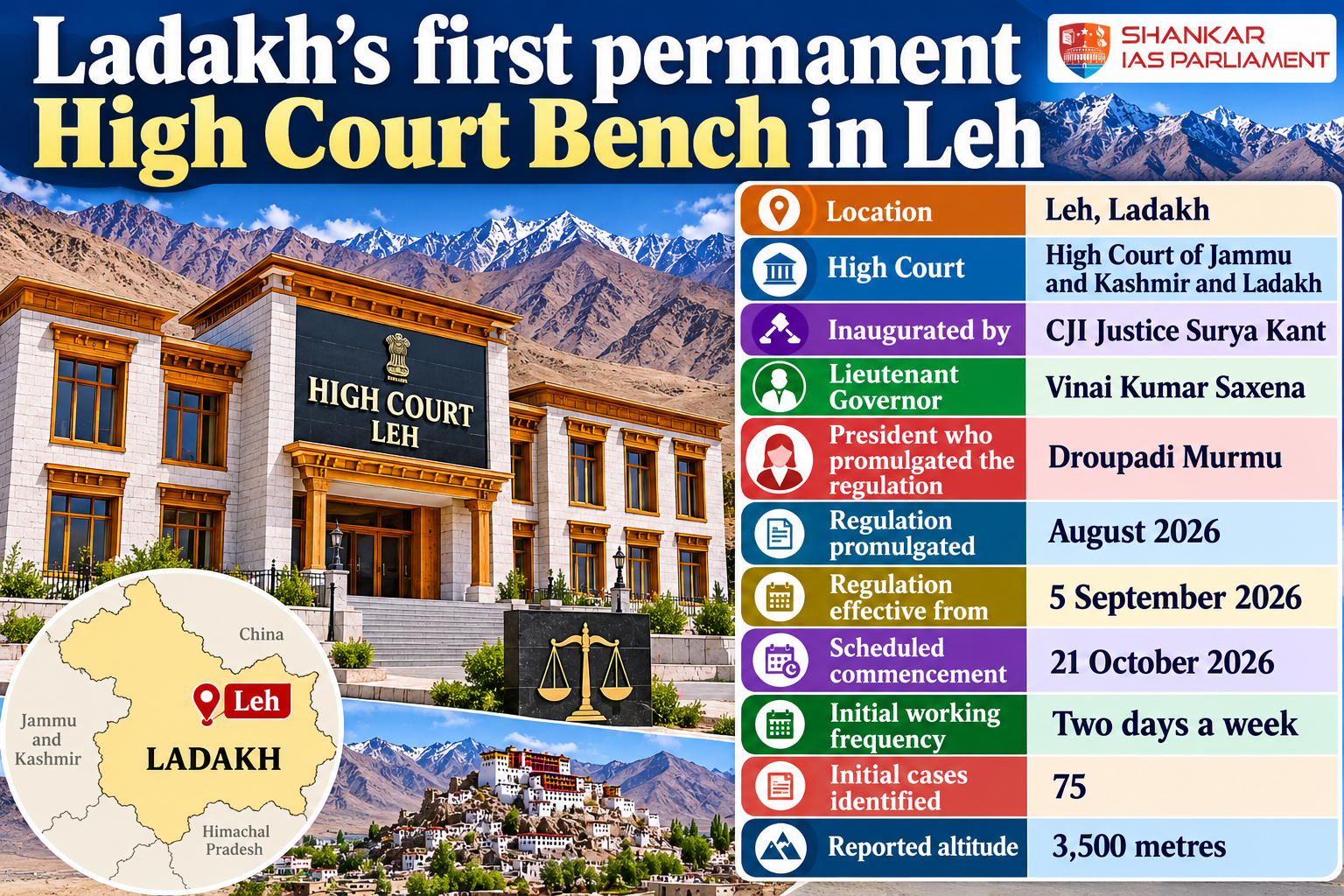
ladakh-high-court-bench-infographic.png

  • This bench forms part of the High Court of Jammu and Kashmir and Ladakh.
  • Situated at – Approximately 3,500 metres above sea level, the bench is reported to be the highest-altitude High Court bench in India.
  • An initial list of 75 cases has been prepared for hearing before the bench.

Distinction Between High Court and High Court Bench

  • A High Court is a constitutional judicial institution that exercises jurisdiction over a State or Union Territory, as applicable.
  • A High Court bench refers to a sitting arrangement in which judges of an existing High Court hear cases at a specific location.
  • The establishment of a permanent bench does not result in the creation of a separate High Court.
  • The Leh bench continues to function as part of the High Court of Jammu and Kashmir and Ladakh.

Constitutional Provisions Related to High Courts

Article

Provision

Article 214

Provides for a High Court for each State, subject to constitutional provisions permitting a common High Court.

Article 215

Every High Court is a court of record and has the power to punish for contempt of itself.

Article 216

Deals with the constitution of High Courts.

Article 217

Deals with the appointment and conditions of office of High Court judges.

Article 222

Provides for the transfer of a judge from one High Court to another by the President after consultation with the CJI.

Article 226

Empowers High Courts to issue writs for Fundamental Rights and other purposes.

Article 227

Provides for the superintendence of High Courts over subordinate courts and tribunals within their jurisdiction, subject to constitutional exceptions.

Article 231

Empowers Parliament to establish a common High Court for two or more States or for two or more States and Union Territories.

Article 226 – High Courts can issue writs not only for the enforcement of Fundamental Rights but also for any other purpose within their jurisdiction.

Background: The High Court of Jammu and Kashmir and Ladakh

  • The Jammu and Kashmir High Court was established in 1928.
  • In August 2019, the former State of Jammu and Kashmir was reorganised into two separate Union Territories:
    • Jammu and Kashmir
    • Ladakh
  • Following this reorganisation, the High Court was renamed as the High Court of Jammu and Kashmir and Ladakh.
  • The establishment of a permanent bench in Leh is intended to improve access to the High Court for residents of the Union Territory of Ladakh.
  • Significance
    • Judicial access and inclusion – It removes geographical barriers, reduces costs, and ensures the availability of writ remedies in Ladakh’s challenging terrain.
    • Local empowerment – It strengthens justice delivery, encourages legal education and careers, and promotes greater regional participation.

Reference

The Hindu | Ladakh’s First Permanent High Court Bench Established in Leh

There are no reviews yet. Be the first one to review.

ARCHIVES

sidetext

