Prelims: Current events of national and international importance | Science & Technology
Why in News?
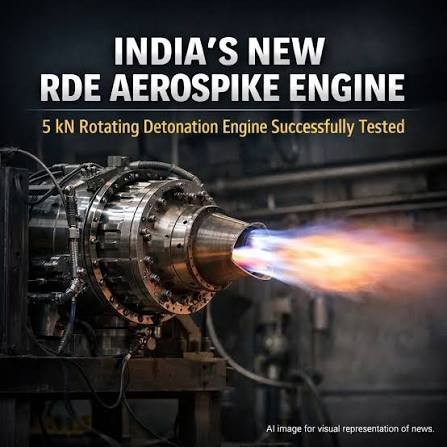
IIT Madras, successfully conducted a hot-fire test of India’s first indigenously developed 5 kN air-breathing Rotating Detonation Engine (RDE) integrated with an aerospike nozzle.
- The engine achieved sustained multi-second pressure-gain combustion delivering a stable 5 kN of thrust under operational test conditions.
- TRL-5 Achievement – It confirms that the engine's combustion chamber, detonation wave stability, and aerospike nozzle design can withstand realistic physical stresses.
- Aerospike Nozzle Integration - The integrated aerospike nozzle adjusts naturally to varying atmospheric pressures, providing high efficiency from sea level to high altitudes.
- Future Target- D-Propulse aims to develop a fully flight-ready engine by December 2027 for defence platforms, including cruise missiles, target drones, and high-speed Unmanned Aerial Vehicles (UAVs).
About Rotating Detonation Engines (RDE)
- Working Principle - Conventional jet engines rely on deflagration (subsonic flame propagation).
- An RDE utilizes pressure-gain combustion, sustaining supersonic detonation waves continuously rotating around an annular channel.
- Thermodynamic Efficiency - Delivers 15–25% higher thermodynamic efficiency than traditional air-breathing systems, offering greater thrust with reduced fuel consumption.
- Simpler Architecture - Eliminates moving parts inside the combustor, allowing production via precision machining rather than complex turbine assemblies.
Reference
Economic Times | India's first indigenous detonation engine



