Prelims: Current events of national and international importance | Environment
Why in News?
The Centre has stepped up efforts to promote agarwood and agarwood oil exports from the North Eastern Region (NER).
The government is also supporting value addition and market infrastructure through the Agarwood Cluster Development Project in Assam and Tripura under PM-DevINE.
An Agarwood International Trade and Research Centre has also been established in Agartala under schemes of the North Eastern Council.
The cultivation of agarwood is also now encouraged in South Indian states (Kerala, Tamil Nadu, Telangana).
About Agarwood
Agarwood is a cultural, ecological and economic asset for India.
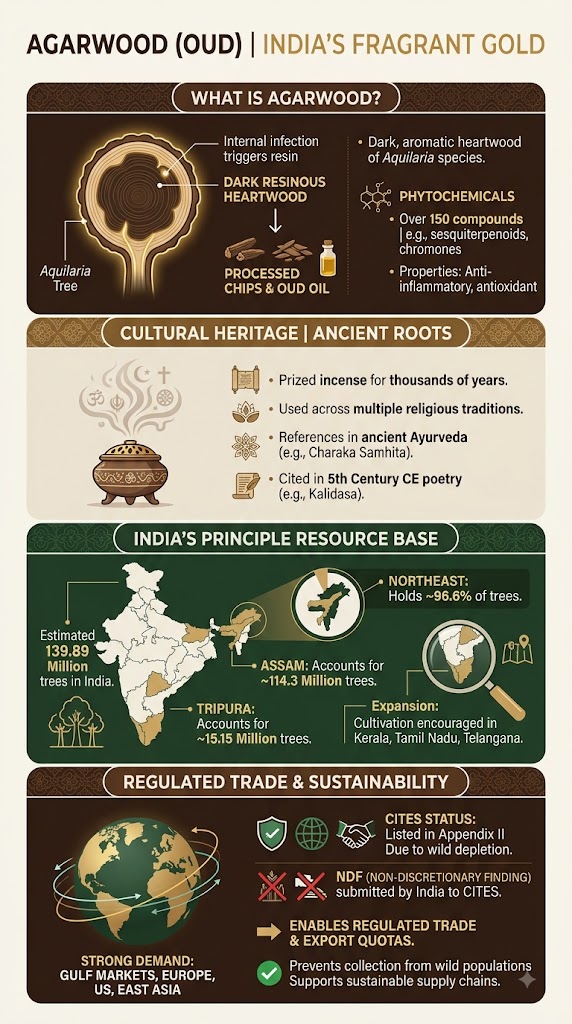
The North Eastern Region is home to an estimated 96.6 per cent of India’s agarwood trees, making it the country’s principal resource base for the highly valued aromatic wood.
India is estimated to have around 139.89 million agarwood trees.
Assam accounts for approximately 114.3 million trees, while Tripura has around 15.15 million trees.
Agarwood resources are also found in Manipur, Nagaland, Meghalaya and other northeastern states.
Agarwood, known as Oud, Gaharu or Agar is prized as the world’s most valuable incense.
For thousands of years, it has been used in various religious traditions including those of Hinduism, Islam, Christianity, and Buddhism.
There are references to its therapeutic properties in ancient Ayurvedic texts, including the Charaka Samhita.
It is also mentioned in the 5th century CE poetry of Kalidasa.
It is a key component of Traditional Chinese Medicine and Unani as well.
Agarwood is the resinous aromatic wood of Aquilaria species and is processed into agarwood chips and agar oil.
Agar oil is widely used in perfumery, incense and other premium products.
Beyond its fragrance, agarwood is a treasure trove of phytochemicals over 150 of which have been identified.
Scientific literature reveals several compounds including sesquiterpenoids, chromones, 2-(2-Phenylethyl) chromones (PECs), etc, which are known to exhibit anti-inflammatory, antioxidant and anti-diabetic properties.
Global demand for agarwood is particularly strong in Gulf markets, while its use in high-value fragrances and related products is expanding in Europe, the United States and East Asia.
Some of the countries where agarwood is grown include India, Cambodia, Vietnam, Malaysia, Indonesia, Laos and Bhutan.
In the wild, it takes nearly a decade for a tree to mature.
Traditionally, harvesters determine resin presence by cutting trees and inspecting the heartwood.
This unsustainable practice not only reduces tree populations but also harms local ecosystems.
Agarwood figured in Appendix II of the Convention on International Trade in Endangered Species of Wild Fauna and Flora (CITES), after international concern built up over the dwindling population of trees worldwide.
Recently, the Government of India submitted a Non-Discretionary Finding (NDF) to prevent inclusion of agarwood in the Review of Significant Trade (RST) of the CITES.
This would enable India to announce a new export quota for agarwood products and derivatives and regulate the trade.
The government has taken measures to prevent the collection of seeds/seedlings/saplings and propagules from wild populations, reserved forests and protected areas.