Prelims: Current events of national and international importance | International Relations
Why in News?
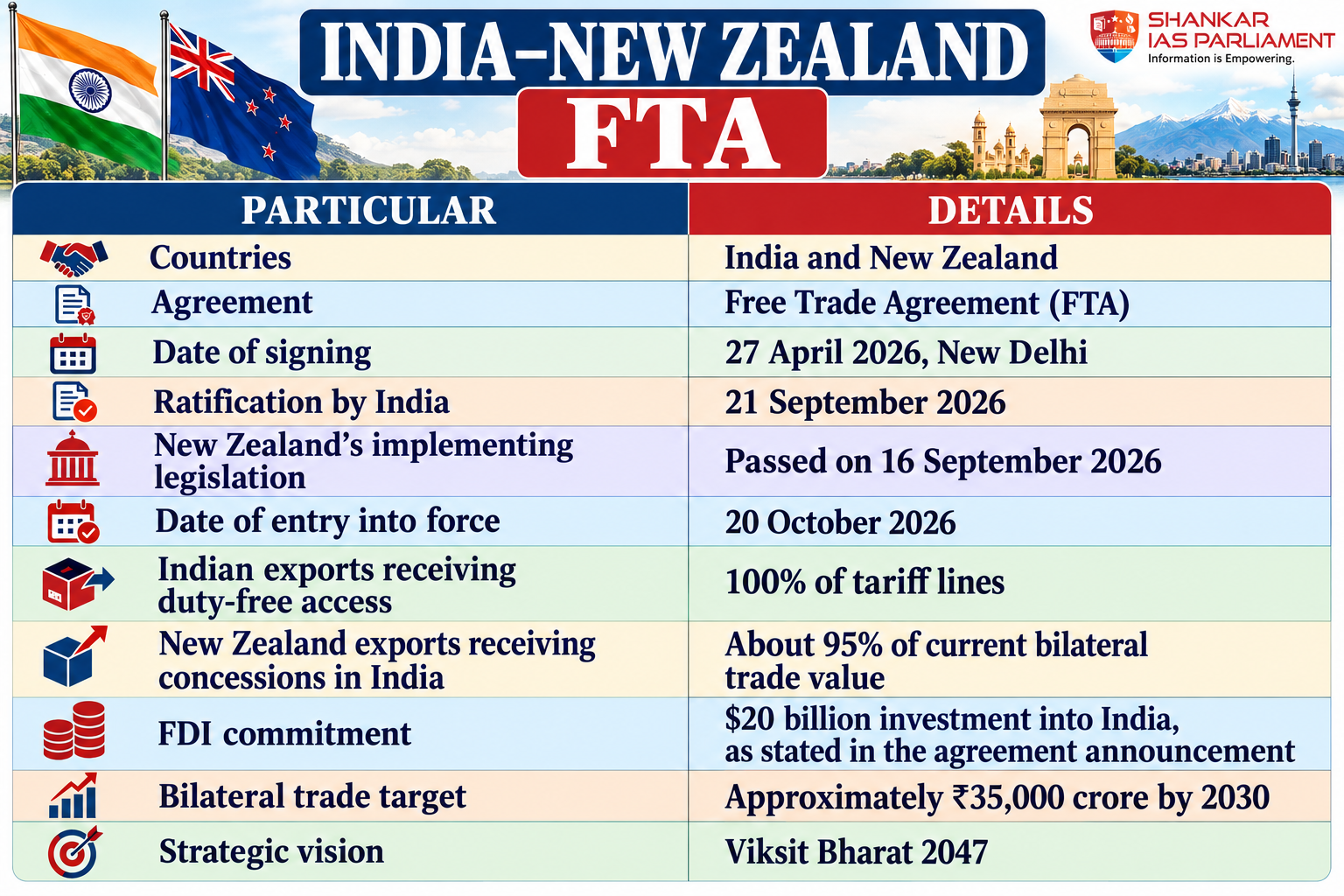
The India–New Zealand Free Trade Agreement (FTA) entered into force on 20 October 2026.
A Free Trade Agreement (FTA) refers to an international treaty established between two or more countries with the purpose of reducing or eliminating import tariffs, quotas, and other trade barriers.
India – New Zealand FTA
- The agreement grants complete (100%) duty-free market access for Indian exports to New Zealand across all tariff categories.
- The agreement establishes new employment visa pathways, increases work opportunities for Indian students, and outlines specific investment commitments.
Key Provisions of the Free Trade Agreement
- Market Access for India – New Zealand has eliminated customs duties on all tariff lines applicable to Indian exports.
- This measure eliminates the previous tariff disadvantage, which included peak tariffs of up to 10%.
- This agreement is recognised as India's first FTA to provide comprehensive duty-free access across all tariff lines from the date of entry into force.
- Market Access for New Zealand – India has extended tariff concessions to approximately 70% of its tariff lines, which account for nearly 95% of the current bilateral trade value.
- Approximately 29.97% of tariff lines remain on the exclusion list.
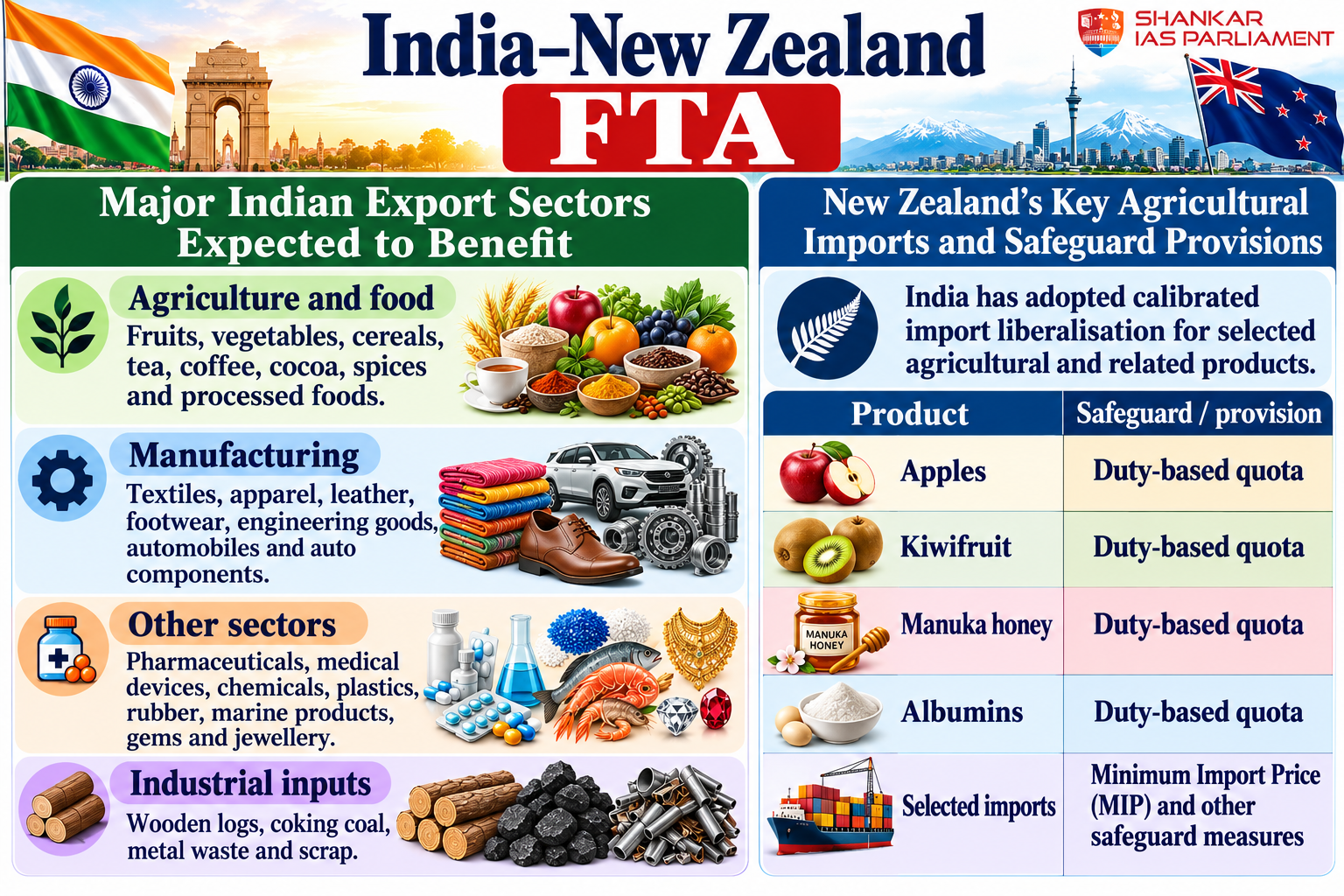
- India has implemented a calibrated approach to import liberalisation for selected agricultural and related products.
Visa and Mobility Provisions – The FTA introduces new opportunities for Indian professionals, students and young people.
- Temporary Employment Entry (TEE) Visas – Two new categories of Temporary Employment Entry (TEE) visas are now available for Indian nationals.
- These visas are intended for individuals in highly skilled occupations and selected professions linked to India.
- A maximum of 5,000 TEE visa holders may be present in New Zealand at any given time.
- Most visa allocations are reserved for skilled occupations already listed on New Zealand's Green List.
- Working Holiday Scheme – A quota of 1,000 Working Holiday visas is allocated annually to Indian nationals.
- This scheme enables eligible young Indian nationals to combine travel with temporary employment, in accordance with visa conditions.
- Indian Students – There is no numerical cap on the number of Indian students, as specified in the agreement announcement.
- Post-study work rights have been expanded for eligible graduates:
- Graduates with STEM bachelor's or master's degrees may receive up to three years of post-study work rights.
- Doctoral graduates are eligible for up to four years of post-study work rights.
- There are commitments to enhance in-study work rights for Indian students.
Services and Investment
- Services – The agreement provides dedicated market access in health and traditional medicine services.
- This coverage includes Ayurveda, Yoga, and other AYUSH systems.
- Streamlined regulatory processes are anticipated to benefit the pharmaceutical and medical device industries.
- Investment – The agreement includes a formal commitment of $20 billion in foreign direct investment to India.
- This investment is expected to support investment, employment generation, manufacturing, and broader economic cooperation.
Significance
- Boosts exports and market access – Enhances opportunities for Indian goods, improving competitiveness in international markets.
- Supports MSMEs and employment – Benefits small exporters, artisans, manufacturing supply chains, and creates jobs for professionals and youth.
- Expands opportunities in key sectors – Promotes exports of agricultural products, pharmaceuticals, medical devices, and services.
- Strengthens economic growth and diversification – Deepens trade ties with a developed Indo-Pacific economy and supports the Viksit Bharat 2047 vision through export-led growth.
Reference
News on Air | India–New Zealand Free Trade Agreement (FTA)



