Prelims: Current events of national and international importance | Species
Why in news?
Himachal Pradesh has significantly raised the survival rate of reintroduced Cheer Pheasants from 11.11% in 2019-20 to 100% in 2024-25 through a scientifically managed captive-breeding and reintroduction programme.
- Cheer Pheasant – It is a vulnerable Himalayan bird species.
- Scientific name – Catreus wallichii
- The cheer pheasant is locally known as 'Chir Tittar'.
- Family & Genus – It belongs to the family Phasianidae and stands out as the only member of its genus, Catreus.
- Habitat – Depends on grasslands, often mixed with shrubs and short trees, in parts of the northwestern and central Himalayas.
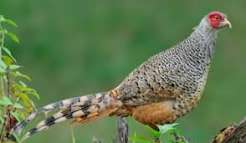
- Appearance – They have buff-brown plumage heavily barred with black and grey, which serves as excellent camouflage against rocky terrain.
- They feature a prominent, messy crest on the head and a long, untidy tail.
- Both males and females display striking, crimson-red patches of bare skin around their eyes.
- The male is slightly larger with a longer tail and a more pronounced crest.
- Diet – As ground-dwelling foragers, they use their strong, curved bills to dig up roots, tubers, bulbs, seeds, berries, and small insects.
- Conservation Status
- IUCN Red List – Vulnerable.
- Wildlife (Protection) Act, 1972 – Schedule I.
- Threats – Grassland degradation, forest fires, overgrazing, fodder collection and other human disturbances.
- Reintroduction Programme – The programme is led by the Khadiyun Cheer Pheasant Breeding Centre in Chail, Solan district.
- So far, 77 captive-bred birds have been released into the wild.
- Latest Release (Wildlife Week 2026) – The latest phase saw another 12 birds, two males, two females and eight chicks released near Koti in Shimla district.
- Key Conservation Strategies
- Parent-Rearing Technique – Instead of relying entirely on artificial incubation, chicks are naturally incubated and raised by their parents.
- Birds raised by their parents are considered better equipped to survive after release.
- In the wild, adult birds help their chicks learn survival skills, including finding food and responding to threats.
- Soft Release Method – Soft release gives captive-bred birds a gradual transition to their natural surroundings rather than releasing them directly without an acclimatisation period.
- Radio Telemetry Monitoring – Very High Frequency (VHF) transmitters are fitted to the male leading each released family.
- The device helps officials track the bird's movements and monitor how the family adapts to the new habitat.
- Camera trap surveillance – Camera traps provide additional evidence about activity in the release areas, including survival, behaviour, movement and adaptation.
Reference
TOI | Himachal Pradesh raises the survival rate of reintroduced cheer pheasants



