Prelims: Current events of national and international importance | Environment
Why in News?
Scientists recorded the Schizopygopsis waddellii in India for the first time, situated at an elevation of approximately 12,800 feet (~3,900 meters) in the border district of Tawang, Arunachal Pradesh.
- Taxonomic Group - Belongs to the family Cyprinidae (carps and minnows) and the subfamily Schizopygopsinae (specialized high-altitude snow trouts).
- Historical Distribution- Native to the trans-Himalayan streams and oligotrophic lacustrine ecosystems of the Tibetan and Chinese plateaus.
- Type Locality- Originally described by Charles Tate Regan in 1905 as Gymnocypris waddellii from Yamdrok Lake in Tibet.
- Integrative Identification- Species identification was confirmed using an integrative taxonomic framework combining morphological evaluation with mitochondrial DNA (mtDNA) sequencing.
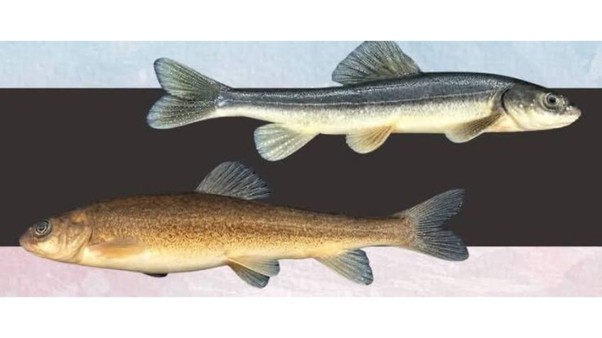
- Hydrodynamic Morphology - Possesses an elongated, sub-cylindrical body with an olive-greyish dorsal surface and a silvery-white underside, suited for low-drag movement.
- Specialized Feeding Mechanism- Features a blunt snout, a subterminal mouth, and a hard, plate-like horny scraping structure around the lower lip used to scrape benthic microalgae and biofilms off submerged rocks.
- Locomotion & Sensory Adaptation - Equipped with a deeply forked caudal (tail) fin for rapid propulsion in cold, high-velocity waters, along with a complete lateral line system.
- Sexual Dimorphism- Males display visible nuptial tubercles/spines on their body surface and brighter coloration during breeding phases, whereas females lack these spines and exhibit muted coloration.
- Extreme Cold Tolerance -Genetically adapted to survive under freezing temperatures, seasonal surface ice cover, low dissolved oxygen, and nutrient-poor (oligotrophic) high-altitude conditions.
Significance for Biodiversity
- Expands National Freshwater Database- Formally adds a new high-altitude genus and species record to India's documented freshwater fish fauna.
- Highlights Data Deficits- Demonstrates that high-altitude lacustrine ecosystems across the Eastern Himalayas remain significantly under-surveyed.
- Ecological Baseline- Provides a scientific baseline for monitoring fragile cold-water aquatic biodiversity, climate change impacts on alpine lakes, and transboundary freshwater conservation along the India-China border region.
Reference
The Print | Schizopygopsis waddellii



