Prelims: Current events of National and International Importance| Environment
Why in News?
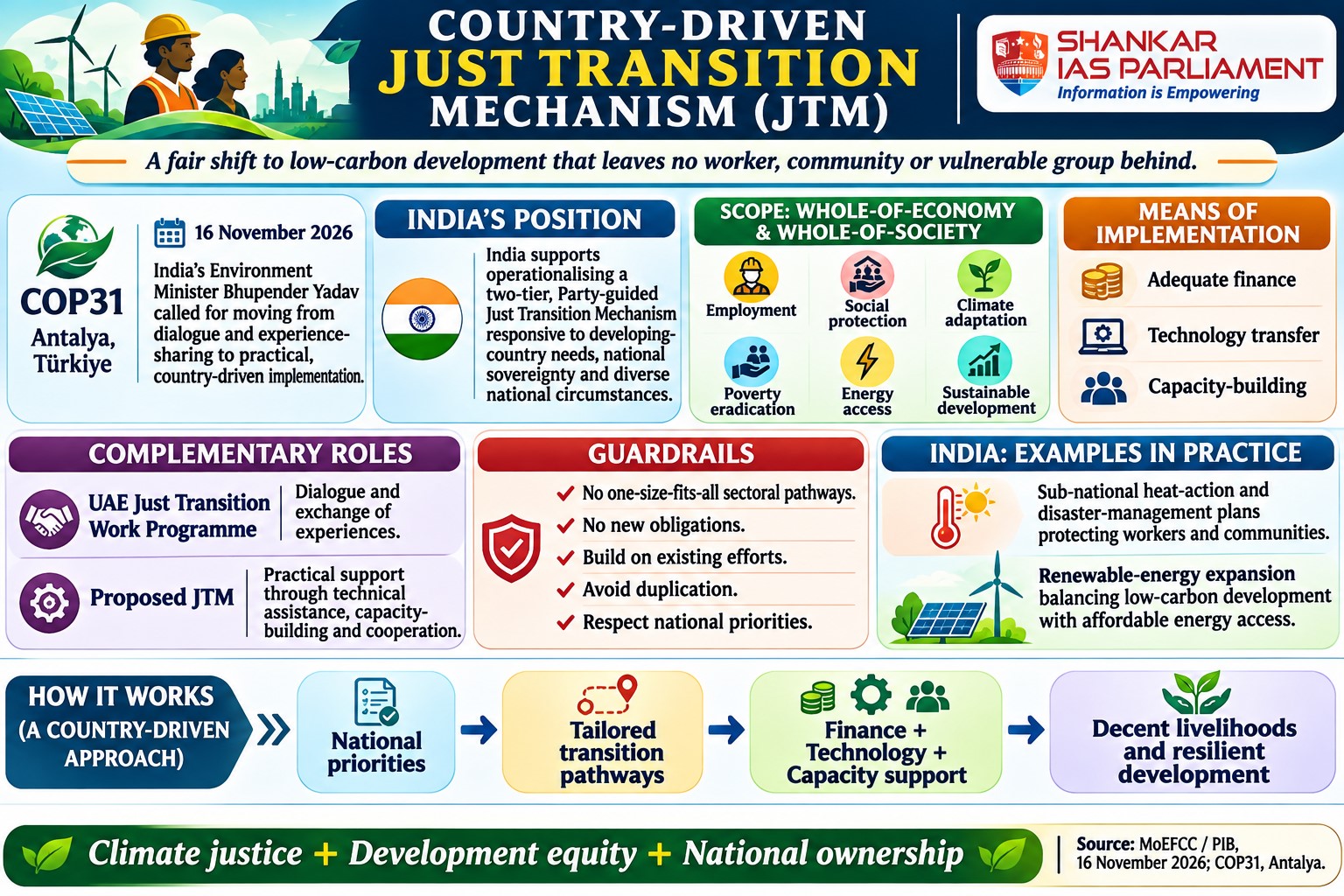
At the UN climate summit (COP31) in Antalya, Türkiye (November 9–20, 2026), India called for operationalising a two-tier, Party-guided, country-driven Just Transition Mechanism (JTM) while forcefully putting historical climate responsibility back at the centre of negotiations.
Country-Driven, Two-Tier Just Transition Mechanism
- Following the agreement at COP30 in Belém to establish a Just Transition Mechanism under the Paris Agreement, India outlined how the framework should work in practice–
- No one-size-fits-all templates– The mechanism must not impose uniform sectoral pathways or create new obligations for developing nations. Countries should shape transitions around their own development priorities.
- Complementary two-tier structure– India called for clear distinction and coordination between the existing UAE Just Transition Work Programme and the proposed mechanism.
- ‘The work programme should remain a space for dialogue and sharing experiences, while the mechanism should deliver practical support such as technical assistance, capacity building, and cooperation without duplicating existing efforts.
- Beyond energy alone– Rather than treating just transition purely as an energy-sector shift, India pushed a whole-of-economy and whole-of-society view covering jobs, social protection, poverty eradication, energy access, and climate adaptation.
- Means of implementation– Developing countries need predictable climate finance, technology transfer, and capacity-building support to execute their transition plans
Reference
Down to Earth| Country-Driven Just Transition Mechanism (JTM)



