Prelims: Current events of National and International Importance | Environment
Why in news?
Meghalaya CM Conrad K. Sangma inaugurates Centre of Excellence for Eri Silk Weaving.
Eri Silk
Eri silk is also known as "peace silk" or "ahimsa silk".
It is an ethical and sustainable fabric produced without harming the silkworm
The silkworm moth leaves the cocoon naturally before the fibers are spun.
The yarn is extracted without killing the silkworms.
Though not as smooth as mulberry or Muga, Eri has a wool-like texture.
And it s the only silk whose yarn is spun, not reeled.
It feels wool-like, soft, and matte, unlike the shiny look of regular mulberry silk.
It is a strong, heavy fabric that gets softer the more you wear it.
It is mainly produced in Northeast India, particularly in states like Assam and Meghalaya.
Assam produces roughly 65% of India's total Eri silk.
But it is also found in Bihar, Odisha, West Bengal and Andhra Pradesh on a smaller scale.
Oeko-Tex certification
The North Eastern Handicrafts and Handlooms Development Corporation Ltd. (NEHHDC) under the Ministry of Development of North Eastern Region, has obtained Oeko-Tex certification for eri silk from Germany.
Oeko-Tex is a worldwide certification for textiles such as yarns, fabrics, buttons, linens, terry cloth, thread, and other accessory materials that tests for harmful substances in raw, semi-finished and finished textile materials and products.
Silk Production in India
Sericulture, also known as silk farming, is the commercial practice of cultivating and raising silkworms.
Silk is renowned as the “Queen of Textiles”
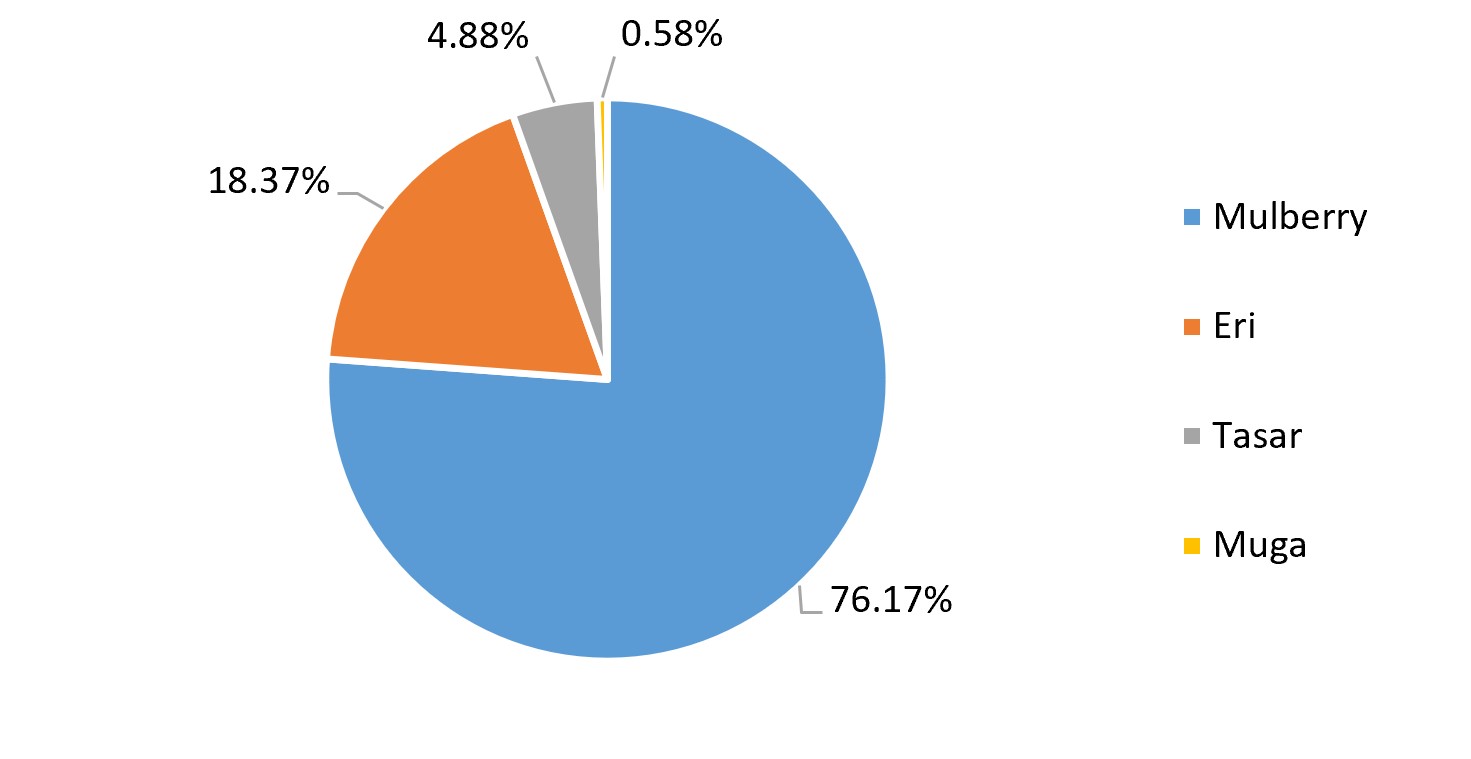
India is the world's second-largest producer of silk, generating over 41,000 metric tons annually.
India is standing out as the only nation that commercially produces all major varieties of natural silk (Mulberry, Tropical Tasar, Oak Tasar, Eri, and Muga).
Kanchipuram, Varanasi, Bhagalpur, Sualkuchi, and Srinagar are each known for distinct weaving styles and craftsmanship.
Mulberry silk is produced mainly in the states of Karnataka, Andhra Pradesh, Tamil Nadu, Jammu & Kashmir and West Bengal,
While the non-mulberry silks are produced in Jharkhand, Chhattisgarh, Orissa and north-eastern states.
Assam produces about 95% of India's Muga silk.
Central Silk Board
Established: As Statutory body in 1948 by an Act of Parliament.
Headquarters: Bengaluru, Karnataka.
Parent Ministry: Autonomous Body under the Ministry of Textiles.