Prelims: Current events of national and international importance | Environment
Why in News?
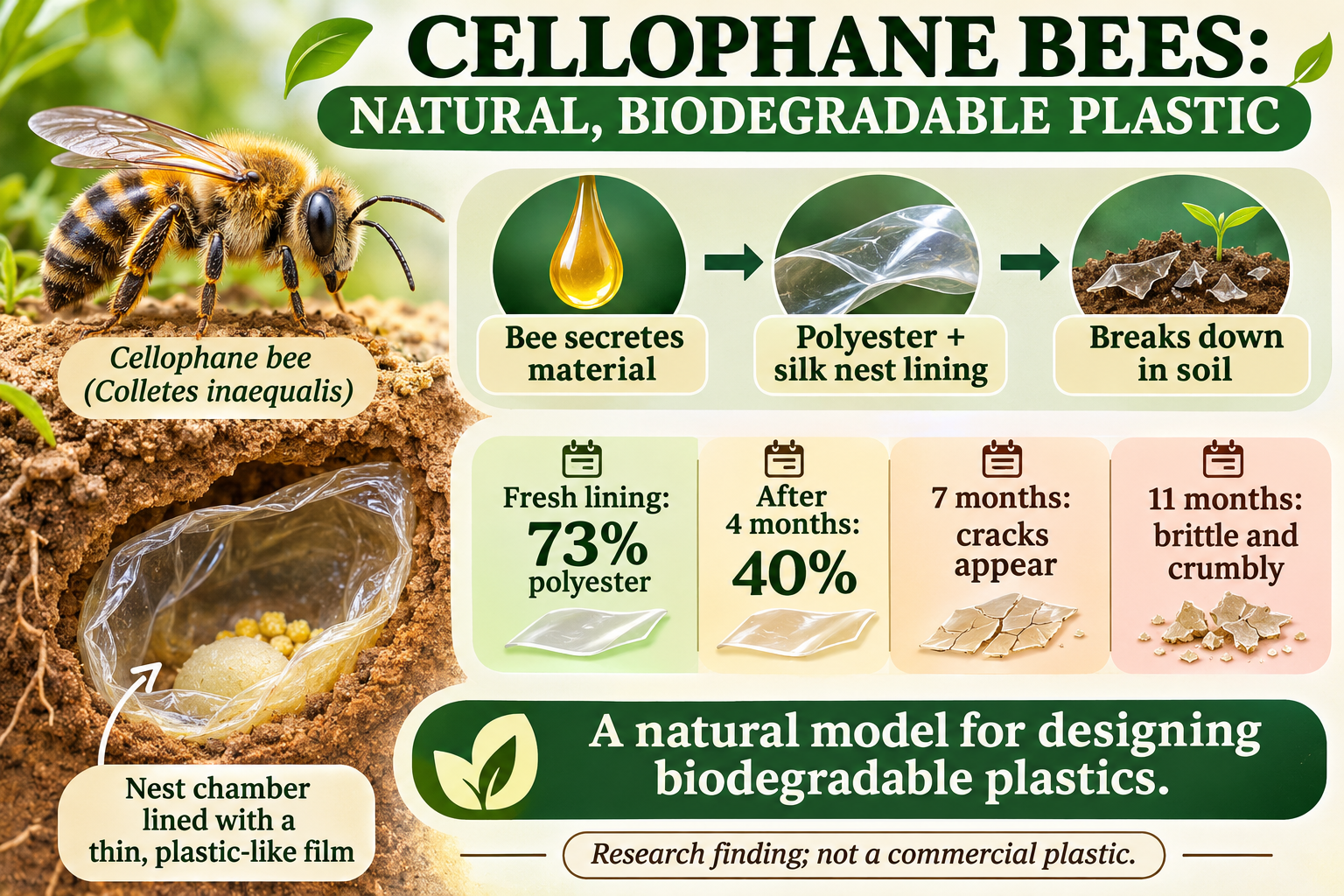
A recent study has revealed that cellophane bees produce a natural, polyethylene-like polyester to line their underground nests that rapidly biodegrades in ambient soil within a year.
|
Feature
|
Detail
|
|
Species Studied
|
Colletes inaequalis (commonly known as Cellophane Bees or Polyester Bees)
|
|
Nesting Behavior
|
Solitary, ground-nesting bees that dig underground tunnels and brood cells
|
Key Highlights
- The discovery provides a promising biomimetic blueprint for scientists trying to solve the global plastic pollution crisis by designing durable, water-resistant plastics that break down naturally without requiring industrial composting.
- Natural Polymer Composition- Female cellophane bees secrete a translucent, flexible, and waterproof film made of silk proteins and a semi-crystalline, cross-linked polyester to protect their underground brood cells from soil moisture and microbes.
- Polyethylene-Like Properties - Chemical and X-ray scattering analyses showed that the bee-made polyester mimics the molecular crystal structure and melting behavior of commercial polyethylene, a plastic notoriously resistant to breakdown.
- Rapid Soil Degradation - Unlike synthetic polyesters that persist for centuries, the nest lining’s polyester content dropped from 73% to 40% within just 4 months in natural soil.
- It began cracking by seven months, and crumbled completely within a year.
- Mechanism of Breakdown - Researchers suspect that the unique structural arrangement of the polymer exposes its ester bonds to water and natural soil enzymes (such as esterases), allowing microbes to cleave the chemical chains efficiently.
Biomimicry
- It is the practice of learning from and mimicking strategies found in nature to solve human design challenges.
- While scaling up bee farms to harvest plastic is impractical, reverse-engineering the exact molecular cross-linking of Colletes polyester could enable manufacturers to produce single-use packaging that performs like conventional polythene during use but safely decomposes in normal soil.
Polyethylene vs. Biodegradable Polyesters
- Polyethylene (Polythene)- A synthetic thermoplastic polymer made from ethylene monomers; its strong carbon-carbon backbone and high crystallinity prevent microbes from breaking it down.
- Polyesters- Polymers containing ester functional groups in their main chain, which are inherently more susceptible to hydrolysis and enzymatic cleavage if their crystalline packing permits moisture penetration.
Reference
The Hindu | Cellophane bees



