Prelims: Current events of national and international importance | Government Policies & Interventions
Why in News?
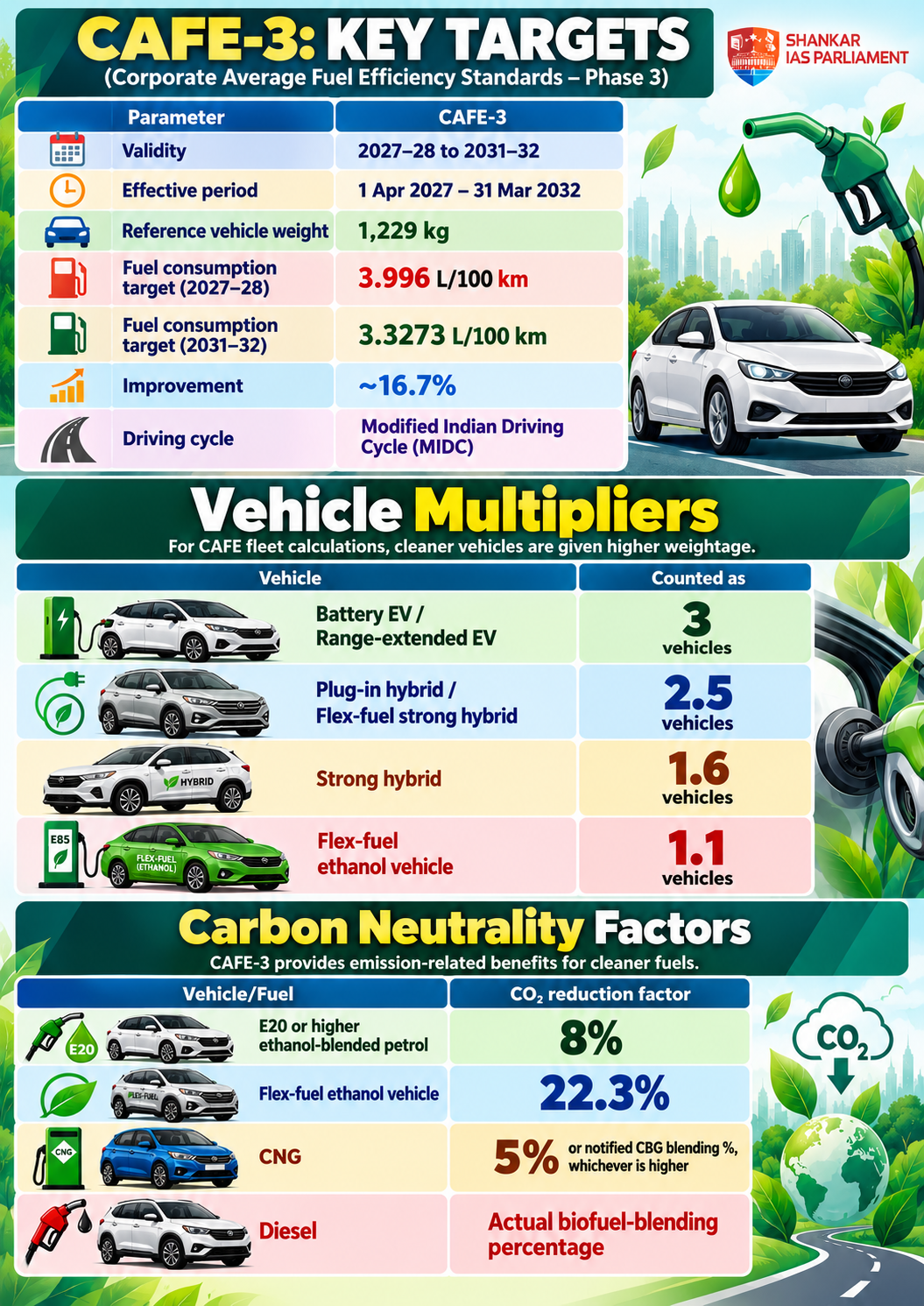
Recently, the Centre has notified new CAFE norms, tightening fuel‑efficiency targets for passenger vehicles.
Corporate Average Fuel Economy (CAFÉ)
- This standard regulates the average fuel consumption across a car manufacturer's entire fleet, rather than evaluating each vehicle individually.
- Objective – To improve fuel efficiency and reducing CO₂ emissions from passenger vehicles.
CAFE Credit System
- CAFE credits function as compliance points within the regulatory framework.
- Manufacturers are permitted to:
- Earn credits by performing better than the prescribed target.
- Carry forward credits or debits within the designated compliance block.
- Engage in credit trading – Purchase credits from the Bureau of Energy Efficiency (BEE) to offset any deficits.
- Key Provisions
- Unused credits expire at the conclusion of the compliance block.
- The credit trading and buyout window is open from 1 to 31 October of each assessment year.
- Credit Buyout Price
- ₹2,500/g CO₂/km in 2027–28.
- ₹4,500/g CO₂/km in 2031–32.
|
Measurement of Fuel Consumption
|
- Modified Indian Driving Cycle (MIDC) – It is utilized to calculate fleet average fuel consumption.
- Fuel consumption is expressed in petrol-equivalent litres per 100 kilometers.
- Various fuels are converted to petrol-equivalent values using standardized conversion factors.
- Electric Vehicles (EVs) – EV Energy consumption for electric vehicles is measured in kilowatt-hours per 100 kilometers (kWh/100 km).
|
- Efficiency Technologies – Manufacturers are permitted to claim a reduction of 1 g CO₂/km for each eligible efficiency technology.
- Examples of eligible technologies include:
- Start-stop systems
- Tyre-pressure monitoring systems
- Regenerative braking systems
- High-efficiency alternators
- LED lighting systems
- Electric water pumps
- The total maximum allowable benefit is 9 g CO₂/km.
- Compliance Verification
- 1st compliance phase – Manufacturers may self-declare claims during this phase.
- 2nd compliance phase – Claims must be substantiated by validated test results during this phase.
Reference
The Hindu | CAFE-3 Norms



