Prelims: Current events of national and international importance| Environment
Why in News?
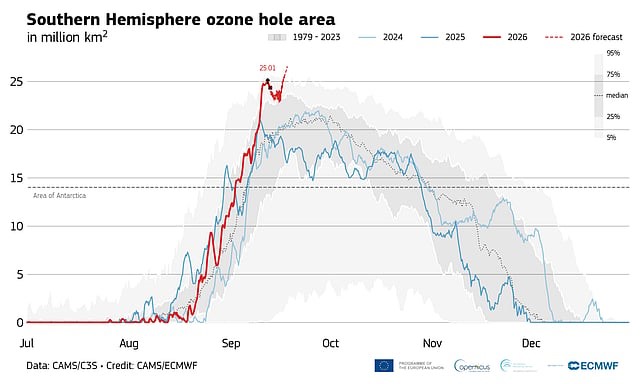
CAMS reported that the 2026 Antarctic ozone hole expanded to around 25 million km² in early September—about 5 million km² above the seasonal average.
Ozone Hole
- Ozone layer – Stratospheric layer that absorbs harmful ultraviolet (UV) radiation.
- Ozone hole – Region where ozone concentration falls below 220 Dobson Units (DU).
- It is not an actual physical hole, but an area of severe ozone depletion.
- Ozone depletion occurs in both hemispheres, but a severe seasonal ozone hole occurs regularly over Antarctica.
Why Antarctica?
- Antarctica develops a strong and stable polar vortex.
- Extremely low stratospheric temperatures favour the formation of Polar Stratospheric Clouds (PSCs).
- PSCs activate chlorine and bromine from human-made chemicals such as CFCs.
- When sunlight returns during the austral spring (August–November), these halogens rapidly destroy ozone.
2026 Ozone Hole – Important Observation
- Rapid growth coincided with a sharp fall in stratospheric temperature around 20 km altitude (50 hPa).
- However, other indicators such as minimum ozone column value and ozone mass deficit remained close to historical averages.
- This indicates the complex nature of annual ozone-hole dynamics.
|
Ozone Thinning
|
Ozone Hole
|
|
General reduction in stratospheric ozone
|
Severe, localized ozone depletion
|
|
Occurs over broader regions
|
Mainly observed over Antarctica
|
|
Gradual weakening
|
Extreme seasonal depletion
|
|
No fixed 220 DU threshold
|
Defined using <220 DU
|
Role of Climate Change
- Global warming can cool the stratosphere, creating conditions favourable for PSC formation.
- However, ozone depletion and climate change involve complex atmospheric interactions and should not be treated as identical processes.
About CAMS
- CAMS: Copernicus Atmosphere Monitoring Service.
- Implemented by – European Centre for Medium-Range Weather Forecasts (ECMWF).
- Provides – information on atmospheric composition, air pollution, greenhouse gases, solar energy and climate forcing.
- It is one of the six services of the Copernicus Earth Observation Programme.
- Copernicus is coordinated by the European Commission and European Space Agency (ESA), along with EU Member States and agencies.
Reference
Down To Earth| 2026 Antarctic ozone hole



