Prelims: Current events of national and international importance | Agriculture
Why in news?
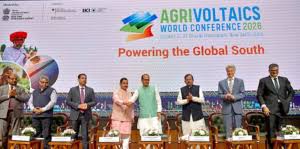
Recently, India hosted the 7th Agrivoltaics World Conference 2026, a three-day conference at Bharat Mandapam, New Delhi, for the very first time in the Global South.
- Agrivoltaics – It combines agriculture and solar power generation on the same land; that is, solar panels are installed above farmland while crops continue to be cultivated beneath them.
- Hosted by – Ministry of New and Renewable Energy (MNRE), with support from Germany’s Federal Ministry for the Environment, Climate Action, Nature Conservation and Nuclear Safety (BMUV).
- Partnership – It has been organised in partnership with Conexio-PSE.
- Theme – “Powering the Global South”.
- Participation – The conference has brought together over 1,200 delegates, including more than 150 foreign participants.
- Key Discussions – It will cover crop productivity, policy frameworks, financing models and farmer-centric business models for the dual use of land for food and clean energy.
- Core Focus – "One Land, Two Harvests" - Agrivoltaics enables dual land use by placing solar panels over active crops, allowing farmers to grow food and generate power simultaneously.
- The conference reflects the vision of “From Power to Empower”; farmers can move beyond their role as food producers (Annadatas) to become clean-energy producers (Urjadatas).
- Next phase of PM-KUSUM – The government announced that the next phase of PM-KUSUM will support one of the world's most ambitious agrivoltaic programmes, with an aim to expand solar energy adoption in agriculture and support AgriPV capacity creation.
- International Partnerships – Acknowledged the contributions of German partners, the Indo-German Cooperation on Agrivoltaics, the International Solar Alliance and other institutions working to advance the sector.
- The countries across Africa, Asia and Latin America faced common challenges; India called for cooperation based on mutual learning and locally adapted solutions.
- Global Agrivoltaics Climate-Zone Technical Framework – This framework is launched, intended to help governments, farmers, developers, researchers and financiers make informed decisions, establish technical standards and move from isolated pilot projects towards broader implementation.
- Launched 3 knowledge resources – the AgriPV Policy Handbook from MNRE, the Decision-Making Tool by the India Agrivoltaics Alliance (IAA) and the Book of Abstracts by the International Water Management Institute (IWMI).
Key Agrivoltaic Potential in India
- Agrivoltaic Potential – Estimates that 47.5 million hectares, or approximately 30% of India’s 160 million hectares of cropland, were technically suitable for agrivoltaics (Energy and Resources Institute (TERI) study).
- Major potential states – Maharashtra, Rajasthan, Andhra Pradesh, Madhya Pradesh, Karnataka and Uttar Pradesh together accounted for nearly 50% of India’s estimated agrivoltaic potential.
- Potential yield improvements – Under suitable agrivoltaic systems, the potential yield improvements of 10–20% for certain crops and reductions of around 30% in water consumption.
- Employment potential – Generate between 1.10 lakh and 3.32 lakh full-time-equivalent jobs, contributing to agricultural productivity, skills development, entrepreneurship and rural employment (AgriPV Manual of the Centre for Study of Science, Technology and Policy).
Key data from the article
- India’s agricultural sector had sustained a growth rate of 4.5%, while agricultural exports had reached a record USD 52.55 billion.
- The average landholding in India was only 0.96 hectares.
- India’s installed electricity capacity based on non-fossil fuel sources had reached 308.03 GW, accounting for more than 55 per cent of its total installed electricity capacity of approximately 560 GW.
- More than 7.70 lakh geo-tagged rural facilities had been mapped under the PM Gram Sadak Yojana,
- Over 400 integrated cold-chain projects had been approved under the PM Kisan SAMPADA Yojana.
- Decentralised solar capacity had reached 16.3 GW during the previous year, comprising 7.6 GW under PM-KUSUM and 8.7 GW under rooftop solar, largely through the PM Surya Ghar Muft Bijli Yojana, which had crossed 63 lakh beneficiaries.
References
DD News | India Hosts Agrivoltaics World Conference 2026 for First Time in Global South



