Prelims: Current events of national and international importance | International Relations
Why in News?
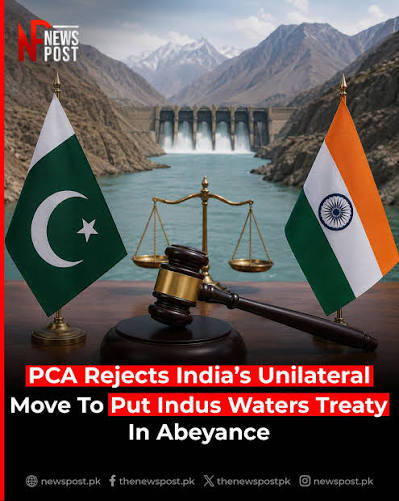
India has formally rejected an award issued by the Hague-based Court of Arbitration (CoA) constituted under the aegis of the Permanent Court of Arbitration (PCA), concerning the Indus Waters Treaty (IWT).
- Rejection of CoA Award - India categorically rejected the arbitration that sought to set aside New Delhi’s decision to suspend the treaty, as well as interim measures targeting construction activity at the Ratle Hydroelectric Project.
- Abeyance Order - India placed the 1960 Indus Waters Treaty in abeyance following security developments and cross-border terrorism (including the 2025 Pahalgam terror attack), linking transboundary water cooperation directly to national security.
- Parallel Proceedings Violation - In 2016, Pakistan sought a Court of Arbitration while India requested a Neutral Expert to resolve technical differences over the Kishenganga and Ratle projects.
- India contends that initiating simultaneous proceedings violates the mandatory sequential process of the treaty.
- Boycott of Tribunal - India has consistently boycotted the CoA, maintaining that its appointment by the World Bank breached the treaty and that New Delhi has never recognized its legal existence.
- Focus Projects - The technical dispute centers on the Kishenganga (330 MW) on a Jhelum tributary and the Ratle (850 MW) project on the Chenab River in Jammu and Kashmir.
Dispute Resolution under IWT (1960)
- Water Allocation
- Eastern Rivers (Ravi, Beas, Sutlej): Allocated to India for unrestricted, exclusive usage.
- Western Rivers (Indus, Jhelum, Chenab): Allocated to Pakistan, though India is permitted non-consumptive uses, including run-of-the-river hydroelectric power generation under specified design limits.
- 3-Tier Graded Dispute Resolution Mechanism (Article IX)
- Permanent Indus Commission (PIC) - Bilateral body of commissioners handling routine operational issues and initial queries.
- Neutral Expert (NE)- Appointed for technical "differences" (such as pondage capacity, spillway gates, and intake levels).
- Court of Arbitration (CoA) - Convened only for formal legal "disputes" when technical channels are exhausted or both parties consent.
Reference
Hindustan Times | India rejects Indus Waters Treaty award



