Introduction and Tax Structure Evolution
- Milestone in Taxation – Launched on 1 July 2017, GST consolidated diverse Central and State taxes into a single framework under the principles of "One Nation, One Tax" and "Ek Bharat - Shreshtha Bharat".
- Rate Structure Rationalization (56th and 57th Council Meetings) – Simplified the traditional four-tier rate structure into two primary rates (5% and 18%).
- Retained a special 40% rate for select luxury and demerit goods/services.
- Introduced process reforms to streamline trade facilitation, compliance, and dispute resolution.
GST Scale and Performance (As of September 2026)
|
Metric
|
Growth / Performance Figure
|
|
Taxpayer Base
|
Expanded from ~60 lakh (2017) to ~1.70 crore (Sept 2026)
|
|
Invoice Uploads
|
3,053 crore cumulative invoice uploads processed
|
|
E-Way Bills Processed
|
833.82 crore cumulative e-way bills generated
|
|
Gross Revenue (Apr–Sept 2026)
|
Rs.12.46 lakh crore (+11.6% Y-o-Y growth)
|
Major Process and Compliance Reforms
Registration and E-Commerce Simplification
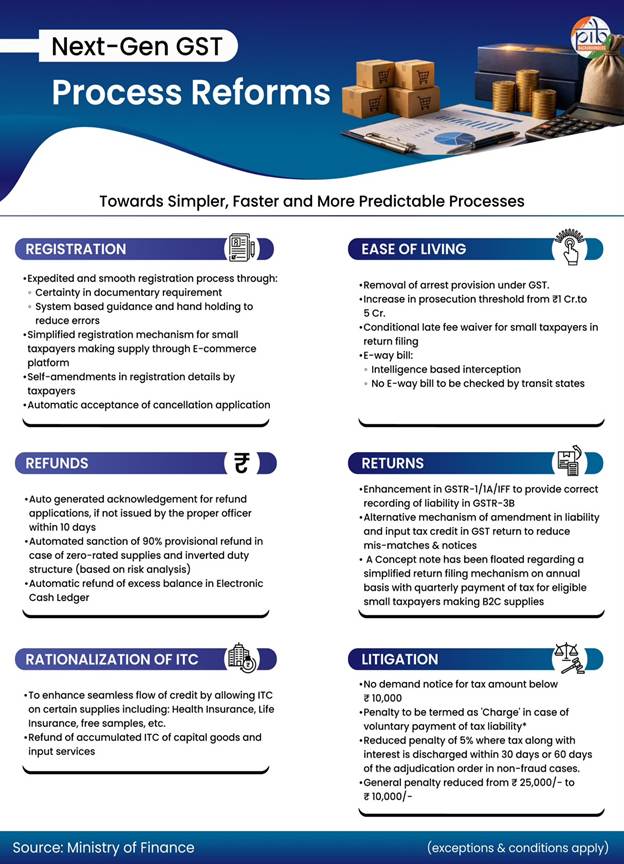
- Enhanced Usability – GST portal updated with contextual guidance, drop-down tooltips, and clear navigational paths.
- Automatic Acceptance of Amendments – Non-core amendments update automatically in real time. For taxpayers registered via the automated route, changes to the Principal Place of Business (PPoB) are also auto-approved.
- Two-Phase Automatic Registration Cancellation –
- Phase 1 – Applications automatically accepted if pending returns/dues are settled and passed-on ITC does not exceed Rs.2.5 lakh/month (or final return filed within prescribed time).
- Phase 2 – Full auto-acceptance for all cancellation applications upon filing final returns; FORM GST REG-16 merged with FORM GSTR-10.
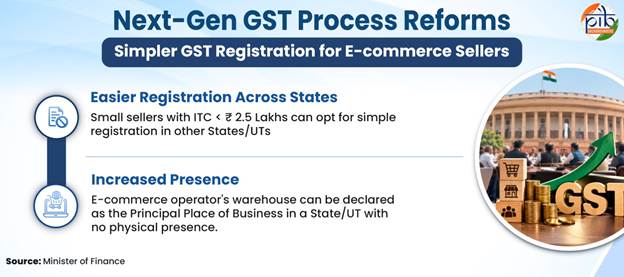
- Relief for Small E-Commerce Sellers – Non-resident small sellers passing ITC Rs.2.5 lakh/month can use simple PAN-based registration in other States/UTs, declaring the Electronic Commerce Operator (ECO) warehouse as their PPoB.
Return Accuracy and ITC Reconciliation
- System Interoperability – Upgraded GSTR-1/1A/IFF for seamless auto-reconciliation with GSTR-3B and GSTR-2B.
- Reverse Charge Mechanism (RCM) – Introduced an "Electronic Statement of tax paid on Reverse charge basis and ITC claimed".
- Invoice Management System (IMS) – Recipients can accept, reject, or mark documents pending for accurate ITC claims.
- Implementation Timeline – Alternate liability and ITC correction mechanisms in GSTR-3B take effect from the April 2027 return period.
Streamlined, System-Based Refunds
- Phase 1 Automation – Refund acknowledgement window reduced from 15 to 10 days (deemed acknowledged if no notice is issued).
- Up to 90% automated provisional sanction for zero-rated supplies and inverted duty structure claims based on risk assessment.
- Phase 2 Automation – Full automated refund sanctioning and processing by system algorithms.
- Rule and Statutory Adjustments – Removed the turnover cap (1.5x domestic supply value) on zero-rated supplies under Rule 89(4)(C).
- Revised Section 54(14) so the Rs.1,000 refund threshold applies to the aggregate refund sum (CGST + SGST/UTGST + IGST combined).
Litigation Reduction and Dispute Resolution
- De Minimis Threshold – No Show Cause Notice (SCN) issued for tax demands below Rs.10,000 (pending notices/appeals below this limit will be dropped).
- Penalty Relief –
- Penalty reclassified as a 'Charge' upon voluntary discharge of tax, interest, and penalty within timeline.
- Reduced penalty of 5% applies if tax and interest are paid within 30 days (Section 73) or 60 days (Section 74A) of adjudication.
- Removed the Rs.10,000 minimum penalty in non-fraud cases; lowered maximum general penalty from Rs.25,000 to Rs.10,000.
- Pre-deposit cap capped at Rs.40 crore for penalty-only appeals.
Key Policy and Statutory Unblockers
- Lifting Blocked ITC Restrictions – Input Tax Credit restrictions removed for outdoor catering, health/life insurance, telecommunication towers, off-site pipelines, free samples, and expired written-off goods.
- Inverted Duty Structure Refunds – Accumulated ITC refunds on input services and capital goods (spread over 60 months) take effect on 1 November 2026 and 1 April 2027, respectively.
- Prosecution Threshold – Raised 5-fold from Rs.1 crore to Rs.5 crore under Section 132(1) to foster a trust-based tax system.
- Transit and Inspection Safeguards – E-way bill conveyances can only be intercepted based on specific intelligence with prior authorization from an officer of Joint Commissioner rank or higher; transit confiscation under Section 130 eliminated.
- Late-Fee Waivers – Full waiver on delayed return filing for taxpayers with aggregate annual turnover up to Rs.5 crore, provided filing is completed within the due month.
Reference
PIB



