Why in news?
Recently, the Indian Institute for Human Settlements (IIHS) analysed data from 80 Urban Local Bodies (ULBs) across 24 States between 2012-13 and 2016-17 to understand ULB finance and spending, and found some key trends.
What are the challenges for the ULBs?
- The 74th Constitution Amendment Act 1992 mandates the setting up and devolution of powers to ULBs as the lowest unit of governance in cities and towns.
- The health of municipal finances is a critical element of municipal governance, which will determine whether India realizes her economic and developmental promise.
- Growing fiscal deficits, constraints in tax base expansion, and weakening of institutional mechanisms that enable resource mobilization remain challenges to the ulbS.
- Revenue losses after implementation of the Goods and Services Tax (GST) and the pandemic have exacerbated the situation.
What are the findings of the IIHS study?
- The own sources of revenue of the ULBs include revenue from taxes on property and advertisements, and non-tax revenue from user charges and fees from building permissions and trade licencing.
- The ULBs’ key revenue sources are taxes, fees, fines and charges, and transfers from Central and State governments, which are known as inter-governmental transfers (IGTs).
- Share of own revenue to total revenue (ratio) reflects the ULBs’ ability to use the sources they are entitled to tap, and their dependency on IGTs.
- Our study found that the ULBs’s own revenue was 47% of their total revenue.
- Of this, tax revenue was the largest component - 29% of the total.
- There was a 7% increase in own revenue from 2012-13 to 2016-17, but ULBs still lacked revenue buoyancy as their share in GDP of own revenue was only 0.5% for the five-year period.
- Property tax - Property tax, the single largest contributor to ULBs’ own revenue, accounted for only about 0.15% of the GDP.
- The corresponding figures for developing and developed countries were significantly higher (0.6% and 1% respectively) indicating that this is not being harnessed to potential in India.
- Estimates suggest that Indian ULBs’ can achieve these levels by leveraging their own revenue-raising powers to be fiscally sustainable and empowered.
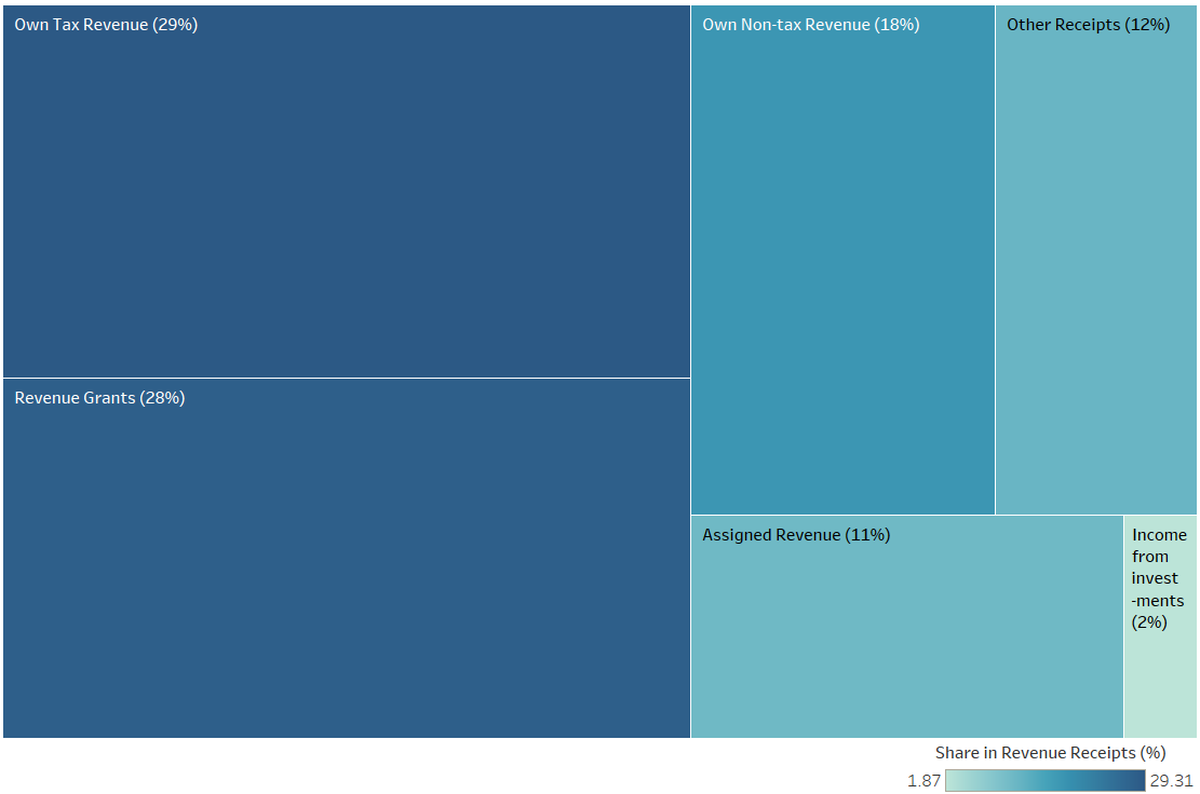
Composition of revenue receipts for the year 2016-2017
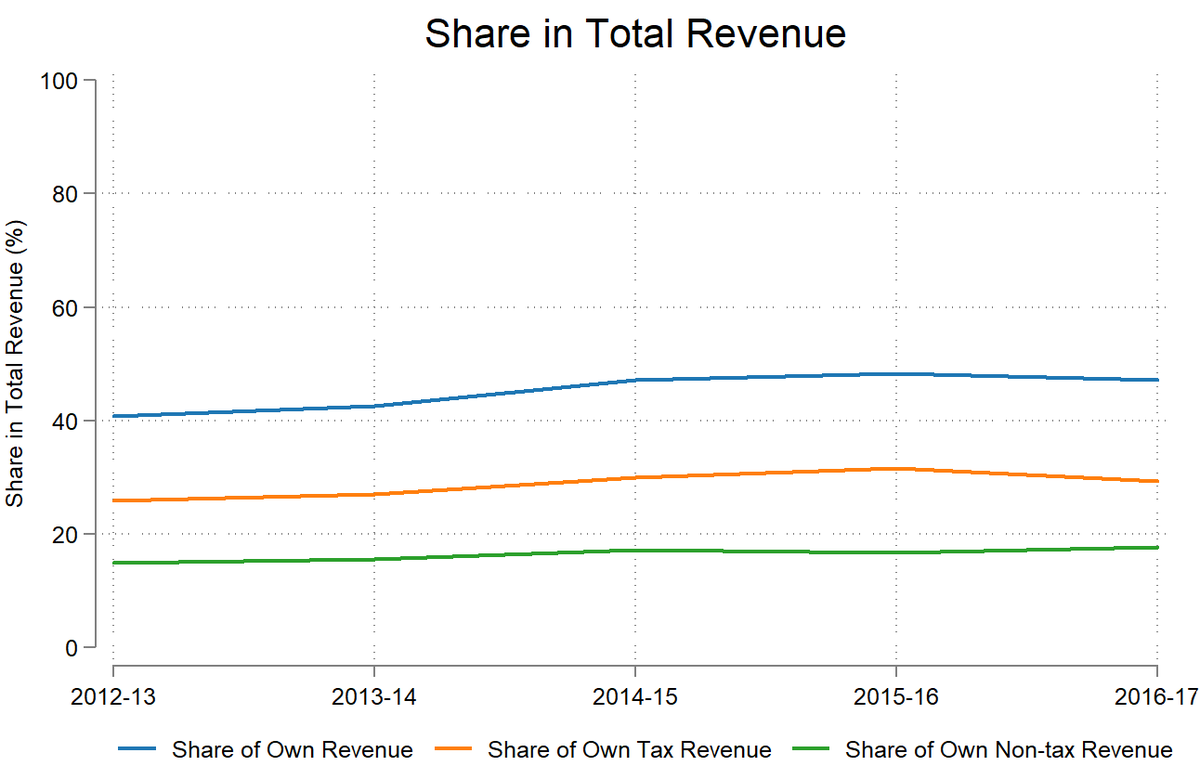
Share in total revenue over the years from 2012-13 to 2016-17
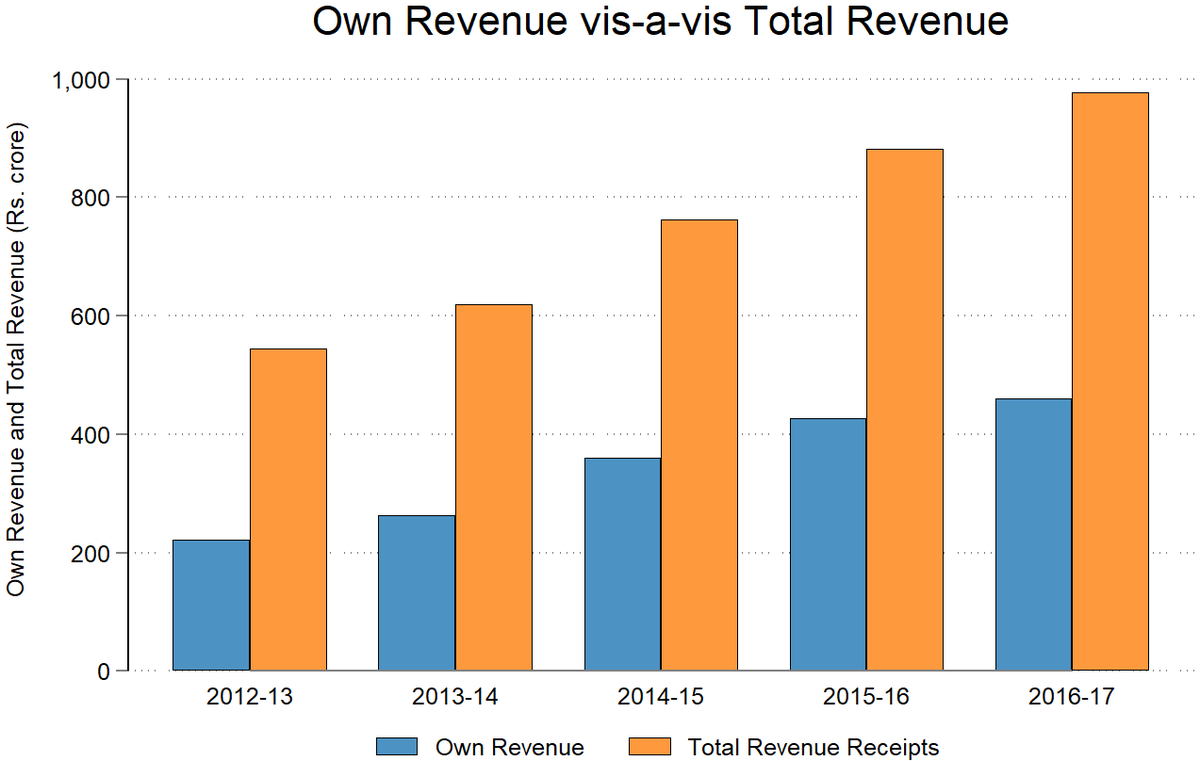
Comparison of own review vs total revenue from 2012-13 to 2016-17
What does the study say about the IGTs?
- Many ULBs were highly dependent on IGTs.
- Transfers from the Central government are as stipulated by the Central Finance Commissions and through grants towards specific reforms.
- Whereas, the State government transfers are stipulated as grants-in-aid and devolution of State’s collection of local taxes.
- Most ULBs were highly dependent on external grants, IGTs accounted for about 40% of the ULBs’ total revenue.
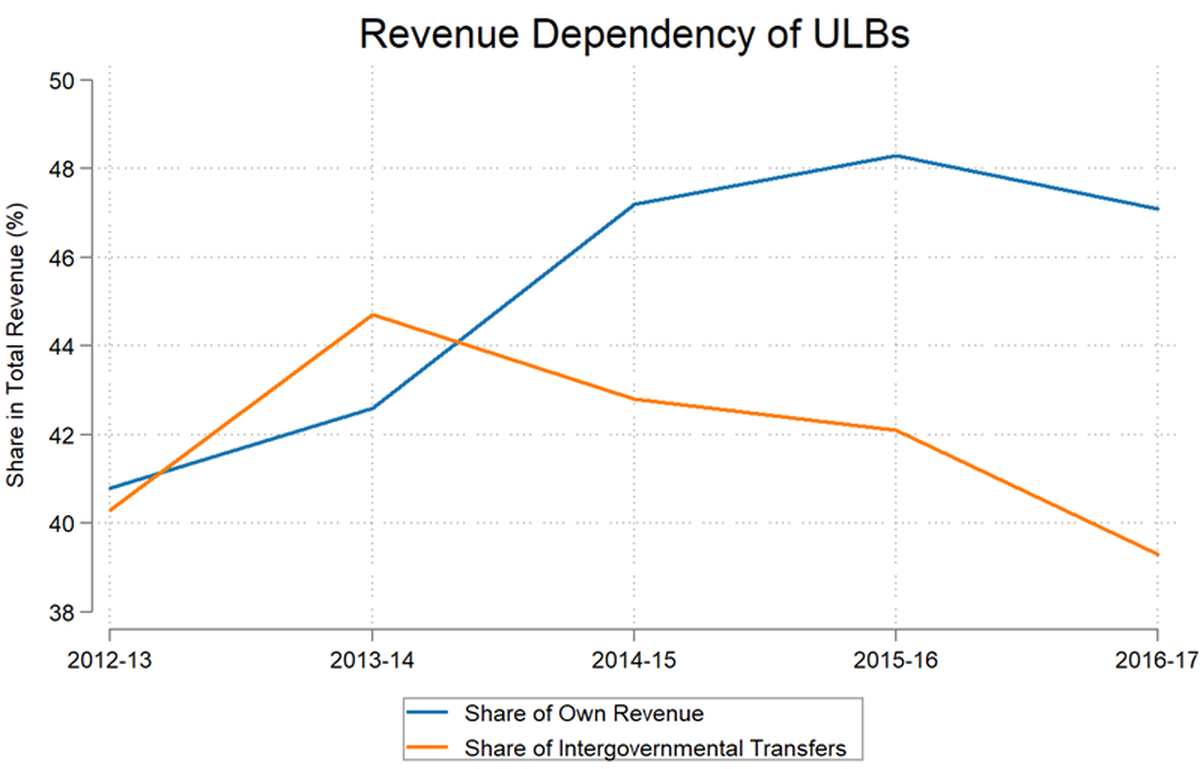
Graph showing the comparison of revenue through IGTs vs Own Revenue
What is the importance of IGTs?
- Stable and predictable IGTs are particularly important since ULBs’ own revenue collection is inadequate.
- While dependence on IGTs dipped over the years due to modest increase in own revenue, the scale of IGTs in India remained at around 0.5% of GDP - far lower than the international average of 2% to 5% of GDP.
- This can be improved by increasing the revenue assigned to ULBs from the State governments, and by allocating a share of the State and Centre’s GST proceeds to ULBs.
What is the importance of tax revenue?
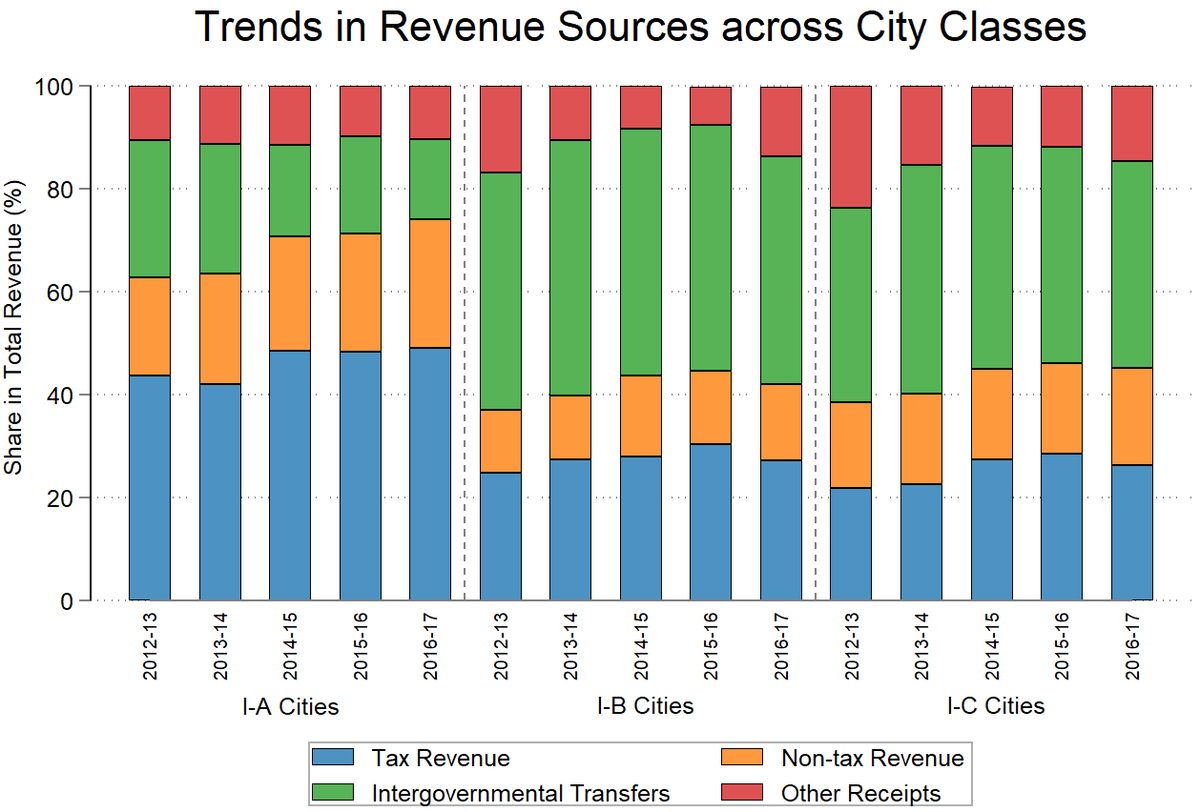
- Tax revenue is the largest revenue source for larger cities, while smaller cities are more dependent on grants.
- There are considerable differences in the composition of revenue sources across cities of different sizes.
|
City Type
|
Dependence
|
|
Class I-A cities
(population of over 50 lakh)
|
Primarily depend on their own tax revenue
|
|
Class I-B cities
(population of 10 lakh-50 lakh)
|
Rely more on IGTs
|
|
Class I-C cities
(population of 1 lakh-10 lakh)
|
Rely more on IGTs
|
What is the situation of own revenue?
- Own revenue mobilisation in Class I-A cities increased substantially, which was primarily driven by increases in non-tax revenue.
- In the five-year period studied, tax revenue in Class I-A cities grew by about 11%, while non-tax revenue grew by about 30%.
- The external revenue dependency of these larger cities gradually reduced over time, from around 27% in 2012-13 to about 15% in 2016-17.
- Own revenues of Class I-B and Class I-C cities, on the other hand, were stagnant even while these cities grew in size.
What about the O&M expenses?
- Operations and maintenance (O&M) expenses are on the increase but still inadequate.
- O&M expenses are crucial for the upkeep of infrastructure and for maintaining quality of service delivery.
- O&M expenses should ideally be covered through user charges, but total non-tax revenues, of which user charges are a part, are insufficient to meet current O&M expenses.
- Increasing cost recovery levels through improved user charge regimes would not only improve services but also contribute to the financial vitality of ULBs.
What is next?
- The scale of municipal finances in India is undoubtedly inadequate.
- A ULB’s realized own revenue resources are far below the estimated potential.
- Tapping into property taxes, other land-based resources and user charges are all ways to improve the revenue of a ULB.
- IGTs assume significance in the fiscal composition of ULBs, and a stable support from Central and State governments are crucial till ULBs improve their own revenues.
- Measures need to be made to also cover O&M expenses of a ULB for better infrastructure and service.
Reference
https://www.thehindu.com/opinion/op-ed/the-scale-of-municipal-finances-is-inadequate/article65631481.ece



