Why in news?
Higher education institutes in India can be the catalysts in integrating micro-credentials with existing academic programmes.
Why there is a need of micro-credentials in higher education?
Microcredentials are short-duration learning activities with proof of specific learning outcomes that are validated through a standard and reliable assessment process.
- Reduce skill gap- It offers a targeted and efficient way to bridge the significant gap between the skills acquired through traditional higher education and the skills demanded by the job market by providing relevant, up-to-date skills that align with industry needs.
- Flexibility- They are offered in online, physical, or hybrid modes at various levels, such as beginning, intermediate, or advanced.
- Adaptability-Micro credentials allow individuals to acquire specific skills quickly, enabling them to adapt to evolving job requirements and stay competitive in the workforce.
- Simplify course- They can be described as condensed, competency-based certifications which involves smaller learning modules delivered over shorter periods than traditional education.
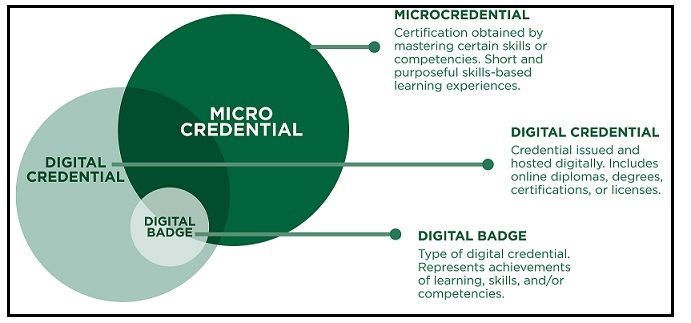
- Compatibility- The credit in micro-credentials is based on hours spent in achieving a specific skill or competency hence they are compatible with those in conventional higher education and can be widely accepted and recognized.
In macro-credential programmes, credit is based on the time spent in learning activities, such as lectures, labs, etc.,
- Lifelong learning- They are well suited for working professionals and individuals who may not have the time or resources to commit to lengthy degree programs.
- Diverse learning paths- It acknowledges that learning happens through various means, allowing learners to gain recognition for specific competencies acquired outside of traditional academic settings.
- Align with NEP 2020- Micro credentials align with this focus on skill development and support the policy's goal of fostering a more flexible and inclusive education system.
The National Education Policy 2020 emphasizes the importance of providing skill-based education from school to higher levels.
- Upskilling- It encourages the culture of continuous learning and upskilling fostering the development of a workforce that can readily adapt to changes in the job market.
- Enhance employability- It provide a tangible way for individuals to demonstrate their competencies to potential employers, enhancing their employability.
- Integrate with National Credit Framework (NCrF)-Micro credentials can be integrated into this framework which provides a structured framework for learning outcomes and credits, allowing learners to accumulate credits that contribute to their overall educational profile.
- Industry- Academia collaboration- It provide an avenue for higher education institutions to collaborate with industries in designing and offering programs that are directly aligned with the needs of employers.
- Global recognition-Offering and earning micro credentials in India can facilitate global recognition of skills, contributing to the mobility and competitiveness of Indian professionals on the international stage.
What lies ahead?
- There should be a clear quality benchmarking and a regulation of these micro-credentials to prevent significant divergences in learning outcomes.
- There is a need of universal validation and recognition of micro-credential credits to facilitate their easy endorsement in the workplace and Higher Education Institutes (HEIs).
- Indian HEIs must serve as agents of transformation and consider introducing micro-credentials a vital element of their strategic institutional objectives.
Quick facts
|
National Credit Framework
|
- About- It is a single meta framework to integrate academic, vocational, and experiential learning through a comprehensive credit system for school, higher education, and vocational training
- Credit levels- It has 8 credit levels based on the cumulative number of years of leaning with 1200 notional learning hours per year and 40 credits per subject.
- Notional learning hours- It refers to the time that the average student would need to attend all classes, study for tests and do assignments and homework.
- Academic Bank of Credits (ABC)-A digital platform to store and redeem the credits earned in different streams of education.
- Objective- It aims to promote lifelong learning, recognition of prior learning, multiple entry and exit, and continuous professional development.
- It also seeks to establish equivalence and mobility between general and vocational education.
|
Reference
The Hindu- Micro-credentials the next step in higher education



