Prelims: Current events of National and International Importance| Science and Technology
Why in News?
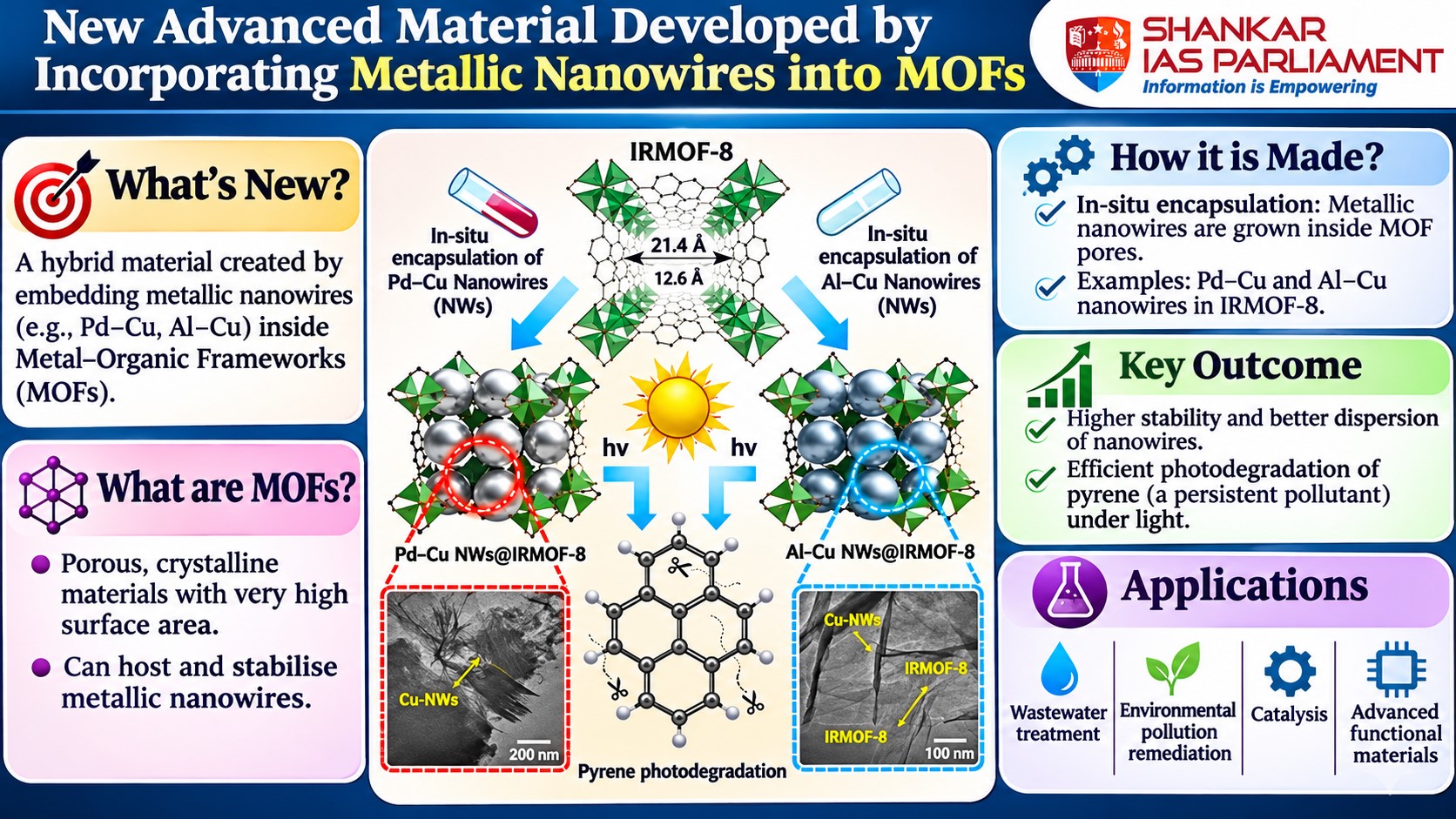
Scientists at the Institute of Advanced Study in Science and Technology (IASST), Guwahati, developed a MOF-based hybrid material incorporating metallic nanowires that removes up to 99% of pyrene, a persistent polycyclic aromatic hydrocarbon pollutant, under light irradiation and ultrasonication.
- Framework & Nanowires– Copper nanowires (Cu NWs) integrated with palladium (Pd) or aluminum (Al) are confined inside a porous metal–organic framework-8 (IRMOF-8) structure.
- Removal Efficiency– The Pd-modified Cu NW in IRMOF-8 achieved 99% pyrene removal, while the Al-modified alternative achieved 85% removal under the tested irradiation and ultrasonication conditions.
- Cost & Light Absorption– Pd boosts broadband light absorption through plasmonic interactions, while abundant, lower-cost Al serves as an antenna-reactor alternative to support interfacial charge transfer and photocatalytic breakdown.
Reference
PIB| New advanced material developed by incorporating metallic nanowires into MOFs



