Why in news?
Prime Minister Narendra Modi had a three-day state visit to the United States adding momentum to the India-USA bilateral relationship.
How significant is the State visit?
- Prime Minister Narendra Modi's 3-day state visit to the US has had a significant impact on India's global standing.
- It highlights the country's dual identity as a spiritual democracy and an economic power.
- The visit showcased India's cultural heritage, diplomatic prowess, and its growing influence on the world stage.
- The bilateral meeting between the two sides brought out several strategic outcomes for India ranging from emerging technologies, space, energy and defence.
- It strengthened the bilateral relationship between India and the U.S.
What are the key takeaways from PM’s U.S. visit?
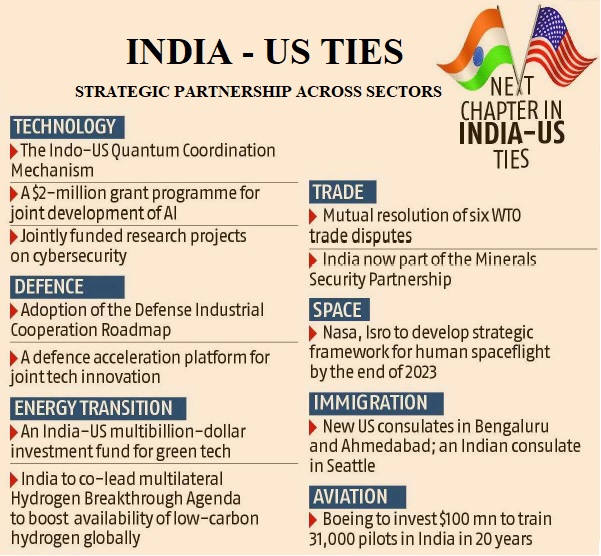
- Semiconductor Supply Chains - A MoU on Semiconductor Supply Chain and Innovation Partnership was signed between the countries.
- Critical Minerals - India became the newest partner of the U.S.’s Minerals Security Partnership (MSP) to diversify and secure critical mineral supply chains.
- Telecommunications - India and the United States launched public-private Joint Task Forces.
- India’s Bharat 6G and the U.S. Next G Alliance will co-lead this public-private research.
- Space - India has signed the Artemis Accords, a common vision of space exploration for the benefit of all humankind. To know more about this, Click here.
- Quantum tech - A Joint Quantum Coordination Mechanism was established to facilitate joint research between the public and private sectors across both countries.
- iCET - ‘Innovation Handshake’, a commercial Dialogue will be launched to connect each country’s start-up ecosystems, supporting U.S.-India Initiative on Critical and Emerging Technology (iCET).
- Civil Aviation - Air India strike a historic agreement with Boeing to acquire more than 200 American-made aircraft.
- Defence - The India-U.S. Defence Acceleration Ecosystem (INDUS-X) was inaugurated joint innovation on defense technologies integrating India’s private defense industry.
- Student Exchange - Launched a new Joint Task Force of the Association of American Universities and leading Indian educational institutions, including the Indian Institutes of Technology.
- Research - Launched a university network of Indo-U.S. Global Challenge Institutes to help create more research partnerships and exchanges in agriculture, energy, health, and technology.
- Energy - USAID signed an MOU with the Ministry of Railways to work together on Indian Railways’ target to become a “net-zero” carbon emitter by 2030.
- India and the United States committed to creating innovative investment platforms for Green Technology.
- Medicine - The U.S. National Cancer Institute through two new grants to develop an artificial-intelligence (AI)-enabled digital pathology platform.
How is India’s strategic independence and geopolitical balance?
-
Indo-Pacific - The United States to join the Indo-Pacific Oceans Initiative, a regional initiative inaugurated by Indian Prime Minister.
- Indian Ocean - The United States and India will hold an Indian Ocean Dialogue that convenes U.S. and Indian officials to promote greater regional coordination.
- The United States promised its support for India in several international forums like
- Reiterates permanent membership in a reformed UNSC,
- Has announced support for Indian membership in the International Energy Agency (IAEA)
- Recommits to advancing Indian membership in the Nuclear Suppliers Group (NSG)
- Also President Biden has invited Prime Minister Modi to attend the APEC Summit in San Francisco in November 2023.
References
- The Indian Express | Highlights of PM Modi’s US visit
- The Indian Express | Modi says talks, decisions add a new chapter
- Whitehouse | Republic of India Official State Visit to the U.S.



