- The collegium consists of CJI and 4 seniors most judges of the Supreme Court.
- The collegium system is not mentioned in the constitution and was created through judicial proceedings.
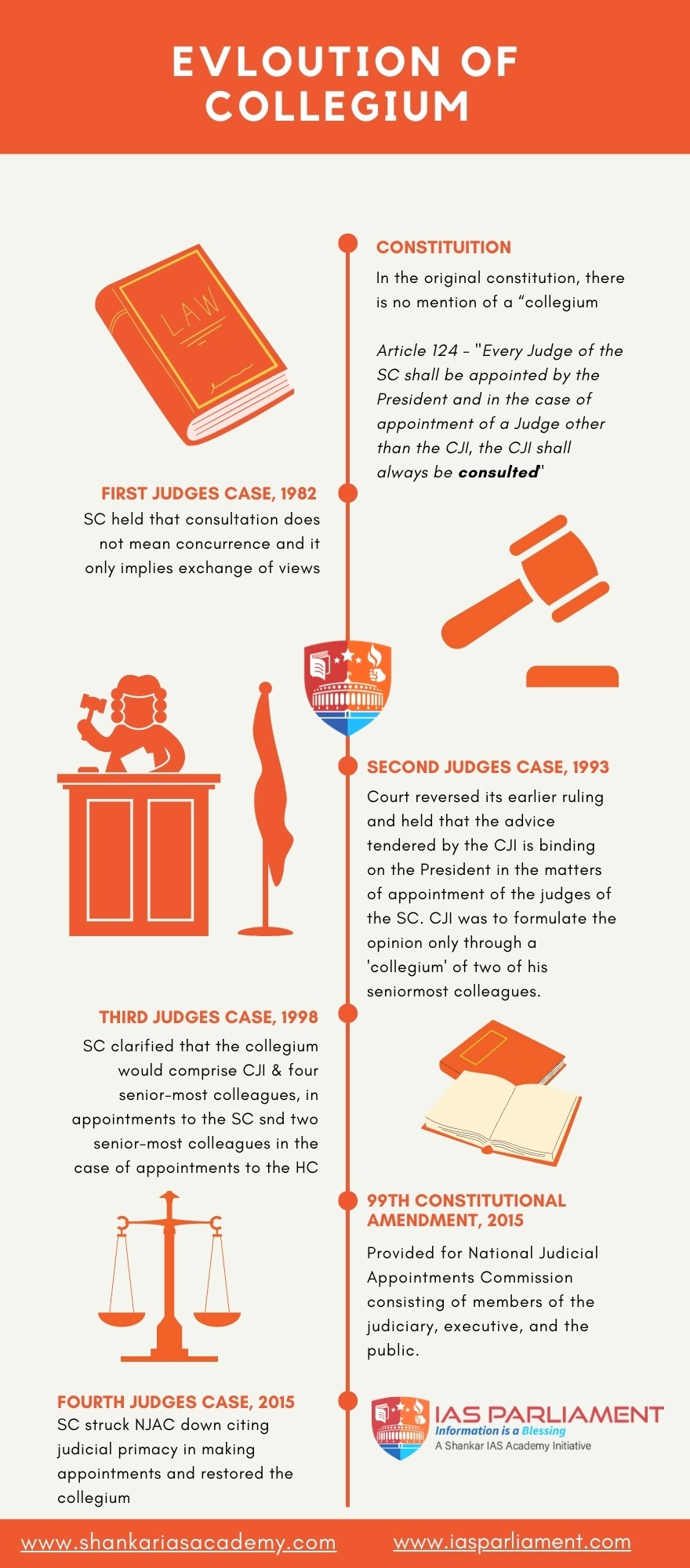
- Evolution of Collegium
- First Judges Case, 1981 (SP Gupta case) - The Supreme Court ruled that the word “consultation” could not be interpreted as “concurrence”.
- Accordingly, the CJI’s opinion was not binding on the executive.
- Second Judges Case, 1993 - The court overruled its earlier decisions and held that “consultation” meant “concurrence”.
- This means that the advice rendered by the CJI on matters of appointments is binding on the President.
- But, the CJI was to formulate the opinion only through a body of senior judges that the court described as the 'collegium'.
- Third Judges Case, 1998 - The court clarified that the collegium would comprise
- CJI and 4 senior-most colleagues - Appointments to Supreme Court
- CJI and 2 senior-most colleagues - Appointments to High Courts
- Additionally, for HCs, the collegium would consult other senior judges in the SC who had previously served in the HC concerned.
- NJAC - The government, through 99th constitutional amendment, sought to replace the collegium with the National Judicial Appointments Commission (NJAC).
- The NJAC included the Union Minister for Law and Justice and two eminent persons, besides the CJI and next two senior most SC judges.
- Fourth Judges Case (2015) - The court ruled that the primacy of the judiciary in judges’ appointments was embedded in the basic structure of the Constitution.
- It also held that the NJAC law gave politicians an equal say in judicial appointments to constitutional courts and declared NJAC to be unconstitutional.
|




