Prelims: Current events of national and international importance | Environment
Why in News?
The IPCC did not reach consensus on the publication timeline for its Seventh Assessment Cycle (AR7) reports during its 65th plenary session.
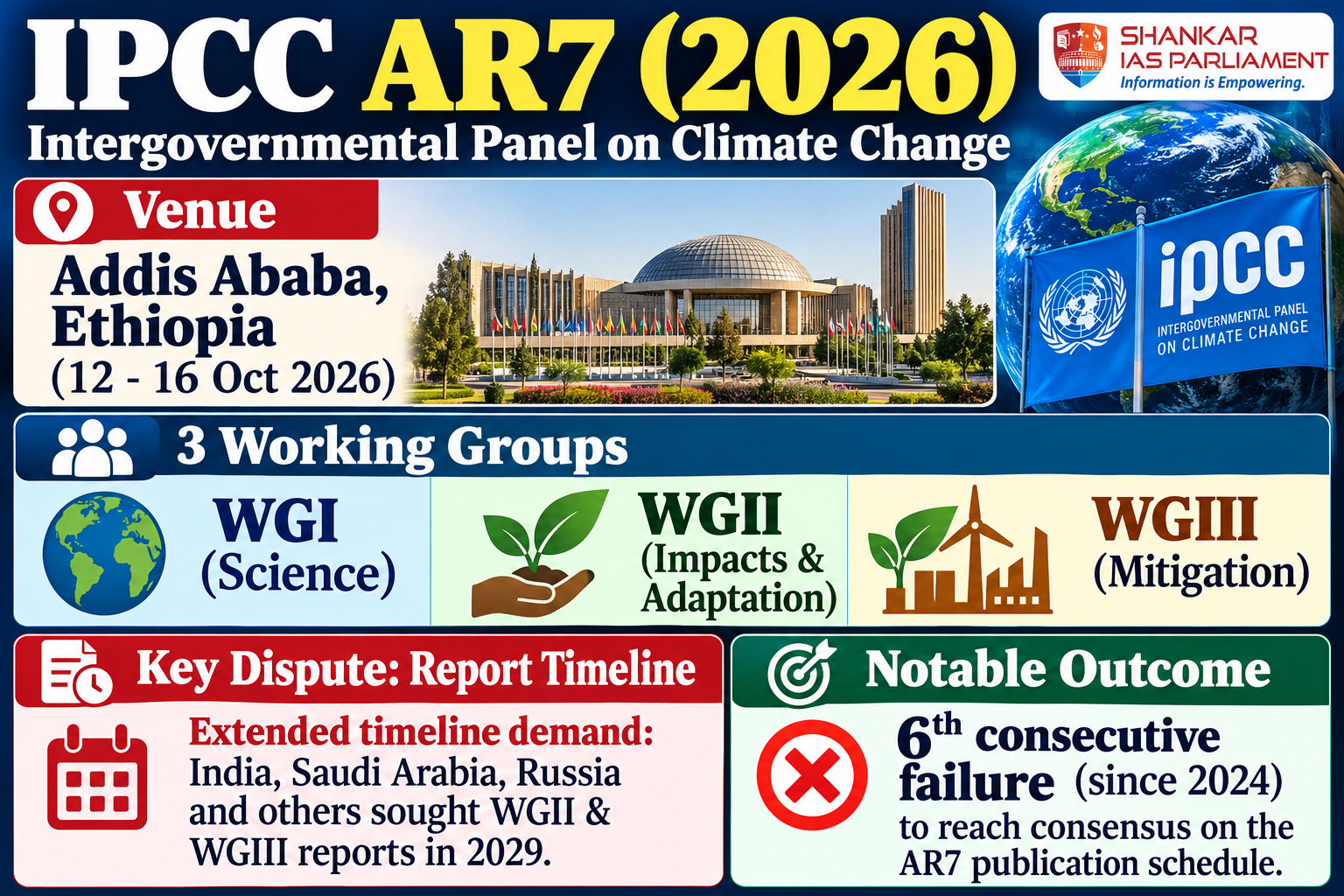
IPCC Seventh Assessment Cycle (AR7)
- Held in – Addis Ababa, Ethiopia, from October 12 to 16, 2026.
- It includes three Working Group assessments.
|
Working Group
|
Area of assessment
|
|
Working Group I (WGI)
|
Physical Science Basis of Climate Change
|
|
Working Group II (WGII)
|
Climate Change Impacts, Adaptation and Vulnerability
|
|
Working Group III (WGIII)
|
Mitigation of Climate Change
|
- This marked the 6th consecutive instance since 2024 in which agreement on a publication schedule was not achieved.
Major Issue: Disagreement over Publication Timeline
- Countries Supporting an Extended Timeline – India, Saudi Arabia, Russia, Iran, Iraq, Algeria, Syria, and Belarus advocated for the publication of the WGII and WGIII reports in 2029.
- Key Concerns Identified
- An accelerated schedule may undermine scientific rigour.
- Government reviewers and scientific experts are likely to encounter excessive workloads.
- Developing countries require sufficient time and support to ensure meaningful participation.
- It is essential that climate assessments remain both independent and inclusive.
- Perspective of Vulnerable Nations – Least Developed Countries advocated for the timely completion of assessments to ensure that the most recent scientific evidence informs global climate action and the 2028 Global Stocktake.
- Significance of the IPCC Timeline
- The scientific assessments conducted by the IPCC assist governments in evaluating climate risks, identifying adaptation requirements, and determining mitigation pathways.
- Delays in completing these assessments can restrict the availability of updated scientific evidence for the Global Stocktake.
India’s stance
- India objected to characterising the proposed timeline as merely “delayed”.
- India argued that the proposed schedule was more compressed than those implemented during the Fifth and Sixth Assessment Cycles (AR5 and AR6).
- India emphasised that vulnerable communities, including those within its own borders, should participate as equal partners in climate science.
- India also raised concerns regarding the insufficient provision of climate finance and technology transfer.
|
Intergovernmental Panel on Climate Change (IPCC)
|
- An intergovernmental body that assesses scientific knowledge on climate change.
- Established – 1988.
- Established by – World Meteorological Organization (WMO) and United Nations Environment Programme (UNEP).
- Headquarters – Geneva, Switzerland.
- Objective – To provide scientific assessments to governments for developing climate policies.
- Significance – It assesses existing scientific literature; it does not ordinarily conduct original climate research itself.
|
|
Global Stocktake (GST) under the Paris Agreement
|
- A collective assessment of global progress towards the objectives and long-term goals of the Paris Agreement.
- Occurrence – Every 5 years.
- Purpose – To identify gaps in climate action and support and help countries strengthen their collective response.
- 1st Global Stocktake – Concluded at COP28 in Dubai, UAE, in 2023.
- 2nd Global Stocktake – Scheduled for 2028, according to the provided article.
|
Reference
Down to Earth | IPCC Seventh Assessment Cycle (AR7)



