0.2584
7667766266
x

India’s Push For Coal Gasification

iasparliament Logo
June 01, 2026

Mains: GS-III – Science & Technology | Economy

Why in News?

In a roadshow promoting surface coal gasification, Union Coal and Mines Minister said that to encourage coal gasification, the Union Cabinet approved a Rs.37,500-crore incentive package via Scheme for Promotion of Surface Coal/Lignite Gasification Projects.

What is coal gasification?
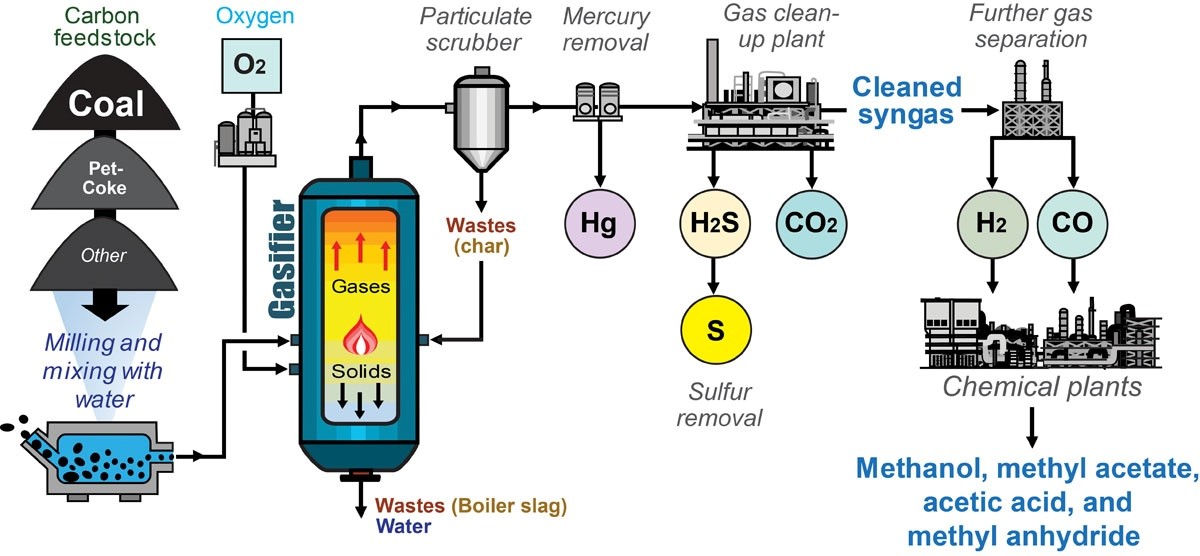
  • Coal Gasification – It entails the conversion of coal into synthetic gas, or syngas.
  • Syngas can be used to produce products such as urea, methanol, ammonium nitrate, synthetic natural gas (SNG), hydrogen, ether, and dimethyl, among others.

Cool GAS

  • India’s Resource Base – According to government data, India possesses approximately 401 billion tonnes of coal & about 47 billion tonnes of lignite.

India holds the world's fifth-largest coal reserve.

  • Coal gasification is driven by the need to make fuller use of India’s coal and lignite reserves while adopting a more sustainable mining approach to generate key downstream products.
  • The government believes this strategy will significantly cut import dependence.
  • India’s Import Dependency – According to the Union Coal Ministry, India imports
    • Urea – 20% imported.
    • Ammonia - Almost entirely imported.
    • Methanol – 80–90% imported.
  • Target – The Ministry has set itself a target of gasifying 100 million tonnes of coal by 2030.
  • With the recently announced scheme in place, the government aims to support the gasification of about 75 million tonnes of coal and/or lignite to reach its 2030 target.

Where does India stand with coal gasification at present?

  • Government Packages – Before the Rs.37,500-crore package was announced this year; the government had approved an Rs.8,500 crore package in January 2024.
  • Of this, Rs.6,233 crore has been disbursed to eight projects owned by private sector and public-sector undertakings.
  • Key Projects
  • Public-sector ventures – Include projects being executed through separate joint ventures of Coal India with Bharat Heavy Electricals and Gas Authority of India Ltd, as well as Coal India’s own project in Western Coalfields.
  • Private-sector participants – Include companies such as Jindal Steel and Greta Energy and Metal.
  • Commissioning Timeline – The Talcher Coal-based Ammonia-urea complex is expected to be commissioned in FY2027-28.
  • The others that include conversion of coal to syngas, ammonium nitrate, direct reduced iron, ethanol, and hydrogen are expected to be commissioned in FY2029-30.

Where does India stand with respect to the technology for coal gasification?

  • Global Context – Countries like China have successfully scaled coal gasification, using it for chemicals and synthetic fuels.
  • India is trying to replicate this model but faces unique challenges due to coal quality and resource constraints.
  • Indigenous Development
  • Bharat Heavy Electricals Ltd – Developed their pressured fluidised bed gasifier technology tailored specifically to handle the high ash content and variability of Indian coal.
  • NITI Aayog – Reports 16 facilities are capable of producing all the critical components required for gasification.
  • Private sector – Jindal Steel Ltd & Greta Energy and Metal have been able to indigenise about 80–90% of their production; Jindal Steel notes indigenisation can reduce project costs by 30–40%.
  • Technology Imports – Despite progress, India may still need foreign technology imports at maturing stages.
  • It for this reason that industry has also sought the government’s consideration of exemptions from provisions of the DPIIT for acquiring necessary technologies, especially from China.

What are the key challenges with respect to coal gasification in India?

  • High Ash Content – Indian coal has 25–45% ash, compared to less than 15% in global averages, makes gasification less efficient and more expensive.
  • Variability in Gross Calorific Value – Indian coal does not have a consistent energy output, this inconsistency makes it harder to design and operate gasifiers efficiently, as the energy yield fluctuates.
  • Presence of Complex Mineral Matter – Indian coal often contains minerals like silica, alumina, and other compounds.
  • These minerals can react during gasification, forming slag or deposits that damage equipment and reduce efficiency.
  • Handling these impurities requires advanced technology and higher operating costs.
  • Water Requirement – Gasification is water-intensive, posing sustainability issues in water-scarce  in coal-rich regions especially states like Jharkhand and Chhattisgarh.
  • Technology Gap – India needs advanced gasifiers and R&D to handle local coal quality.
  • Environmental Concerns – Though cleaner than direct coal burning, gasification still emits CO₂ unless paired with carbon capture.
  • Capital-Intensive Projects – By their very nature, coal gasification projects are highly capital-intensive and involve long gestation periods.
  • Cost & Viability – Independent research shows that in India, the capital cost of circulating fluidised bed gasifiers makes up the largest share of syngas production costs — nearly 30% of the total.
  • This makes financial viability especially important.
  • It is for this reason that the latest package, which provides financial incentives amounting to one-fifth of plant and machinery costs, is essential.

What is the key alternative & Government initiatives?

  • Fluidised-bed gasification – It is considered most suitable for Indian coal; this technology uses a gas stream to lift coal out of ash and gasify it with heat.
  • It is different from technologies used in China, Australia, and the U.S., where coal has lower ash content.
  • National Coal Gasification Mission – It aims to achieve 100 Million Tonnes (MT) of coal gasification by 2030, reducing India's import dependence for critical commodities like LNG, urea, and methanol.
  • Shifting to Domestic Coal Gasification – Recent conflicts, such as the volatility in West Asia, have severely disrupted global fuel supplies and spiked import costs.
  • Shifting to domestic coal gasification serves as a "strategic shield" for the economy.

What lies ahead?

  • Ministry of Coal has stated in April 2026 “In the coming months, more projects are expected to be sanctioned.”
  • Indicates pipeline expansion and stronger push toward the 2030 target of 100 million tonnes gasification.

Reference

The Hindu | Why is India pushing for coal gasification?

 

Login or Register to Post Comments
There are no reviews yet. Be the first one to review.

ARCHIVES

MONTH/YEARWISE ARCHIVES

sidetext
Free UPSC Interview Guidance Programme
sidetext