Mains: GS II – Education and HR
Why in News?
Higher education is a critical pillar of India’s transition towards a knowledge-based, innovation-driven and inclusive economy.
What are the achievements of India in higher education sector?
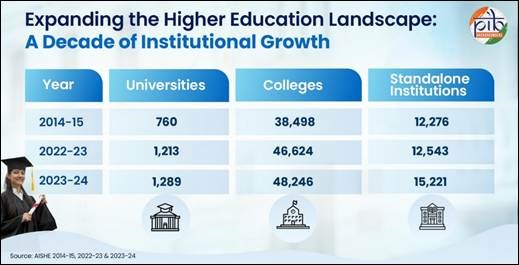
- Expanding Institutional Footprint – India has witnessed a significant expansion of its higher education infrastructure over the last decade.
- The number of universities increased from 760 in 2014–15 to 1,289 in 2023–24, representing a growth of about 69.6%.
- The number of colleges increased from 38,498 to 48,246, registering a growth of 25.3%.
- Standalone institutions increased from 12,276 to 15,221, a rise of approximately 24%.
- This expansion has widened the geographical and institutional reach of higher education.
- It has created greater opportunities for students, particularly those from regions and social groups historically underrepresented in higher education.
- However, expansion in numbers must be accompanied by improvements in academic quality, accreditation, faculty availability, research capacity and learning outcomes.
- Rising Enrolment and Access – Higher education enrolment has increased substantially over the decade.
- Total enrolment rose from 3.42 crore students in 2014–15 to 4.50 crore in 2023–24, representing a growth of 31.5%.
- The Gross Enrolment Ratio (GER) increased from 23.7% in 2014–15 to 30% in 2023–24.
- This marks significant progress towards the NEP 2020 objective of achieving 50% GER by 2035.
- The expansion has occurred across different levels of education. Between 2014–15 and 2023–24:
- Ph.D. enrolment increased from 1.17 lakh to 3.43 lakh, a rise of 192.89%.
- Postgraduate enrolment increased from 38.53 lakh to 57.85 lakh, or 50.15%.
- Undergraduate enrolment increased from 2.71 crore to 3.45 crore, or 27.27%.
- Diploma enrolment increased by 32.22%.
- Certificate enrolment increased by 22.55%.
- Integrated programme enrolment increased significantly by 301.36%.
- The sharp rise in doctoral and integrated programme enrolment indicates growing interest in advanced and multidisciplinary education, although the expansion of research capacity must keep pace with this demand.
- Women’s Participation and Gender Parity – One of the most significant developments has been the increasing participation of women in higher education.
- Female enrolment increased from 1.57 crore in 2014–15 to 2.24 crore in 2023–24, a growth of 42.2%, exceeding the growth in overall enrolment.
- Female GER rose from 22.9% to 31.2% during the same period and has remained higher than male GER, which stood at 28.9% in 2023–24, for the seventh consecutive year.
- The Gender Parity Index (GPI) improved from 0.92 in 2014–15 to 1.08 in 2023–24. A GPI of 1 indicates parity, while a value above 1 indicates relatively higher female participation.
- Socially disadvantaged groups have also recorded significant progress. The GPI for SC students increased from 0.91 to 1.11, while that for ST students increased from 0.81 to 1.08.
- These trends demonstrate the positive impact of scholarships, financial assistance, institutional expansion and policies aimed at improving women’s and disadvantaged groups’ access to education.
- Greater Social Inclusion – The higher education system has also become more socially representative.
- The share of SC enrolment increased from 13.44% in 2014–15 to 15.5% in 2023–24, while the share of ST enrolment increased from 4.8% to 6.4%.
- The share of OBC enrolment rose from 32.8% to 40.1%, recording the largest increase among the major social categories.
- GER among SC students increased from 18.9% to 27.8%, while ST GER rose from 13.5% to 22.8%.
- These developments reflect progress towards the constitutional vision of equality of opportunity and social justice.
- STEM & Research– STEM education is central to India’s aspirations of becoming a global innovation and technology hub.
- STEM enrolment increased from 91.5 lakh in 2014–15 to 1.02 crore in 2023–24, an increase of approximately 11.5%.
- The expansion of STEM education can support emerging sectors such as artificial intelligence, semiconductors, biotechnology, renewable energy and advanced manufacturing.
- However, India must increasingly focus on quality of STEM learning, industry-academia collaboration, research output and employability, rather than enrolment alone.
- Internationalisation – Foreign student enrolment increased from 42,293 in 2014–15 to 58,134 in 2023–24, a rise of approximately 37.5%.
- This indicates India's growing attractiveness as a higher education destination and provides opportunities for academic collaboration and global knowledge exchange.
- Faculty – The teaching workforce expanded from 14.73 lakh teachers in 2014–15 to 17.32 lakh in 2023–24, an increase of approximately 17.6%.
- The number of female teachers increased by 36.7%, while their share of the teaching workforce rose from 44.3% in 2022–23 to 44.9% in 2023–24.
- Infrastructure – In 2023–24, libraries were available in 98% of universities, 98% of colleges and 98% of standalone institutions.
- Laboratories were available in 89% of universities, 85% of colleges and 94% of standalone institutions.
- Playgrounds were available in 94% of universities, 95% of colleges and 91% of standalone institutions.
- The expansion of digital infrastructure, laboratories, health facilities, skill centres and accessibility facilities can further strengthen the quality of the learning environment.
What are the key challenges?
- Quality and learning outcomes – Expansion must be accompanied by stronger accreditation, academic standards and outcome-based education.
- Employability – Greater integration of vocational education, internships, apprenticeships and industry partnerships is required.
- Research and innovation – India needs higher investment in R&D and stronger university-industry linkages.
- Regional disparities – Institutional and enrolment growth remains uneven across states and regions.
- Faculty quality and availability – Recruitment, professional development and research opportunities need strengthening.
- Digital divide – Technology-enabled education must not deepen inequalities among students.
- Accessibility – Greater attention is required to the needs of PwBD students and other vulnerable groups.
What could be done?
- India needs to transition from an expansion-centric model to a quality-and-outcomes-oriented higher education system.
- The implementation of NEP 2020 should focus on multidisciplinary institutions, flexible curricula, credit mobility, vocational integration and research.
- Greater public and private investment in higher education, stronger accreditation mechanisms, better faculty development and deeper industry-academia collaboration can improve educational outcomes.
- Scholarships, hostels, digital access and targeted support should be strengthened for disadvantaged groups.
- The Internationalisation of Higher Education should be promoted through academic collaborations, global research partnerships and attracting international students while preserving India's educational diversity and cultural strengths.
What lies ahead?
- India's higher education sector has made substantial progress over the past decade.
- The next phase must focus on quality, equity, employability, research, innovation and global competitiveness.
- As India aspires to become a developed nation, higher education must evolve from being merely a provider of degrees into an engine of human capital, social transformation and innovation.
- The successful implementation of NEP 2020, supported by adequate resources, cooperative federalism, technological integration and evidence-based policymaking, can enable India to harness its demographic potential and build a knowledge society that is inclusive, innovative and globally competitive.
Reference
PIB| Higher Education Sector in India



