0.0913
7667766266
x

India’s Birth Crisis

iasparliament Logo
March 26, 2024

Why in news?

Recent lancet study reveals that by 2050, 1 in 5 Indians will be a senior citizen while there will be fewer younger people to take care of them.

TFR

What are the key highlights of the lancet study?

  • Data- The report is based on the Global Burden of Diseases (GBD), Injuries and Risk Factors Study 2021.
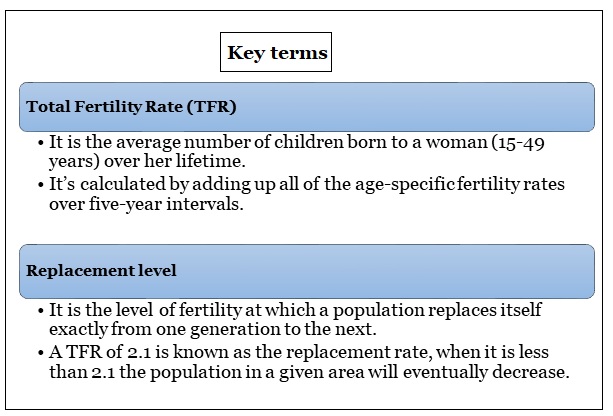
  • Decline in TFR- India’s TFR has fallen to 1.29 well below the replacement rate of 2.1.
  • Aging factor- By 2050, it’s predicted that 1 in 5 Indians will be senior citizens with comparatively smaller young population to support them.
  • Global trends- TFR is globally more than halved from 1950 to 2021, declining from 4.84 to 2.23.
  • Global annual live births peaked in 2016 at 142 million, then decreased to 129 million by 2021.
  • Researchers estimate that by 2050, 155 of 204 countries (76% of the world) will be below the replacement level of fertility.
  • China- It is already dealing with the demographic disadvantage of an ageing population, India too is heading in that direction.

Both India and China account for more than a third of world’s population, the ageing population will increase the dependency ratio.

Why there is decline in India’s TFR?

  • Effective policies- Historical efforts to control population growth, including family planning programs and incentives for limiting family size.
  • Enhanced health- Improved maternal and child health, leading to decreased infant mortality and increased confidence in child survival.
  • Economic changes- The society is witnessing the reversed Inter-generational flow of wealth, children are now seen as a significant financial burden rather than an economic asset.
  • Rising female literacy- Education empowers women, providing them with greater knowledge about family planning and reproductive health.
  • Women participation in workforce- Career consciousness, financial returns and economic independence have meant that women are reconsidering their options of having a second child.

Steps taken by India to combat population

  • National Family Planning Program- It was started in 1952 as part of the First Five-Year Plan, and became the first country in the world to have a state-sponsored population programme.
  • National Family Planning Indemnity Scheme (NFPIS)- The clients are insured in the eventualities of death, complication and failure following sterilization.
  • National Population Policy, 2000- It was launched to address the unmet needs for contraception, healthcare infrastructure, and health personnel, and providing integrated service delivery for basic reproductive and child healthcare.
  • Mission Parivar Vikas- It was launched in 2016 that substantially increase access to contraceptives and family planning services in 146 high-fertility districts with a TFR of above 3.
  • Family Planning Logistic Management and Information System (FP-LMIS): A dedicated software to ensure smooth forecasting, procurement and distribution of family planning commodities across all the levels of health facilities.
  • 360 degree media campaign- Launched a comprehensive media campaign including TV commercials, radio shows, and a dedicated website in 2017.
  • Awareness generation- Observance of World Population Day (July 11), Vasectomy Fortnight, and promotional activities in high fertility districts.

What are the long term consequences of declining TFR?

  • Increase in aged population- By 2050, over 20% of India’s population will be senior citizens, it poses challenges related to care, support, and health care.
  • Financial burden- Healthcare for the elderly lead to increased healthcare costs and pressure on public health budgets.
  • Shrinking workforce- A smaller working age population could lead to labour shortages and affect economic growth.
  • Lack of skilled employees- Industries that heavily rely on younger workers, such as healthcare, manufacturing, and technology, may face challenges in finding skilled employees, potentially leading to inefficiencies and decreased competitiveness.
  • Wage inflation- Labor shortages can also result in increased competition for talent, leading to wage inflation and potential economic instability.
  • Gender imbalance- Son meta preference will impact demographic structure resulting in unequal access to education, employment opportunities, and resources for women.

What lies ahead?

  • Proactive measures such as affordable childcare and health care investments can help mitigate the negative impacts of demographic changes and ensure sustainable development.
  • Gender equity is essential men can support women’s participation in the workforce by sharing the burden of unpaid care work which would contribute to more balanced family dynamics.
  • The need of the hour is economic policies that prioritize growth, job creation, and social security reforms are vital for adapting to demographic changes and mitigating their impacts.
  • India can adapt policies and strategies of the successful models from other countries which suit India’s specific contexts and needs.

Global experimental policies to boost fertility

  • Germany- Boosts births through liberal labour laws, allowing more parental leave and benefits.
  • Denmark- Offers state-funded IVF for women below 40 years.
  • Hungary- Nationalised IVF clinics.
  • Poland- Gives out monthly cash payments to parents having more than two children.
  • Russia- It makes a one-time payment to parents when their second child is born.
  • Russia reinstituted the Soviet-era ‘Mother Heroine’ title, who bore and raised more than 10 children amounting to Rs. 13 lakh.


References

  1. Indian Express- Lancet forecast fertility rate dip
  2. The Print- India’s fertility rate plunged in last 70 years
Login or Register to Post Comments
There are no reviews yet. Be the first one to review.

ARCHIVES

sidetext
Free UPSC Interview Guidance Programme
sidetext