Why in News?
Recently Lok Sabha passed the Supreme Court (Number of Judges) Amendment Bill, 2026 as a money Bill, a route it had also taken in 2019 when the Supreme Court strength was raised to 34.
What is a Money Bill?
- A Money Bill – A Money Bill in India is a special law that deals exclusively with financial matters like taxes, government borrowing, and spending or withdrawing money from the Consolidated Fund of India
- It is a bill that contains only provisions dealing with the matters listed in Article 110(1), such as:
- Imposition, abolition, remission, alteration, or regulation of taxes.
- Borrowing of money by the Government of India.
- Custody, payment into, or withdrawal from the Consolidated Fund of India or the Contingency Fund of India.
- Appropriation of money from the Consolidated Fund.
- Declaration of expenditure charged on the Consolidated Fund.
- Receipt, custody, or audit of public money.
- Any matter incidental to the above subjects.
|
Relevant Articles of Money Bill
|
- Article 109 – Prescribes the special procedure for passing a Money Bill.
- Article 110 – Defines a Money Bill.
- Article 111 – President's assent to Bills. The President cannot return a Money Bill for reconsideration.
- Article 117 – Deals with Financial Bills, which are different from Money Bills.
|
What are the special legislative procedures of a money bill?
- Introduction – A Money Bill can be introduced only in the Lok Sabha, only by a Minister, and only with the prior recommendation of the President.
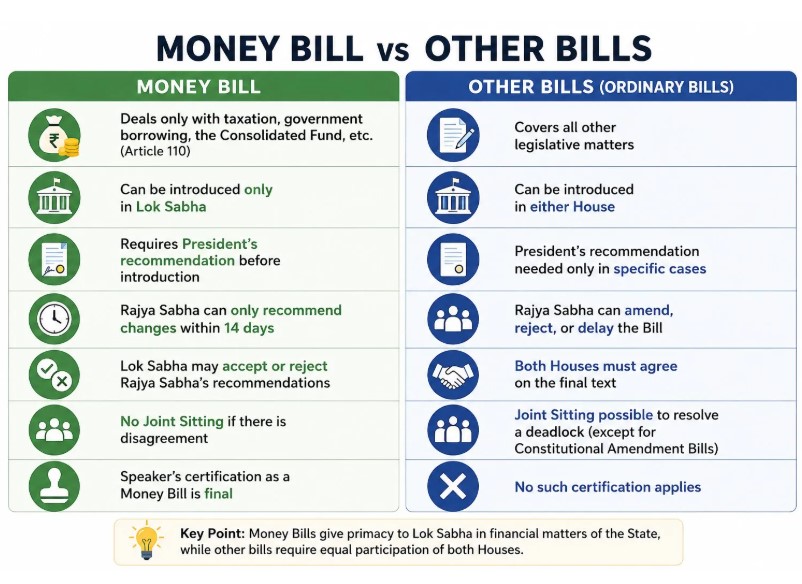
- Speaker's Certification – The Speaker of the Lok Sabha certifies whether a Bill is a Money Bill.
- Under Article 110(3), this decision is declared final, though it is subject to limited judicial review as recognized by the Supreme Court.
- Limited Role of the Rajya Sabha – The Rajya Sabha cannot amend or reject a Money Bill.
- It can only recommend changes and must return the Bill within 14 days.
- The Lok Sabha may accept or reject these recommendations.
- If the Bill is not returned within 14 days, it is deemed to have been passed by both Houses in the form approved by the Lok Sabha.
- President's Assent and No Joint Sitting – There is no provision for a joint sitting in the case of a Money Bill.
- After being passed by Parliament, the Bill is presented to the President, who cannot return it for reconsideration under Article 111.
What are the contentious legislations passed as money bills?
- Aadhaar Act, 2016 – Passed as a Money Bill to provide statutory backing to the Aadhaar biometric identity system.
- Its classification as a Money Bill remains one of the central constitutional controversies.
- Finance Act, 2017 (Tribunal Reforms) – Passed as a Money Bill, It reorganised several tribunals and altered the appointment, qualifications, tenure, and service conditions of tribunal members.
- These provisions were challenged as unrelated to the core definition of a Money Bill.
- Prevention of Money Laundering Act (PMLA) Amendments – Several amendments to the PMLA were introduced through Finance Acts passed as Money Bills (not through a standalone "PMLA Amendment Act" passed as a Money Bill).
- Their validity on the Money Bill issue is pending before the Supreme Court.
- Foreign Contribution (Regulation) Act (FCRA) Amendments – Certain amendments affecting foreign funding of NGOs were introduced through Finance Acts passed as Money Bills, leading to constitutional challenges over whether such provisions could validly be included.
- Supreme Court (Number of Judges) Amendment Bill, 2026 – The parliament passed this bill that increases the sanctioned strength of the Supreme Court from 34 to 38 judges (including the Chief Justice of India).
- Parliament passed it as a Money Bill, citing the additional government expenditure required for salaries, staff, residences, security, and other
What are the concerns in using money bill route to pass important laws?
- Circumventing the Rajya Sabha – The Upper House cannot amend or reject a Money Bill; its role is limited to non-binding recommendations within 14 days.
In his 2018 dissent in the Aadhaar case, then Justice D. Y. Chandrachud called the use of the Money Bill route a "fraud on the Constitution" and a "subterfuge", arguing it bypasses the Rajya Sabha.
- Bypassing Opposition – Governments use this shortcut to push controversial legislation through the Lok Sabha alone when they lack numbers in the Upper House.
- Reduced Debate – Rushing bills as financial measures cuts short comprehensive committee evaluation and public deliberation.
- Ambiguity in Article 110 – Broad phrases like "incidental" financial provisions allow non-financial subjects to sneak into a Money Bill.
- Questionable Precedents – High-profile laws—such as the Aadhaar Act and tribunal/PMLA amendments—were passed this way, triggering intense legal challenges over executive overreach.
- Limited Review – The absolute authority of the Lok Sabha Speaker to certify a bill leaves little room to question misuse.
Reference
The Indian Express| The Money bill route
PRS India| Money Bill Vs Other Bills



