Why in News?
Recently, reports from certain parliamentary committees have been laid before the respective Houses of Parliament.
What are Parliamentary Committees?
- Parliamentary Committee – The committees which are appointed or elected by the House or nominated by the Presiding Officer of the respective Houses (Speaker or Chairman) and which work under the direction of the Presiding Officer.
- These committees act as a “Mini Parliament”.
- Objective – To examine legislation, government expenditure, policies, and administrative functioning in detail.
- Origin – These Committees have their origins in the British Parliament.
- Authority – They draw their authority from Article 105 and Article 118 of the Indian Constitution.
- Article 105 deals with the privileges of MPs.
- Article 118 gives Parliament authority to make rules to regulate its procedure and conduct of business.
- Reports – It presents its report to the respective House or to the Presiding Officer (Speaker/Chairman).
- Nature of Recommendation – The recommendations of these committees are advisory in nature.
- Secretariat – They are provided with a secretariat in the respective House of Parliament.
- Legal Provisions – The procedure regarding the functioning of DRSCs, serviced by Lok Sabha, has been enumerated in Rules 331C to 331Q of the Rules of Procedure and Conduct of Business in Lok Sabha.
- Rules 268 to 277 of the Rules of Procedure and Conduct of Business in Council of States (Rajya Sabha) govern DRSCs serviced by the Rajya Sabha Secretariat.
What is the need for Parliamentary Committees?
- Detailed legislative scrutiny – Examine Bills in detail and identify legal, financial & implementation flaws.
- Executive accountability – Scrutinise ministries and ensure government accountability.
- Financial control – Examine public expenditure, budget proposals and CAG reports.
- Specialised examination – Provide expert and detailed analysis of complex policy issues.
- Better governance – Identify systemic weaknesses and recommend administrative reforms.
- Reduce parliamentary burden – Enable in-depth scrutiny while reducing the workload of the Houses.
How are the Parliamentary Committees in India classified?
- 2 Kinds – Parliamentary Committees are of two kinds
- Standing Committees and
- Ad hoc Committees.
- Standing Committees – These are permanent and regular committees which are constituted from time to time (constituted every year or periodically) in pursuance of the provisions of an Act of Parliament or Rules of Procedure and Conduct of Business in Lok Sabha.
- Nature – The work of these Committees is of a continuous nature.
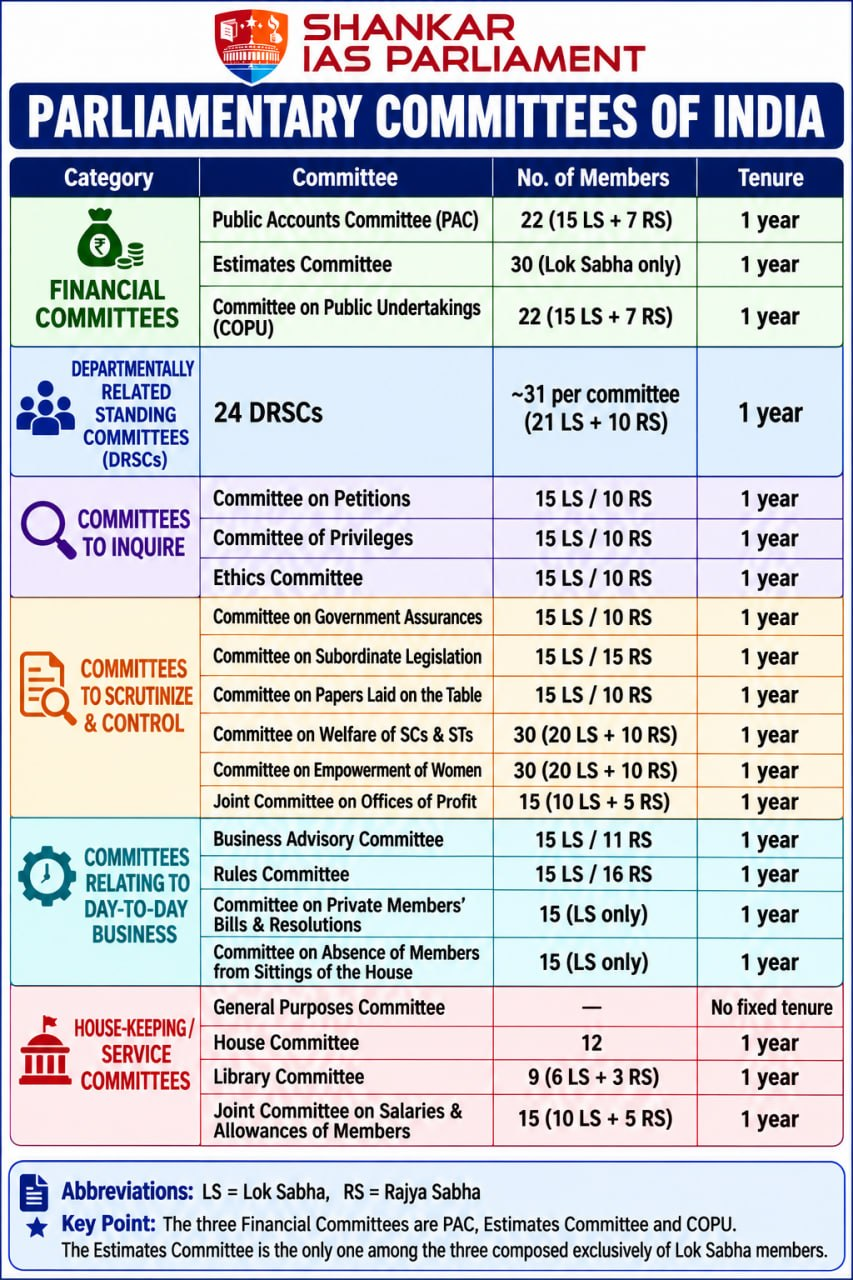
- 6 Categories
- Financial Committees
- Departmental Standing Committees
- Committees to Enquire
- Committees to Scrutinise and Control
- Committees Relating to the Day-to-Day Business of the House
- House-Keeping Committees or Service Committees.
- Ad hoc Committees – They are appointed for a specific purpose, and they cease to exist when they finish the task assigned to them and submit a report.
- Inquiry Committees – Investigate specific issues (Joint Parliamentary Committee on scams).
- Advisory Committees – Select/Joint Committees on Bills for detailed legislative scrutiny.
- Other Ad hoc Committees – Select and Joint Committees on Bills, Railway Convention Committee, Joint Committee on Food Management in Parliament House Complex etc.
- Eligibility – A Minister is not eligible for election or nomination to the
- Financial Committees,
- DRSCs and
- Committees on
- Empowerment of Women
- Government Assurances
- Petitions
- Subordinate Legislation
- Welfare of Scheduled Castes and Scheduled Tribes.
What are the key functions of each committee?
- Estimates Committee – It examines estimates; promotes economy & efficiency.
- Public Accounts Committee (PAC) – Examines government accounts & CAG reports.
- Committee on Public Undertakings (COPU) – Examines PSUs & their performance.
- Departmentally Related Standing Committees (DRSCs) – Examine Demands for Grants, Bills, Annual Reports & policy documents of ministries.
- Business Advisory Committee – Allocates time for House business.
- Committee of Privileges – Examines breaches of privilege.
- Committee on Petitions – Examines petitions & representations.
- Government Assurances Committee – Reviews implementation of ministerial assurances.
- Subordinate Legislation Committee – Scrutinises delegated legislation.
- Rules Committee – Reviews parliamentary procedure and rules.
How do these committees work?
- 3 ways of reference – A bill can usually be referred to a parliamentary committee in 3 ways.
- Minister’s Initiative – The minister piloting the bill can seek the permission of the House to refer the Bill to a committee.
- Speaker/Chairman’s Discretion – The Speaker (Lok Sabha) or Chairman (Rajya Sabha) has the authority to decide whether a bill should be referred to a committee.
- Building Political Consensus – When ministers aim to build political consensus, they often welcome the referral of the bill to a committee for wider consultation.
- However, when the government wants to expedite the bill’s passage, ministers may request the Speaker/Chairman not to refer it to a committee.
- This is when the third mechanism comes into play.
- Opposition Mobilisation – When a bill reaches a House where the government does not have a majority, the MPs can move a motion to refer the bill to a committee through collective mobilisation.
- Political Polarisation & Committee Scrutiny – Whenever the government and Opposition hold extreme positions on a bill’s provisions, such bills are generally not referred to committees for scrutiny.
What is the significance of Parliamentary Committees?
- Specialised forum – This committee system in Parliament is to provide a specialised forum for deliberation on policy issues, beyond the limited sitting days of Parliament.
- Technical nature of debates – Debates in committees are more technical, and so the deliberations require time and stretch for a few months, unlike the shorter political debates on the floor of the House.
- Ensure accountability – The main purpose is to ensure the accountability of the Government to Parliament through more detailed scrutiny and consideration of policies and bills.
- Strengthening Administration – By offering meaningful parliamentary support, committees help strengthen the administration and improve governance.
- Contribution to Legislative Process – The committee, over the years, has worked well in strengthening the country’s legislative process.
- Slowing Down Legislation – The referral of a bill to a committee slows its legislative journey, as the House can debate it only after the committee submits its report.
- Building Consensus – This slowdown, though a source of tension between ruling and opposition parties, provides time to build consensus and ensures more balanced legislation.
What are the challenges associated with Parliamentary Committees?
- Non-binding recommendations – The recommendations of these committees are not binding on the government.
- Limited scrutiny of Bills – Many Bills may not undergo detailed committee examination.
- Limited research capacity – These Committees often lack adequate expert and research support.
- Poor attendance – The irregular participation of members can reduce the quality of deliberations.
- Delayed reports – The lengthy examination may reduce the timeliness of recommendations.
- Resource constraints – Insufficient staff, data and technical expertise hinder effective scrutiny.
- Executive dominance – The dependence on government-provided information can constrain independent oversight.
What are the measures need to be taken?
- Need for Robust Scrutiny – A strong lawmaking process requires thorough scrutiny by Parliament, ensuring that laws are carefully examined before being passed.
- Independence from Numbers or Politics – Scrutiny should remain independent of majority strength or political agreement, protecting the integrity of the legislative process.
- Mandatory Referral to Committees – To guarantee robustness, all Bills should be referred to Parliamentary committees for detailed examination.
- Strictly Defined Exceptions – Any exceptions to this referral rule must be strictly defined and clearly explained to Parliament.
- Strengthening Committees – Committees should be empowered and strengthened to scrutinise Bills effectively and present reports in a timely manner.
- Ensuring debate for all Bills – Ensure that all Bills, regardless of the ruling party, undergo a well‑structured process of debate before passage.
- Greater transparency – Promotes public access to reports, evidence and committee proceedings, wherever appropriate.
- Adequate resources – Provide sufficient staff, technology, finances and infrastructure.
To know about the recent committee reports, click here



