Why in news?
The Law Ministry has recommended the Ram Nath Govind panel to examine if the constitutional amendments required to facilitate simultaneous elections would require ratification by the States.
|
Ram Nath Govind Panel
|
- The Central government set up a panel headed by former President Ram Nath Kovind to explore the feasibility of the ‘One Nation, One Election’ (ONOE) plan.
- Simultaneous Elections refers to structuring the Indian election cycle by synchronizing the elections to Lok Sabha and State Assemblies.
|
How the Constitution is amended?
Article 368 in Part XX of the Constitution deals with the powers of Parliament to amend the Constitution and its procedure.
- Article 368- It states that the Parliament may, in exercise of its constituent power, amend by way of addition, variation or repeal any provision of the Constitution in accordance with the procedure laid down for the purpose.
- Limitation- In the Kesavananda Bharati case (1973), the Supreme Court ruled that the Parliament cannotamend those provisions which form the ‘basic structure’ of the Constitution.
- Procedures of Constitutional Amendments-
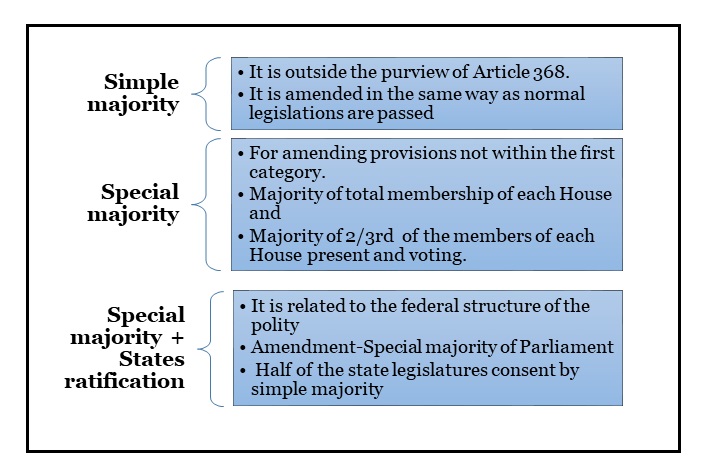
- Simple majority- It does not require specific quorum.
- It is applicable to
- Article 4- It is related to changes in the organisation of states,
- Article 169- It deals with abolition or creation of Legislative Councils in States,
- Schedule VI- Provisions for the administration of Tribal Areas in the States of Assam, Meghalaya, Tripura and Mizoram.
- Special majority - The requirement is applicable only to the final voting stage.
- Lok Sabha rules prescribes adherence to special majority at all effective stages of the Bill.
- It is applicable to
- Fundamental Rights
- Directive Principles of State Policy
- All other provisions which are not covered by the 1st and 3rd categories.
- Special majority + States ratification- The moment half of the states give their consent, the formality is completed.
- There is no time limit within which the States should give their consent to the bill.
- Revoking the ratification – There is no specific mention in the Constitution about the States revoking their ratification.
States Ratification in the U.S.
- The U.S. Constitution does not specify any such time period. However, in Dilllon v. Gloss (1921), the U.S. Court held that State ratification must take place within ‘reasonable time’.
- In the U.S., once a State has agreed to an amendment and communicated it to the Secretary of State, it cannot revoke its ratification. However, the US Court in Chandler v. Wise (1939) held that a State can ratify an amendment even if it has rejected it previously.
- States Ratification was applied for
- 99th Amendment Act- Established the National Judicial Appointments Commission (NJAC) for the appointment of Supreme Court judges
- 101st Amendment Act 2016- Introduced GST regime
- Federal structure- Specifically listed in Article 368(2) and are commonly referred to as ‘entrenched provisions’
|
Entrenched Provisions
|
Article
|
|
Election to the President of India
|
Article 54 and 55
|
|
Extend of the executive power of the Union or State government
|
Article 73 and 162
|
|
Union judiciary
|
Article 124-147
|
|
High court
|
Article 214-231
|
|
Distribution of legislative powers between the Union and the states
|
Article 245 to 255
|
|
Any of the lists mentioned in 7th schedule
|
Union list, State list, Concurrent list
|
|
Representation of states in the Parliament
|
Article 82
|
|
Goods and Services Tax Council
|
Article 279-A
|
|
Power of Parliament to amend the Constitution and its procedure
|
Article 368 itself
|
The Constituent Assembly debates show that Dr. B.R Ambedkar was in favour of ratification by States for amending certain constitutional provisions to ensure that the federal structure of the Constitution remains unaltered.
Can a constitutional amendment be struck down for want of ratification?
- Anti-Defection case- In Kihoto Hollohan v. Zachillu (1992), the constitutional validity of the 10th Schedule of the Constitution inserted by the 52nd Amendment Act, 1985 was challenged on the ground that the amendment was not ratified by the States.
- The Court upheld the validity of the Tenth Schedule but declared Paragraph 7 of the Schedule invalid for want of ratification.
- 97th amendment act, 2011- In Union of India v. Rajendra N. Shah, the Court held that the amendment required ratification by at least one-half of the State legislatures as per Article 368(2), since it dealt with an exclusive State subject under 7th Schedule.
52nd Amendment Act, 1985 - Introduced anti-defection law in India which became the part of 10th Schedule of the Constitution.
97th Amendment Act, 2011 - Gave constitutional status to Cooperative Societies.
Law Commission Report (2018) on Simultaneous Elections
- The Law Commission, chaired by Justice B. S. Chauhan, released a draft report stipulating that simultaneous elections are not feasible within the existing framework of the Constitution.
- It suggested that appropriate amendments have to be brought about in
- The Constitution,
- Representation of the People’s Act 1951,
- Rules of Procedure of Lok Sabha and State Assemblies
- It highlighted that a constitutional amendment to this effect must receive ratification from at least 50% of the States.
- B.P. Jeevan Reddy Commission (1999), similarly advocated for holding Lok Sabha and Assembly elections together.
- Experts have cautioned that implementing the recommendations of the Law Commission is not possible without infringing upon the federal structure of the Constitution.
Reference
- The Hindu- States ratification in Constitutional Amendments



