Mains: GS II – Issues Relating to Development and Management of Social Sector/Services relating to Health
Why in News?
Recently, India continues to see a drop in exclusive breastfeeding by six months, despite high initiation rates.
What is breastfeeding?
- Definition – Breastfeeding, also called nursing
- It is the process of feeding a mother's breast milk to her infant.
- It is done either directly from the breast.
- It is also done by pumping out the milk from the breast and bottle-feeding it to the infant.
- Status in India – Only 63.7% of infants meeting World Health Organisation (WHO) guidelines, according to the National Family Health Survey (NFHS) -5.
- India’s current systems treat it as optional or supplemental.
|
World Breastfeeding Week
|
- Celebrated on – Every year in the first week of August.
- Supported by – WHO, UNICEF, Ministries of Health and civil society partners around the world.
- Aim – To recognize breastfeeding as a powerful foundation for lifelong health, development, and equity.
- Theme for 2025 – Prioritise Breastfeeding: Build Sustainable Support Systems.
|
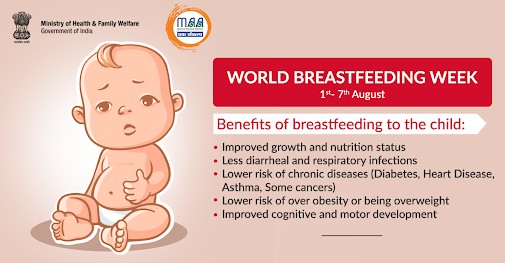
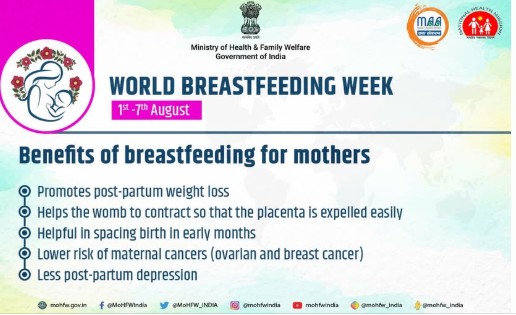
What are the benefits of breast feeding?
What are the challenges in breastfeeding?
- Physiological barriers – Latching difficulties, maternal nipple pain and low perceived milk supply are primary causes for early discontinuation.
In breastfeeding, latching refers to how a baby attaches their mouth to the mother's breast to feed. A good latch involves the baby's mouth covering not just the nipple, but also a portion of the areola (the dark area around the nipple). This allows for effective milk transfer and minimizes discomfort for the mother.
- Hormonal issues – It can inhibit oxytocin -the hormone essential for milk ejection, further complicating feeding.
- Stress elevates cortisol, which interferes with prolactin-driven milk production.
- Poor maternal health – Marginalised mothers especially from tribal, migrant and urban poor communities face compounded challenges of malnutrition, low literacy and poor access to health information.
- Lack of Maternity leaves – Women in informal sectors, lack maternity leave which inhibits breastfeeding habit.
- Absence of safe spaces – There is a insufficiency of safe and secure spaces to feed milk.
- It causes early weaning.
Weaning, is the process of switching an infant's diet from breast milk or formula to other foods and fluids.
- Lack of trained staff – Without trained staff to correct positioning and latch, mothers often stop within weeks.
- They are not equipped to diagnose a poor latch, assess milk transfer, or identify feeding-related weight faltering.
- Psychosocial barriers – It includes lack of support from partner, family and workplace stress.
- Low compliance – Although India’s Maternity Benefit Act mandates breastfeeding breaks and crèche facilities, compliance is low.
What can be done to promote breastfeeding?
- Lactation support – ASHAs (Accredited Social Health Activist) and ANMs (Auxiliary Nurse Midwife) - play a pivotal role in extending lactation support into communities.
- Competency-based lactation training – It provides access to visual tools and referral pathways for unresolved cases.
- Digital aids – Growth monitoring charts and helpline access can increase field-level efficacy.
- For example, Exclusive breastfeeding at 3 and 6 months can be tracked
- Structural reforms – Access to clean, private feeding rooms increase breast feeding duration.
- Public-private partnerships and CSR-backed infrastructure in factories and informal work hubs could address these gaps.
- Innovative methods – We need mobile crèches, lactation pods and peer-led support at the community level.
- Targeted advocacy – We need multilingual, audio-visual counselling and incentives embedded in schemes like ,
- Pradhan Mantri Matru Vandana Yojana (PMMVY)
- Mothers’ Absolute Affection (MAA) program
- Indira Gandhi Matritva Sahyog Yojana (IGMSY)
- Establishing as right – Treating breastfeeding as a health right could develop a sense of consciousness among people.
- Social support – Attaching local leaders in programme planning can enhance trust and cultural fit.
What lies ahead?
- The government and health organisations could encourage people to embed lactation science into everyday healthcare delivery.
- Structured, evidence-based support could be made available at every level hospital, home and workplace.
Reference
The Hindu| Structural Reforms to Promote Breastfeeding



