Why in news?
The Annual Status of Education Report (ASER) 2023 confirms the unprecedented learning poverty due to Covid.
What is ASER Report?
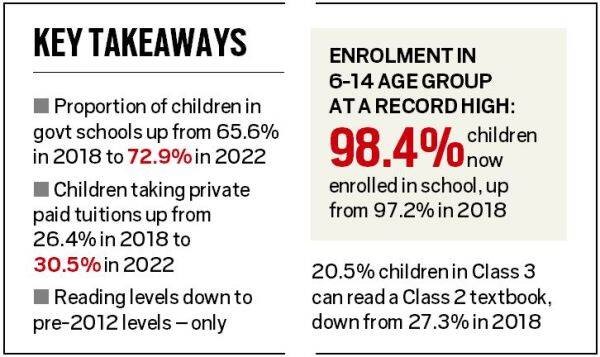
- The 17th Annual Status of Education Report (ASER) 2022 was released by the NGO Pratham after 4 years.
- It is a household survey conducted for children in the age group of 3 to 16 years to record their schooling status and assess their basic reading and arithmetic skills.
- The 17th ASER covered across 616 rural districts and covers 6 .9 lakh children in the age group of 3 to 6 years.
- It records the impact of school closures in 2020 and 2021, as well as the return to school of children in 2022.
What are the initiatives of the government?
- Government schools in most States have become the place of children from vulnerable social groups, where the parents have limited incomes.
- Improving a government school is the most pro-poor activity that any State can undertake.
- Mission Kayakalpa – Uttar Pradesh’s ‘Mission Kayakalpa’ for making schools attractive and an inviting place once again, is a great example to follow.
- Sarva Shiksha Abhiyan – To universalise elementary education
- While a lot has been done to improve the schools on the supply side with Sarva Shiksha Abhiyan, there is a need for rejuvenating and re-imagining learning in schools.
- ASER 2023 confirms that boys and girls of elementary school going age have all come back to schools.
How can impactful outcomes of learning be ensured in schools?
- Local governments – Local governments & women’s collectives should be given the responsibility for elementary schools with funds and functionaries.
- The school should become a community institution rather than be a government entity.
- Training to use gadgets – All teachers should be trained in the use of gadgets and course material that can facilitate learning.
- Every classroom must have a large TV and a good sound system to provide online lessons that supplement what is taught in class.
- Mid-Day-Meal Programme – The Mid-Day Meal responsibility must be handed over to the village level self-help group (SHG) of women.
- Teachers should not have any role in the Mid-Day Meal scheme and they must only teach.
- Public libraries – Libraries should be developed where older children in the village can study and prepare for jobs and admissions to good institutions.
- Infrastructure – Sound boxes, video films, play-way learning items, indoor and outdoor sports, cultural activities for learning on scale, should be used.
- Nutrition – Field functionaries like Aanganwadi Sevikas, Ashas, ANMs and Panchayat Secretaries must all be made responsible for the well-being of children.
- Community Campaigns – There should be community campaigns and regular school level interactions with parents.
- Teachers must build a relationship with every household to ensure children’s care and learning.
- Grants – The Central and State grants be disaggregated gram panchayat-wise and urban local body-wise, to ensure transfer of untied funds to schools, including salary payment.
- The Central/State governments equally share the additional resources needed to rejuvenate the system, given that education is a Concurrent subject 1976 onwards.
What is the way forward?
- Making learning attractive for children is possible today with little effort.
- The Nipun Bharat Mission to ensure oral and written literacy and numeracy, should become a people’s movement like the Total Literacy Campaign.
Reference
- The Hindu Business Line │ Govt schools need urgent fixing



