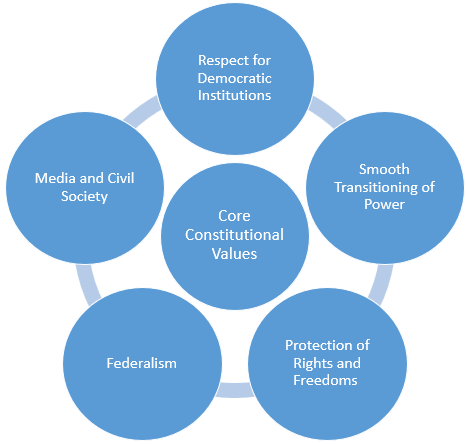
- Lengthiest written constitution – Geographical vastness of country and diversity, Single constitution for both centre and state.
- Fundamental Rights and duties – The Constitution of India guarantees six fundamental rights to its citizens.
- Blend of rigidity and flexibility – It can also be amended to reflect the evolving needs of society to navigate through significant challenges, including internal conflicts, regionalism, and social inequalities.
- Despite these amendments, the core spirit of the Constitution, which champions justice, liberty, equality, and fraternity, remains intact.
- Directive Principles of State Policy – Directives to the government to maintain social and economic democracy in the country.
- Parliamentary System – The constituent assembly decided to continue parliamentary form of government both for the centre and the states as it is well-suited to accommodate India's diverse population,
- Federal system with unitary basis – Our constitution has both unitary and federal features.
- Federal features - Written constitution, supremacy of constitution, rigidity of constitution, independent judiciary, and bicameralism are federal features.
- Unitary features – Strong centre, emergency provision, single citizenship, flexibility of constitution, integrated judiciary, all India services, governor appointment.
- Universal adult franchise - All men and women enjoy an equal right to vote. Each citizen above the age of 18 years has the right to vote.
- Single citizenship – All citizens enjoy a common uniform citizenship.
- Integrated judiciary– The integrated system of court enforces both central as well as state laws.
- Independent judiciary – Provide independence by security pf tenure, expenses charged on consolidated fund of India and separation of judiciary from executive.
- Fundamental duties – Which were inserted by 42nd and 86thconstitutional amendment serves as a remainder to citizen of duties that they have to their country.
- Secularism – Means it doesn’t uphold any particular religion as the official religion of the state.
- Independent bodies – Constitution has setup various independent bodies and are envisaged as bulwarks on Indian constitution.
- Election Commission, CAG, Finance Commission
- Emergency provisions – To safeguard the sovereignty, unity, integrity, and security of the country.
- Three-tier government – 73rd and 74th amendment act provide rural and urban local bodies that ensure grass root level government.
|