Mains: GS II -Issues Relating to Development and Management of Social Sector/Services relating to Health, Education, Human Resources.
Why in news?
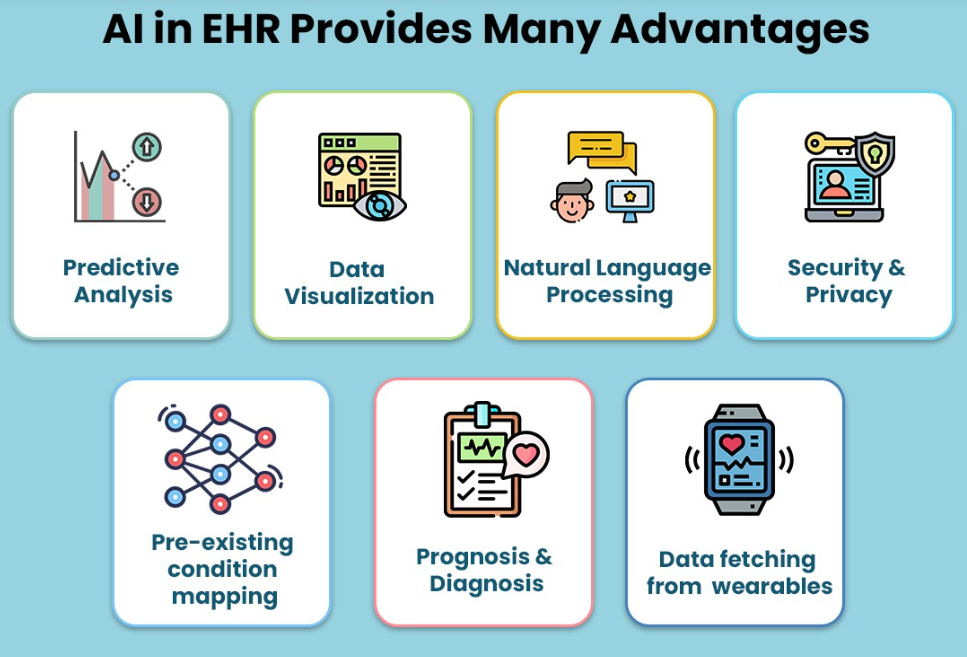
In recent times AI-enabled Electronic Medical Records (AI EMRs) are revolutionizing healthcare by enhancing diagnosis accuracy, improving accessibility, and reducing costs.
What is AI-based EMRs?
- AI EMRs – It is the integration of Artificial Intelligence with digital health records.
- They process patient symptoms, lab reports, and historical data to suggest accurate diagnoses and ideal treatment options.
- It acts as decision-support tools for doctors, nurses, and even patients.
- Advantage – Studies show AI models outperform human doctors in diagnosis accuracy, including complex medical scenarios.
- Optimised diagnosis & treatment – AI factors in every data point—symptoms, tests, reports.
- Unified health records - Consolidates patient data from multiple sources—doctors, labs, hospitals.
- Language inclusivity – It supports multi-language voice transcription during doctor-patient interactions.
- AI assistants interact with patients in native languages to collect medical details.
What is the role of AI-based EMRs in health care delivery?
- Affordable healthcare for the masses – AI EMRs is cost-effective, making quality healthcare accessible even to the poor and underserved.
- It also helps in reducing dependency on expensive specialist consultations.
- Improved healthcare access in rural areas – Rural areas suffer from a lack of qualified doctors and specialists.
- It can guide primary health workers or patients themselves by suggesting diagnoses and treatment options based on available data.
Multi language support ensures even non-English speakers benefit.
- Better diagnosis – AI EMRs processes vast amounts of patient data, lab reports, and medical images to provide highly accurate diagnoses.
- It is beneficial in overburdened public healthcare facilities.
- Unified patient records across the system – Patient health data from different hospitals, labs, and clinics can be consolidated.
- It creates a seamless, lifelong health record that improves continuity of care and it is useful in emergencies or when patients relocate.
- Empowerment of patients – AI EMRs explains complex medical information in simple, local languages.
- Patients can make informed decisions about their health and can question unnecessary treatments or expensive procedures.
- Reducing urban-rural healthcare divide – It reduces dependence on physical proximity to top hospitals or specialists.
- Remote villages can access AI-driven expertise via mobile phones or telehealth platforms integrated with AI EMRs.
- Boost to Digital India & health tech sector – It encourages start-ups, health-tech innovations, and AI development in the healthcare space.
What are the challenges?
- Resistance from medical community – Many doctors see AI EMRs as a threat to their livelihood and professional authority.
- Fear that AI may replace clinical judgement or reduce patient dependence on doctors.
- Data privacy – Handling sensitive health data requires robust data protection mechanisms.
- India still lacks a comprehensive, fully enforced Data Protection Law specific to healthcare.
- Security concerns – Risks of data leaks, misuse, or cyberattacks remain concerned.
- Lack of digital infrastructure – Rural areas often face poor internet connectivity, lack of digital devices, and inadequate tech literacy.
- Fragmented health records – Currently, patient data is scattered across hospitals, clinics, and labs.
- Integrating this into a unified AI EMR system is technically and logistically challenging.
- AI System accuracy – Though AI has high accuracy, it is not 100% error-free.
- Overdependence on AI without human oversight could lead to misdiagnoses or treatment errors.
- Reliability – AI models trained on Western datasets may underperform in Indian medical conditions.
- Legal & ethical concerns – No clear legal and ethical framework governing AI decision-making in healthcare.
- Questions around accountability arises if AI suggests a wrong diagnosis.
- High cost – Initial setup of AI EMR systems can be expensive for small clinics or individual doctors.
- Awareness barriers – Low awareness among the public about AI EMRs limits patient-driven demand.
- Elderly or digitally illiterate patients may struggle to use AI tools.
What lies ahead?
- Introducing as pilot method in premier institutes like AIMS, JIPMER to analyse the effectiveness of AI EMR system.
- Patient driven use of AI EMR/PHR systems in healthcare by increased accuracy in diagnosis and treatment.
- Creating awareness among the doctors to use it as a tool for effective health care delivery.
Reference
The Hindu| AI-based Electronic Medical Records transform healthcare



