Mains: GS II – Effect of Policies and Politics of Developed and Developing Countries on India’s interests
Why in News?
Recently, US president has announced a 25% additional penalty on Indian goods, for continuing to purchase oil from Russia, taking the total baseline tariff to 50%.
What are reciprocal tariffs?
- Definition – It is a tax or trade restriction that one country places on another in response to similar actions taken by that country.
- Implementation – If one country raises tariffs on goods from another, the affected country might respond by imposing its own tariffs on imports from the first country.
- Purpose – This response is meant to protect local businesses, preserve jobs, and fix trade imbalances.
- Impacts – It can lead to a back-and-forth increase in trade barriers, potentially resulting in a trade war that negatively impacts both economies.
- It can disrupt supply chains, raise prices for consumers, and slow down economic growth.
How US imposes reciprocal tariffs?
- Section 232 – It allows the US department of Commerce to investigate and impose additional tariffs if the import of the goods threaten national security.
- Tariffed goods
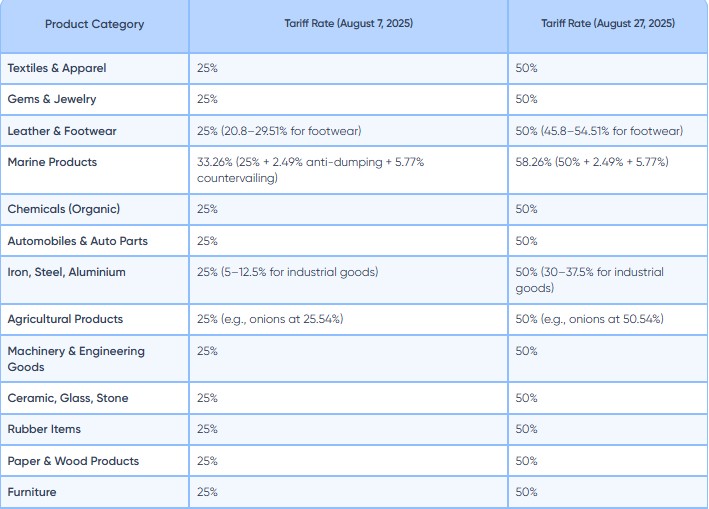
- Exempted items – Pharmaceuticals, Electronics & Semiconductors, Energy Products and Critical Minerals.
- These exempt items account for approximately 30% of India’s exports.
How it will impact India?
- Reduction in exports – Exporters in the textiles, chemicals and gems and jewellery segments will face reduction of 50 to 70% in their exports to the US.
- All the tariffed goods from India will be extremely expensive in US.
- Decreases consumers for Indian goods – With India’s competitors such as Vietnam, Indonesia, Malaysia and Philippines facing reciprocal tariffs of less than 20%, Indian goods are going to find fewer takers in the US market.
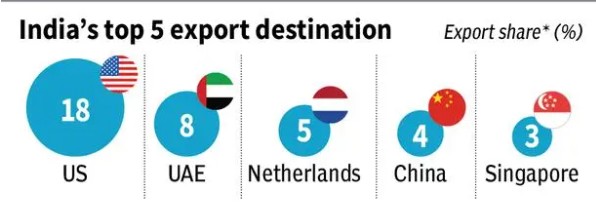
- Makes exports expensive – The 50% tariff can reduce overall Indian exports to the US by 40 to 50 %.
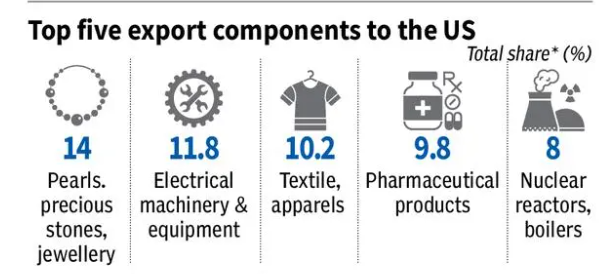
- Sectoral impacts – The following sectors are going to face severe impacts
|
Sector
|
Total Share in Exports in 2025
|
|
Textiles and apparels
|
37%
|
|
Chemicals
|
15%
|
|
Electrical machinery
|
32%
|
|
Jewellery
|
30%
|
|
Average Share in Exports for the last 3 Years
|
- Downfall of stock market - The stocks like Gokaldas textiles, Kitex, Camlin, Aarti industries, Atul, Bharat forge, Suprajit Engineering, Sona BLW etc will see a sharp reduction in revenue and profitability.
- Reduction in external demand – There will be weakening of external demand for the companies due to the ongoing chaos, which can diminish the outlook for all companies.
- Diminishes GDP – Exports to the US accounting for approximately 2.2 % of our GDP in 2025, per commerce ministry data.
- A 50% reduction in the US exports can lead to a decline of at least 30 to 40 basis points in our GDP for FY26.
What lies ahead?
- India could look for ways to help the affected exporters through subsidies or other schemes.
- Reduction of crude oil imports from Russia could be an option too, given that $87 billion of exports is at stake.
Reference
Business Line| US Tariff and its Effect on India



