0.1275
7667766266
x

Reciprocal tariffs of USA

iasparliament Logo
April 05, 2025

Mains (GS II) – Effect of policies and politics of developed and developing countries on India’s interests

Why in news?

Recently, US President Donald Trump celebrated America’s Liberation Day on April 2 by announcing reciprocal tariffs against all major trading partners.
What are the tariffs announced by Trump?

  • Reciprocal tariff – It is a tax or trade restriction that one country places on another in response to similar actions taken by that country.
  • If one country raises tariffs on goods from another, the affected country might respond by imposing its own tariffs on imports from the first country.
  • USA discounted reciprocal tariffs – In the context of USA it is termed as USA discounted reciprocal tariffs.
  • USA calculates Reciprocal tariff by estimating the tariff each country charges on American imports and then halving that amount.
  • There were two sets of tariffs announced,
  • Base tariff
  • Country-specific tariff
  • Base tariff – It is 10% on all imports and it is common for all countries that is imposing tariffs on US goods.
  • This base rate of tariffs will go into effect on April 5.
  • Country-specific tariff – It is specific for each country and is calculated by estimating tariffs each country charges on US goods.
  • It also took account on factors such as currency manipulation, lax pollution and labor laws and harsh regulations that create difficulties for the US in global markets.
  • These country specific tariffs will be enforced from April 9 onwards.
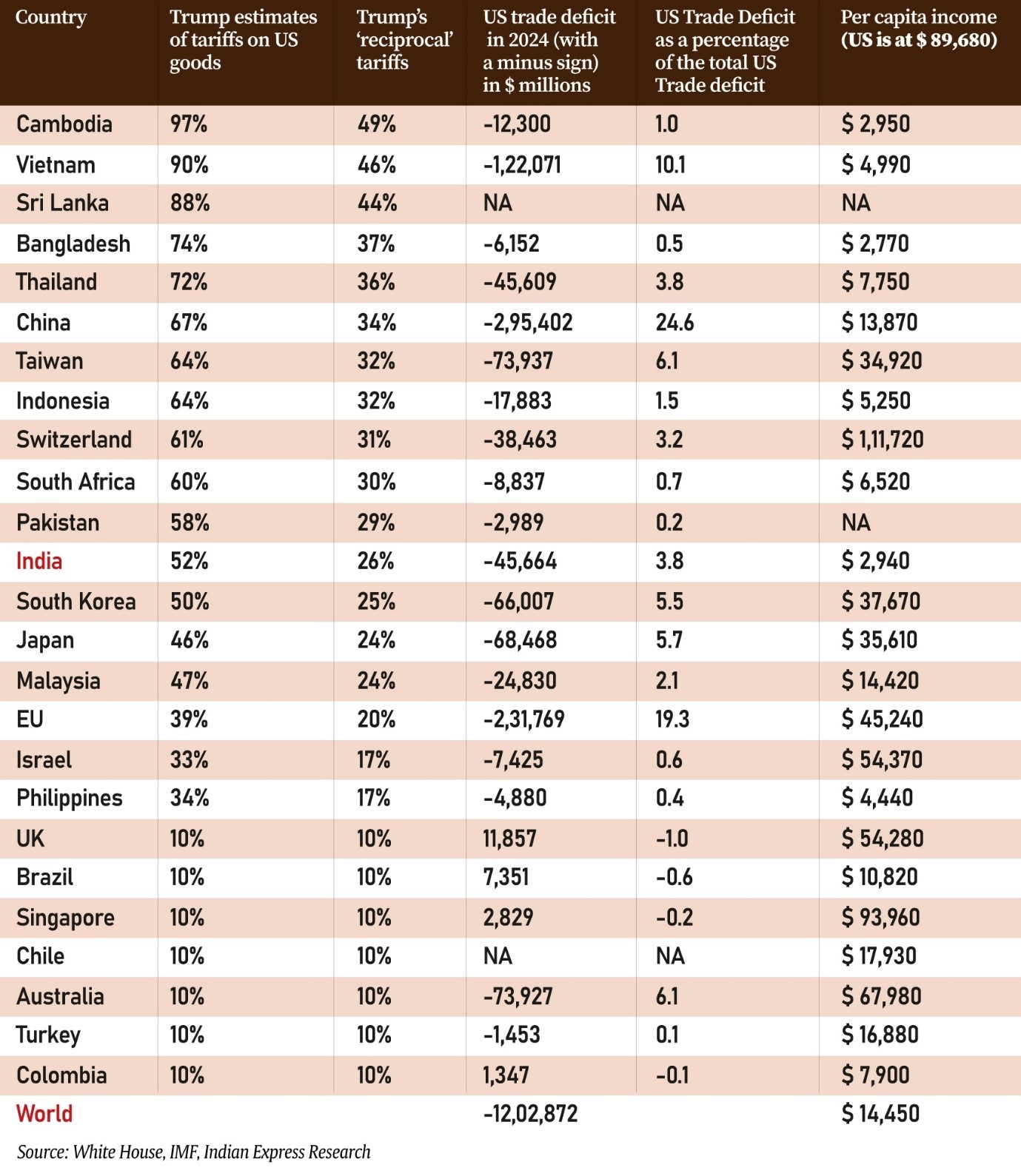
  • Tariff structure on India – According to US trade department, India imposes a 52% tariff on U.S. imports, and in response, the U.S. has levied a reciprocal tariff of 26% on Indian goods.

1

Why is USA imposing such tariffs?

  • Addressing trade deficit – The tariffs aim to address a $1.2 trillion trade deficit and revive local manufacturing in the US.

Trade deficit is the gap between the value of a countries imports and exports.

  • Reduce reliance on foreign goods – It is believed that tariffs will incentivize companies to relocate production domestically.
  • Economic benefits and debt reduction – The revenue generated by tariffs is expected to help reduce taxes and pay down the national debt, strengthening the U.S. economy.
  • Attracting investment – It is estimated that tariffs will lead to $6 trillion in investments in USA.
  • Bringing back manufacturing and jobs – By making foreign goods costlier, the policy aims to encourage both domestic and foreign companies to invest in U.S.-based manufacturing.

What are the impacts of the tariff for India?

Positive Impacts

  • Relative advantage – India could remain competitive in the U.S. market as competitors like China (34%), Vietnam (46%), Taiwan, and Thailand (36%) face higher tariffs than India (26%).
    • It could potentially boost India’s export share.
  • Boost in textile exports – India may gain a comparative advantage over Vietnam, Bangladesh and China to access the American textile market.
    • US accounts for 20% of Bangladesh's total ready-made garment exports.
  • Trade balance flexibility – India’s low electronics imports from the U.S. provide room to adjust tariffs strategically, helping maintain trade balance.
  • Relaxation to pharma – The US Administration has exempted pharmaceuticals from reciprocal tariffs, highlighting the significance of affordable, life-saving generic drugs.
    • India exports USD 8.7 billion pharma products to US annually.

Negative Impacts

  • Challenges to exports – India’s exports will face difficulties US is India’s 2nd largest trading partner in FY24.
    • U.S. accounts for 18% of India’s total goods exports.
  • Increased price - Increased tariffs will increase the price of Indian goods in America.
  • Decline in export - This may result in decline of import of Indian goods in USA.
  • And the country's exports to the US could fall by 2-3 % points in the current fiscal, according to some experts.
  • Domestic industry pressure – The decline in export to USA could disrupt domestic industries and reduce the profit margins.
  • Economic slowdown – According to some experts, the reciprocal tariff could shave off India's GDP growth rate by up to 50 basis points to 6 % and.
  • Financial impact – If India’s export to US declines, it will affect the repatriation of US dollars to India.
  • This may in turn prevent the strengthening of Indian rupee against US dollar and weaken it.

What are the consequences of tariffs for U.S.A and global economy?

  • Slow down in global growth – The speed and scale of these tariff hikes could further slow global growth, create market uncertainty, and pressure businesses worldwide.
  • Higher inflation – Tariffs imposed on goods will be passed on to end user which raises the goods price resulting in inflation.
  • Inflation can be avoided only if the dollar strengthens significantly (e.g., by 26% against the rupee, from 85 to 108), keeping import prices stable for U.S. consumers.
  • Disrupts trade flows – Tariffs will increase the costs for importers in US which affects exporters globally, forcing them to either absorb losses or pass costs to U.S. consumers.
    • It will further reduce demand and alter trade volumes.
  • Stagflation and recession in U.S – A combination of faltering growth and spiking inflation could lead to stagflation.
  • Reduced demand combined with costlier imports, could shrink GDP further, and may lead to recession in US.

Stagflation — stagnant growth with persistent high prices (inflation).

  • Supply chain reconfiguration – Exporting countries may seek alternative markets which will disrupt established supply chains.
  • Risk of retaliation – Countries might retaliate back on US which will create an escalatory spiral that could further complicate global trade environment.

What lies ahead?

  • The ongoing Bilateral trade agreement negotiations, provides a platform to address tariff concerns, potentially securing exemptions or reductions by offering U.S. market access in areas like agriculture or services.
  • Tariff war needs to be avoided to prevent mutual economic harm as it would be self-defeating and will impose clear costs on both India and the U.S.
  • India could de-escalate tensions and foster better trade relations by diplomatic negotiations.

References

  1. The Indian Express| Trump’s reciprocal tariffs — impact on India
  2. The Indian Express| Trump announces 26% reciprocal tariffs on India
  3. The Indian Express | The silver linings for India Reciprocal tariffs
There are no reviews yet. Be the first one to review.

ARCHIVES

sidetext

