Why in News?
Recently World Economic Forum has released Global Risk Report 2024.
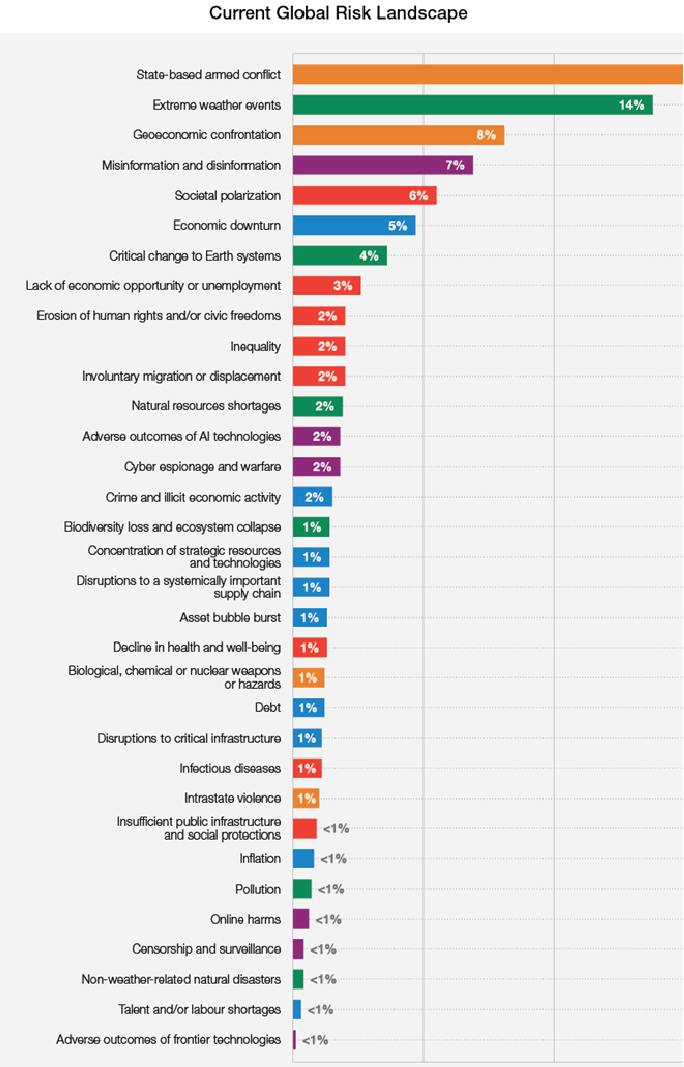
What are the current global risks ?
- Declining optimism - The global outlook is increasingly fractured across geopolitical, environmental, societal, economic and technological domains.
- Geopolitical tensions - State-based armed conflict, now ranked as the #1 current risk by 23% of respondents ,was overlooked as a leading two-year risk two years ago.
- National security considerations are starting to dominate government agendas.
- Geopolitical recession - Dangers of unilateralism taking hold in national security considerations and the worsening humanitarian impacts of the ongoing conflicts.
- Destabilizing consequences following Russia’s invasion of Ukraine, as well as in the Middle East and in Sudan are amplifying the global risks.
- Supercharged economic tensions - The rise in the two-year ranking of Geoeconomic confrontation, from #14 last year to #9 today reflects unease about the path ahead for global economic relations.
- Misinformation and disinformation - False or misleading content is complicating the geopolitical environment, affecting voter intentions.
- It can sow doubt among the general public worldwide about what is happening in conflict zones
- It can be used to tarnish the image of products or services from another country.
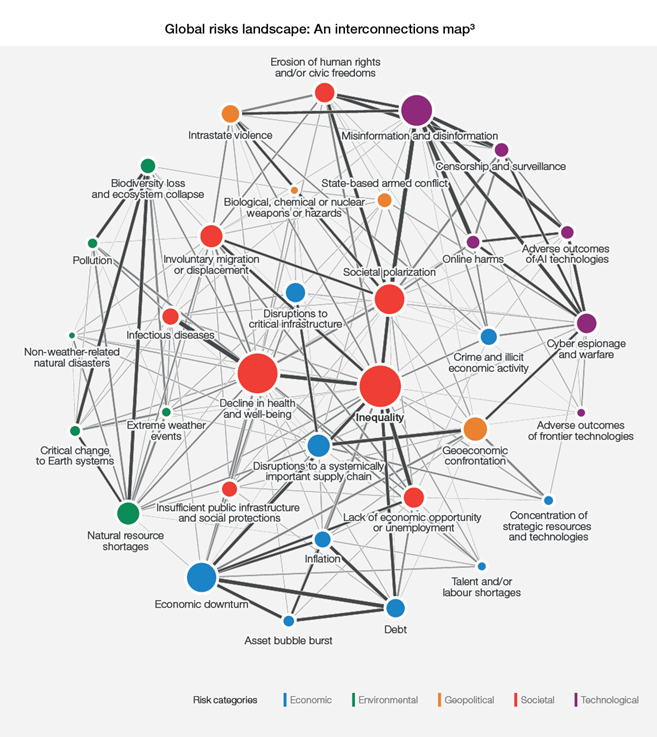
- Societal fragmentation - Inequality in wealth and income is perceived as the most central risk of all, playing a significant role in both triggering and being influenced by other risks.
- It is contributing to weakening trust and diminishing our collective sense of shared values.
- Other societal risks - Societal polarization, Involuntary migration or displacement and Erosion of human rights and/ or civic freedoms.
- Economic downturn and Inflation - Impacts of the cost- of-living crisis since 2022 contributed to Inequality becoming the top interconnected risk this year.
- Super-ageing societies - Unfavourable demographic trends in Japan, South Korea, Italy or Germany will cause pensions crises and labour shortages in the long-term care sector.
- Environmental risks - Extreme weather events, biodiversity loss and ecosystem collapse, pollution are expected to become even more of a concern than they already are.
- Technological risks - The role of Generative AI (GenAI) in producing false or misleading content at scale and the consequent societal polarization.
- Biotech challenges - Intrastate violence from biological terrorism and adverse outcomes of frontier technologies involving accidental or malicious misuse of gene editing technologies, or even of brain-computer interfaces.
What can be done to manage the risks?
- Strengthen the existing structures to tackle the challenges collectively confronting us.
- Leaders across the public and private sectors, civil society, international organizations and academia must seize the baton to work openly and constructively with each other.
- Deepening honest dialogue and act to mitigate the risks to rebuild trust and create stronger, more resilient economies and societies.
- Expand the role of regional organizations in managing tensions like African Union.
- Diversify supply chains to increase it’s resilience.
- Foster multilateralism to address geoeconomic confrontations.
- Develop strategic regional or bilateral ties with countries that offer complementarity in terms of sectoral strengths, natural resource endowments and skill.
- Strengthen the domestic economy, such as financial sector development or investment in education, health and infrastructure.
Reference
WEF | Global Risk Report 2025



