Prelims: Current events of national and international importance| Science and Technology
Why in News?
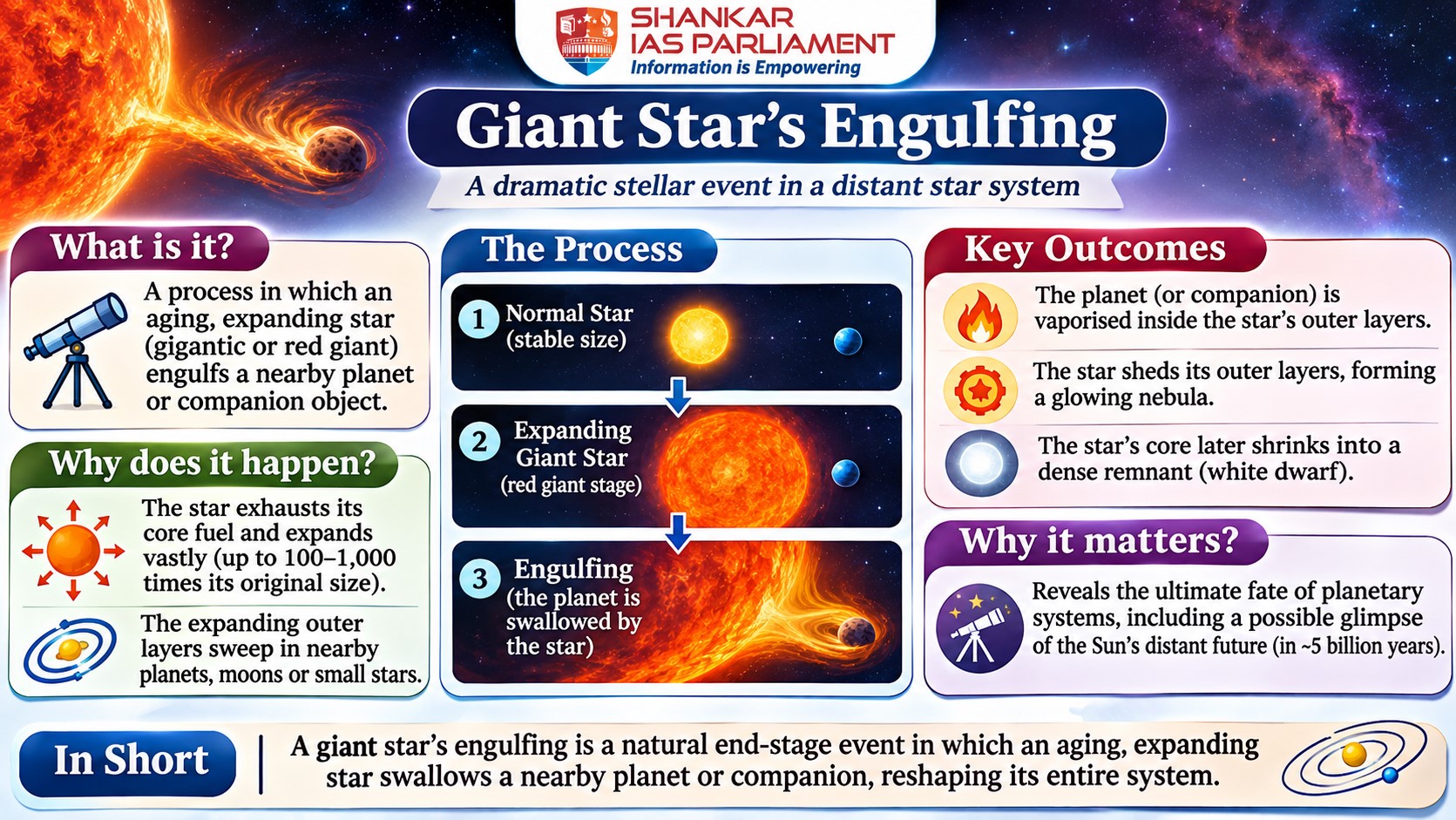
Astronomers have directly observed a giant star engulfing its smaller companion for the first time in a binary system designated AT 2025abao (nicknamed "Bao") in the Andromeda galaxy, about 2.5 million light-years away.
How the Engulfment Unfolded?
- The Stars– The primary star was a puffy supergiant roughly 7 times the mass of the Sun, 350 times wider, and 18,000 times brighter.
- Its companion star was about 0.7 times the mass of the Sun.
- Slow Inward Spiral (from ~2018)– The smaller star entered the giant's loosely bound outer layers and began spiraling inward due to orbital drag and friction, causing gradual brightening and dust production.
- Major Eruption (October 2025)– A powerful outburst spiked the system's brightness to roughly a million times that of the Sun and expelled about 0.1 to 0.2 solar masses of material.
- Webb Follow-Up (December 2025) – NASA's James Webb Space Telescope observed the system 47 days after the peak eruption, helping researchers reconstruct the interaction and aftermath.
Why It Matters?
- Unlike previously observed mergers of compact stars, puffy supergiants can either merge into a single "rejuvenated" star or eject their outer envelope to leave behind a tight binary.
- Tracking AT 2025abao gives astrophysicists direct data on how common-envelope interactions shape close binary systems and stellar lifespans.
Reference
Science Daily| Giant Star’s engulfing



