0.2504
7667766266
x

Frog-Inspired Humidity-Responsive Brain Sensor

iasparliament Logo
April 10, 2026

Prelims - Current events of national and international importance | Science & Technology

Why in News?

Researchers at the Jawaharlal Nehru Centre for Advanced Scientific Research (JNCASR), Bengaluru, have developed a frog-inspired neuromorphic sensor that responds to humidity and light.

Key Features -

  • It is a type of advanced electronic device designed to mimic the way a biological brain processes information (Biological Mimicry).
  • Technology Type – Neuromorphic sensor.
  • Biological Inspiration – Cricket frogs, whose synaptic behaviour is highly sensitive to moisture and daylight.
  • Material Base – One-dimensional supramolecular nanofibers.

Supramolecular nanofibers are one-dimensional nanostructures formed through the self-assembly of small molecules or polymers.
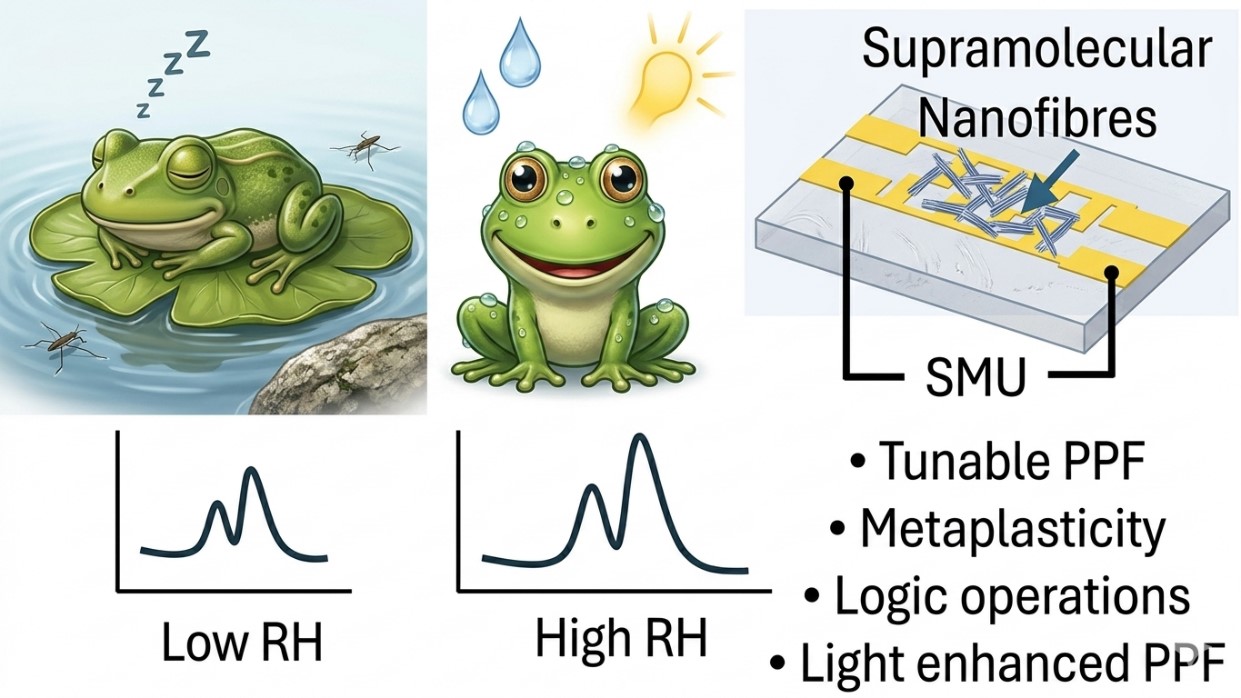
  • Primary Stimulus – Humidity (first neuromorphic device to use moisture as main trigger).
  • Secondary Stimulus – Light (modulates sensitivity).
  • Functions – Sensing, memory storage, and signal processing simultaneously.
  • Synaptic Functions Replicated – Facilitation, depression, meta-plasticity, and basic logic operations.
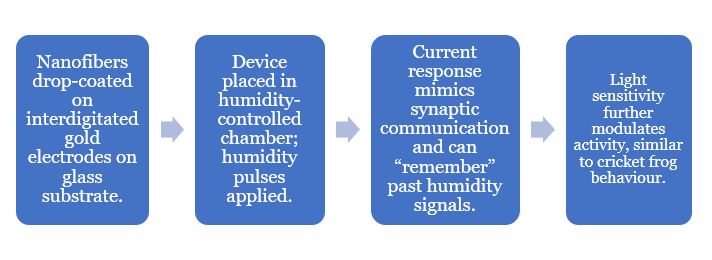
  • Procedure –Frog-Inspired Humidity-Responsive Brain Sensor

Frog-Inspired Humidity-Responsive Brain Sensor - 1

  • Conventional vs Frog-Inspired Sensor –

Aspect

Von Neumann Bottleneck (Conventional Systems)

Frog-Inspired Neuromorphic Sensor

Data Handling

Separate units for sensing, memory, and processing requires constant data transfer.

Integrates sensing, memory, and processing in a single platform.

Energy Use

High energy consumption due to repeated transfer between CPU, memory, and sensor.

Low energy use by computing at the source (edge computing).

Response Mode

Always-on, continuous operation drains battery.

Event-driven response fires only when stimulus detected.

Efficiency

Slower, less efficient due to transfer delays.

Brain-like efficiency simultaneous sensing, storage, and processing.

Biological Analogy

Mechanical separation of functions unlike natural systems.

Mimics frog synapses adaptive, moisture/light-sensitive behaviour.

  • Significance - Smart Environmental Monitoring - Adaptive sensors for humidity/climate changes.
  • Healthcare Devices - Wearables that sense sweat/breathing with ultra-low power.
  • AI (Artificial Intelligence) and IoT (Internet of Things) - Supports sustainable edge computing, reducing reliance on power-hungry server farms.
  • Global First - First neuromorphic device using humidity as primary stimulus.

Reference

PIB | Neuromorphic Sensor

Login or Register to Post Comments
There are no reviews yet. Be the first one to review.

ARCHIVES

MONTH/YEARWISE ARCHIVES

sidetext
Free UPSC Interview Guidance Programme
sidetext