0.2928
7667766266
x

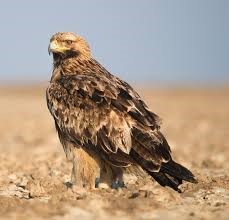
Eastern Imperial Eagle  

iasparliament Logo
December 31, 2025

Prelims: Current events of national and international importance | Species

Why in News?

Wildlife enthusiasts have recently confirmed the presence of an Eastern Imperial Eagle visiting the Mudumalai Tiger Reserve (MTR) in Tamil Nadu during the winter migratory season.
  • Scientific name – Aquila heliacal.
  • Family – Accipitridae.
  • It is a large, powerful bird of prey found across Eurasia, known for its majestic appearance and historical reverence as a "sacred bird" or "cross-bearing eagle.
  • Habitat – They prefer forests with tall isolated trees for nesting, also found in steppes, open landscapes, agricultural areas, semideserts and wetlands (especially in winter).
  • Geographic Range – They are native to southern Europe, central Asia, and Siberia. In winter, they migrate to northeast Africa (Egypt–Kenya), India, and southeast China.
  • Size – It can grow to a length of about 0.92 m, and it can have a wingspan approaching 2.14 m and have a mass of about 3.6 kg.
  • Appearance – Similar to Golden Eagle but with a shorter tail and white shoulders that can be hard to spot.
  • The underwings are dark with low contrast.
  • Adults are dark brown with a golden crown/nape and white scapular “braces.”
  • Juveniles are paler, streaked, and often confused with other spotted eagles, but larger and more robust.

Eastern Imperial Eagle

  • Physical Adaptations – They have strong legs and feet with long, curved talons that they use to seize, kill, and carry prey.
  • Reproduction – They begin breeding at around four years of age, forming lifelong monogamous pairs.
  • Lifespan – Up to 56 years in the wild and captivity.
  • Behaviour – They are mostly solitary, migrate in loose flocks, travel 8,000 km, and fly with heavy wingbeats but are swift when hunting.
  • Diet – They are carnivorous, their prey includes small mammals (rabbits, ground squirrels), reptiles (including snakes), birds (ducks, magpies) and occasionally carrion (dead lambs).
  • Conservation Status
    • IUCN Red List - Vulnerable
    • CITES - Appendix I
    • Wild Life (Protection) Act, 1972 - Schedule I
  • Threats – Habitat loss, hunting, disturbance, reduced food availability, poison ingestion, and electrocution from power lines.

References

  1. The Hindu | Rare Imperial Eagle spotted in Mudumalai Tiger Reserve
  2. Animal Diversity Web | Eastern Imperial Eagle  


Login or Register to Post Comments
There are no reviews yet. Be the first one to review.

ARCHIVES

MONTH/YEARWISE ARCHIVES

sidetext
Free UPSC Interview Guidance Programme
sidetext