Mains: GS-II – Polity & Governance
Why in News?
Alongside support from the Government of India, state governments also provide financial assistance—such as grants and subsidies—to cooperatives through their own schemes, in line with state-specific rules and regulations.
What are Cooperatives?
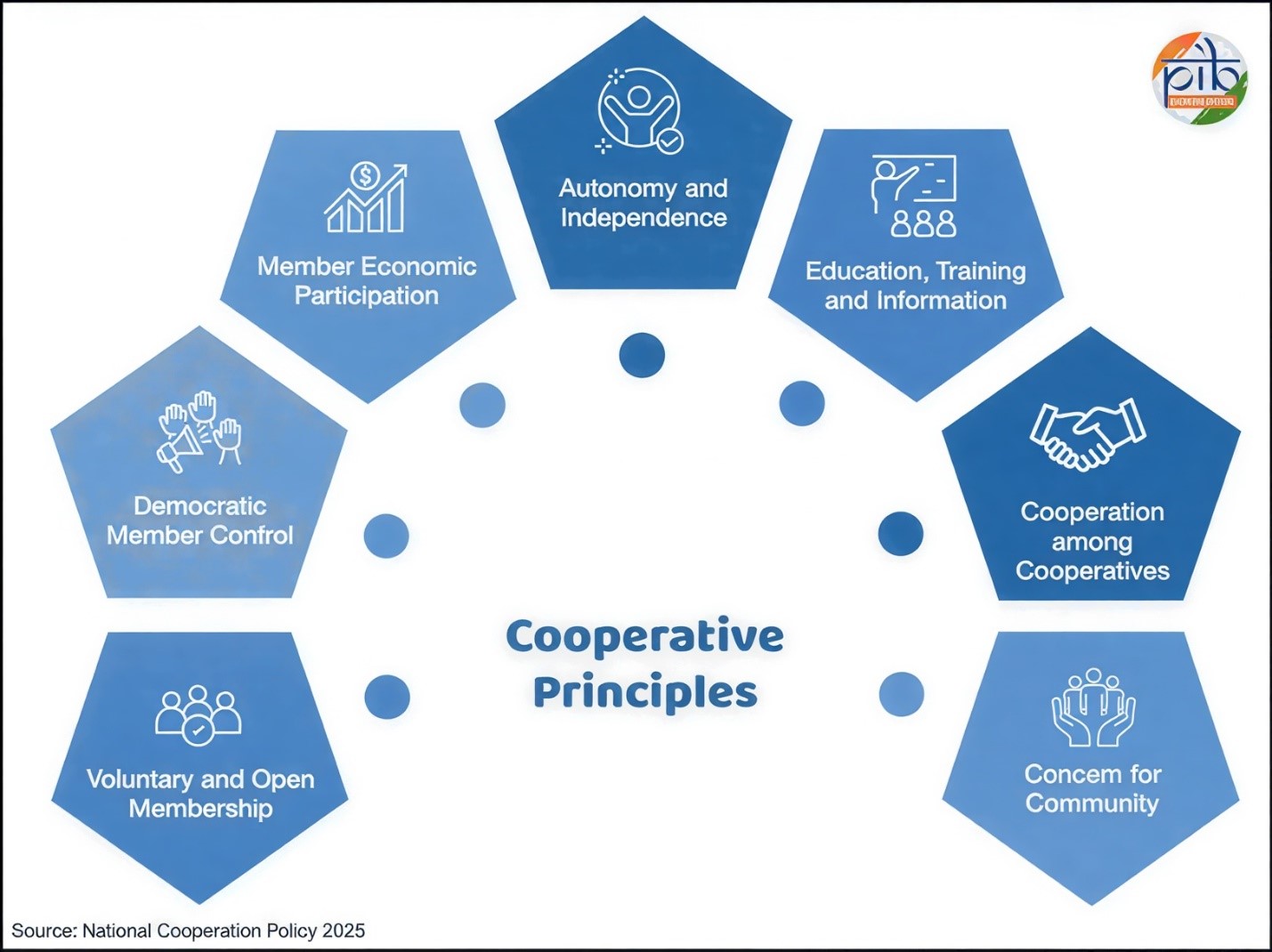
- Cooperative – It is an autonomous association of persons, united voluntarily to meet their common economic, social, and cultural needs and aspirations through a jointly owned and democratically member-controlled enterprise.
- Principle – Founded on principles of self-help & mutual assistance,
- Aim – To serve the interests of disadvantaged sections of society rather than to generate profits.
- Coverage – They plays a major role in India’s economy, with 98% coverage in rural India, cooperatives are the mainstay of rural economy ensuring sustainable livelihoods and income for people.
- Diverse Sectors – Cooperative societies in India operate across various sectors such as Agriculture, Credit and Banking, Housing, and Women’s Welfare.
Cooperatives is a State subject under the Constitution of India.
 What is the historical evolution of cooperatives in India?
- Pre-Independence Era
- 1904: Cooperative Credit Societies Act – first legal framework.
- 1912: Expanded scope to marketing and artisan societies.
- 1914: Maclagan Committee proposed a 3-tier cooperative banking system.
- 1925: Bombay Cooperative Society Act – provincial legislation.
- 1942: Multi-Unit Cooperative Societies Act for cross-province cooperatives.
- Post-Independence Era
- Cooperatives integrated into Five-Year Plans for rural development.
- 1963: National Cooperative Development Corporation (NCDC) established.
- 1982: NABARD created to support rural credit.
- 1984: Multi-State Cooperative Organisations Act streamlined governance.
- 2002: National Policy on Cooperatives harmonized legal frameworks.
- 2023: MSCS Amendment Act strengthened transparency and governance.
- 2025: National Cooperation Policy
What are the constitutional & legal framework for cooperative societies in India?
- Seventh schedule
- Entry 44 of the List I - Union List for objects not confined to one State.
- Entry 32 of the List II - State List for objects confined to one State.
- Fundamental Rights – Article 19(1)(c) deals with the right to form cooperative societies.
- Directive Principles of State Policy – Article 43B mentions about state policy for promotion of cooperatives.
- Part IX B – Introduced Articles 243ZH to 243ZT for incorporation, regulation, and winding up of cooperatives.
Article 19(1) (c), Article 43B, part IX B were added in Constitution by 97th constitutional amendment act, 2011.
- Cooperative Societies Act, 1912 – The first comprehensive law for cooperative societies in India.
- State Cooperatives – Societies operating within one state are regulated by state-specific Cooperative Societies Acts, overseen by State Registrars.
- Multi-State Cooperatives – Societies operating in more than one state are governed by the Multi-State Co-operative Societies Act, 2002, overseen by the Central Registrar.
- Cooperative Banks – While registered under state or central laws, they are regulated by the RBI under the Banking Regulation Act, 1949, with supervision from NABARD.
- Nodal Ministry – The central Ministry of Cooperation, established in 2021, provides policy oversight.
What is the Structure of Cooperatives in India?
Credit vs Non-Credit Cooperatives
- Cooperative Credit Society – It provides financial assistance to members by accepting deposits and granting loans at reasonable interest rates.
- Examples include Village Service Cooperative Society and Urban Cooperative Banks.
- Non-Credit Cooperatives – It provides goods/services like farming inputs, housing, etc. Examples includes
- Consumers’ Cooperative Society - Formed to provide consumer goods at reasonable prices, eliminating middlemen by purchasing directly from producers. Eg. Kendriya Bhandar & Apna Bazar.
- Producers’ Cooperative Society - Supports small producers by providing necessary production items such as raw materials and equipment. Eg. APPCO & Haryana Handloom.
- Cooperative Marketing Society - Assists small producers in marketing their products by collectively selling on their behalf. Eg. Gujarat Cooperative Milk Marketing Federation (AMUL).
- Cooperative Farming Society - Small farmers form these societies to gain benefits of large-scale farming. Eg. Lift-irrigation cooperatives & pani-panchayats.
- Housing Cooperative Society - Offers affordable residential options by purchasing and developing land for members. Eg. Employees’ Housing Societies and Metropolitan Housing Cooperative Society.
What are the significance of Cooperatives in India?
- Scale & Reach – India is home to over 8.44 lakh cooperatives, including 2 lakh credit cooperatives & 6 lakh non-credit cooperatives across housing, dairy, fisheries, and more.
India has more than one-fourth of the world's cooperatives.
- Housing cooperatives – Approximately, 1.92 lakh societies, expanding in both rural and urban areas.
- AMUL – The benchmark success story, inspiring replication across sectors.
- Grain Storage Plan – India aiming for the world’s largest cooperative grain storage infrastructure, with warehouses at PACS and society level.
- "Sahkar se Samriddhi" (Prosperity through Cooperation) Model – The government is fostering these institutions to turn small, disjointed farmers into empowered economic units through modernized, digitally enhanced cooperatives (like the focus on enhancing 100,000 PACS).
- Empowerment of Women & Small Producers – Cooperatives allow small producers to combine resources, enhancing bargaining power.
- They act as a key to empowering women through local, self-reliant economic organizations.
What are the challenges faced by cooperatives in India?
- Governance issues – Lack of professional expertise leads to inefficiency, weak financial oversight, and occasional fraud or corruption.
- Political Interference – Excessive state control in elections and decision‑making undermines autonomy and democratic functioning.
- Financial Limitations – Rural cooperatives often suffer from inadequate capital and restricted access to funds, limiting growth and diversification.
- Member Participation & Awareness – Low awareness of cooperative benefits results in poor participation and weak representation of marginalized groups.
- Infrastructure & Technology Gaps – The outdated facilities and slow adoption of modern technology reduce efficiency and outreach.
- Regulatory & Legal Complexities – The Urban cooperative banks face dual regulation (Registrar & RBI), while constitutional debates around the 97th Amendment create uncertainty over Union vs. State powers.
- Financial Distress – Having high levels of NPAs in urban cooperative banks erode trust and threaten long‑term sustainability.
What are the recent initiatives taken by the government to improve the cooperatives in India?
- National Cooperative policy, 2025 – Recently formulated by the Government, which marks a strategic roadmap for revitalizing India’s cooperative sector to meet the nation’s goal of becoming “Viksit” by 2047.
- UN International Year of Cooperatives – The year 2025 was declared as the International Year of Cooperatives.
- Union Budget 2025–26 – Ministry of Cooperation has allocated with Rs.1,186.29 crore, to emphasis on digitization, training, institutional support.
- MSCS Amendment Act, 2023 – To strengthen governance, enhance transparency, increase accountability and reform electoral process, etc. in the Multi State Cooperative Societies.
- Tax benefits to cooperative societies – Benefit from reduced surcharge rates and concessional tax regimes, enhancing cooperative’s income and supporting rural and farming communities.
- Digital & Infrastructure Initiatives
- Computerization of PACS - Over 15,000 societies onboarded (aims to computerize 63,000 PACS).
- PACS as Common Service Centers (CSCs) – An MoU with MeitY and NABARD enables 30,647 PACS to offer 300+ e-services to rural citizens.
- Diversification – PACS running petrol/diesel outlets, PM Jan Aushadhi Kendras, and PMKSK fertilizer services.
What lies ahead?
- Revitalizing cooperatives demands a comprehensive strategy that strengthens both their operational capacity and structural framework.
- Such an approach aligns with the goals of inclusive development and has the potential to uplift marginalized communities in India, echoing Gandhian ideals of self‑reliance and self‑governance.
- Building a large and robust cooperative ecosystem can firmly establish the belief that cooperation can be a vital instrument for the country’s development for future generations.
- The role of the cooperative sector can be strengthened in achieving the goal of 'Viksit Bharat 2047.
References
- PIB | Grants To Cooperative Institutions
- PIB | National Cooperation Policy 2025



