Prelims: Current events of national and international importance | Health
Why in News?
A new artificial intelligence (AI) framework that identifies 3 distinct developmental states of cancer stem-like cells can help identify hidden cancer stem cells from thousands of patient samples.
- Cancer stem-like cells – These are a small and specialised population of cells within tumours.
- They possess stem-cell-like properties, including the ability to self-renew and generate different tumour cell types.
- They can contribute to
- Tumour recurrence
- Metastasis
- Therapy resistance
- Tumour progression
- Treatment failure
- Their rarity and ability to change their cellular identity make them difficult to detect using conventional approaches.
- ACSCeND - ACSCeND stands for AI-based Cancer Stem-like Cell Profiler and Neoplasm Deconvoluter.
- It is an AI-based framework designed to identify and quantify different cancer stem-like cell states within tumours.
- Key Features - Unlike conventional methods that assign a tumour a single “stemness” score, ACSCeND identifies three distinct CSC developmental states.
|
CSC State
|
Key Feature
|
|
Pluripotent-like CSCs
|
Highest developmental potential
|
|
Multipotent-like CSCs
|
Intermediate developmental potential
|
|
Unipotent-like CSCs
|
More restricted developmental potential
|
- Working - Single-cell RNA sequencing → Stemness-state learning → Deep learning → Bulk tumour RNA sequencing → CSC-state deconvolution → Clinical prediction
- It learns cellular characteristics from high-resolution single-cell RNA sequencing.
- It combines this information with deep learning.
- It can then analyse conventional bulk tumour RNA sequencing data.
- This allows researchers to estimate hidden CSC populations even in large patient datasets where single-cell sequencing is unavailable.
- Deconvolution - Deconvolution refers to computationally separating or estimating the different cell populations present within a mixed bulk tumour sample.
- Role of OncoMark - OncoMark was an earlier AI platform developed by the researchers.
- It was designed to identify biological hallmarks associated with cancer progression from large genomic datasets.
- It demonstrated the ability of AI to uncover complex biological patterns that are difficult to detect manually.
- ACSCeND builds upon this AI-based approach to specifically investigate cancer stem-like cells.
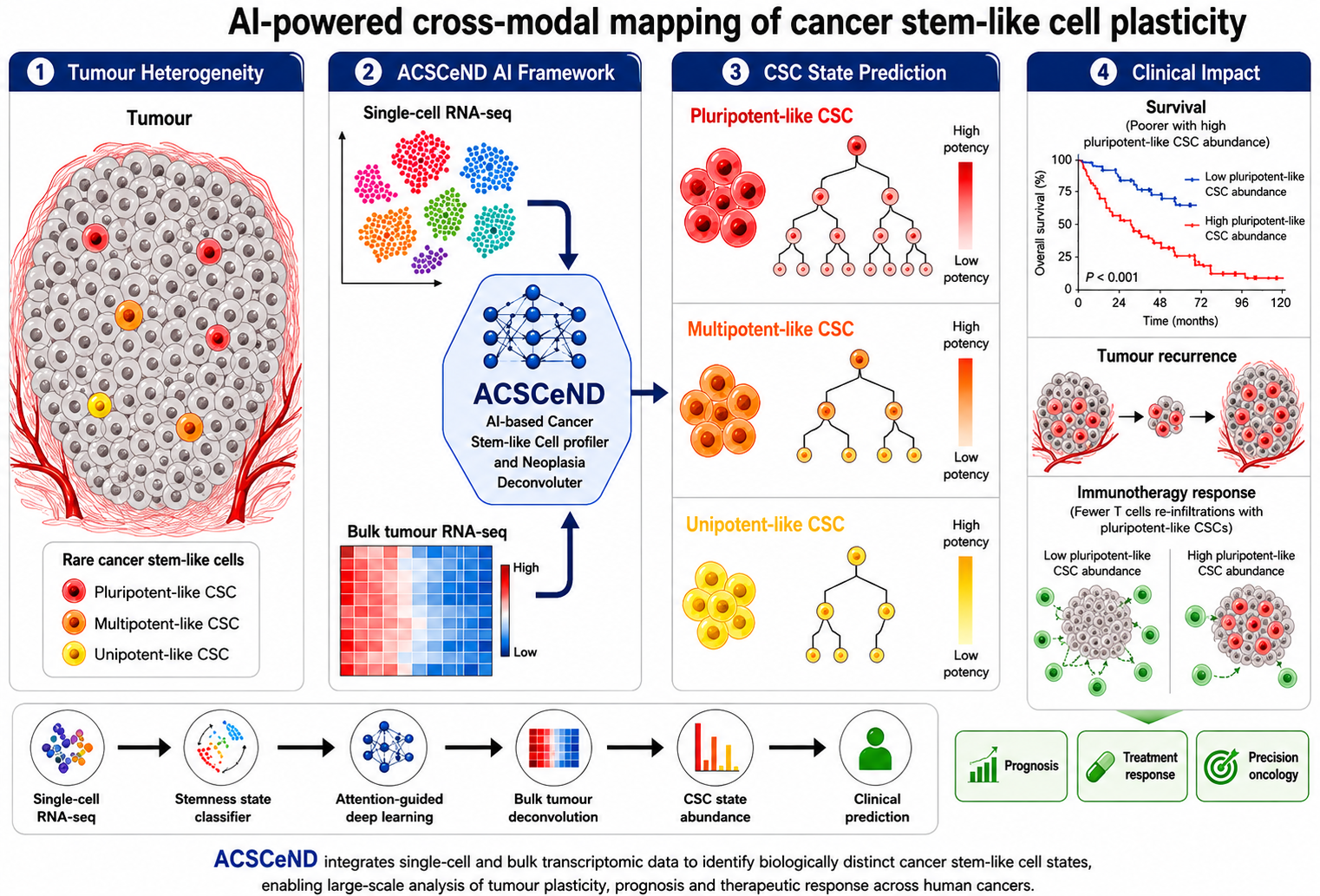
- Findings of the study - Researchers applied ACSCeND to more than 25,000 tumour samples from major international cancer databases, including:
- TCGA – The Cancer Genome Atlas
- PRECOG
- The analysis found that tumours with a higher abundance of highly potent, pluripotent-like CSCs were associated with:
- Poorer patient survival
- Higher probability of tumour recurrence
- Reduced response to immunotherapy
- The framework also identified molecular programmes that may help CSCs survive, adapt and evade the immune system.
Reference
DST | AI uncovers hidden cancer stem cells



