Prelims: Current events of national and international importance | Science & Technology
Why in News?
Recently, the European Organization for Nuclear Research (CERN) and French artificial intelligence leader Mistral AI signed a landmark statement of intent to establish a long-term strategic partnership.
- Aim - To develop advanced AI foundation models specifically tailored for scientific discovery, starting with high-energy physics.
Core Objectives
- Developing the Large Physics Model
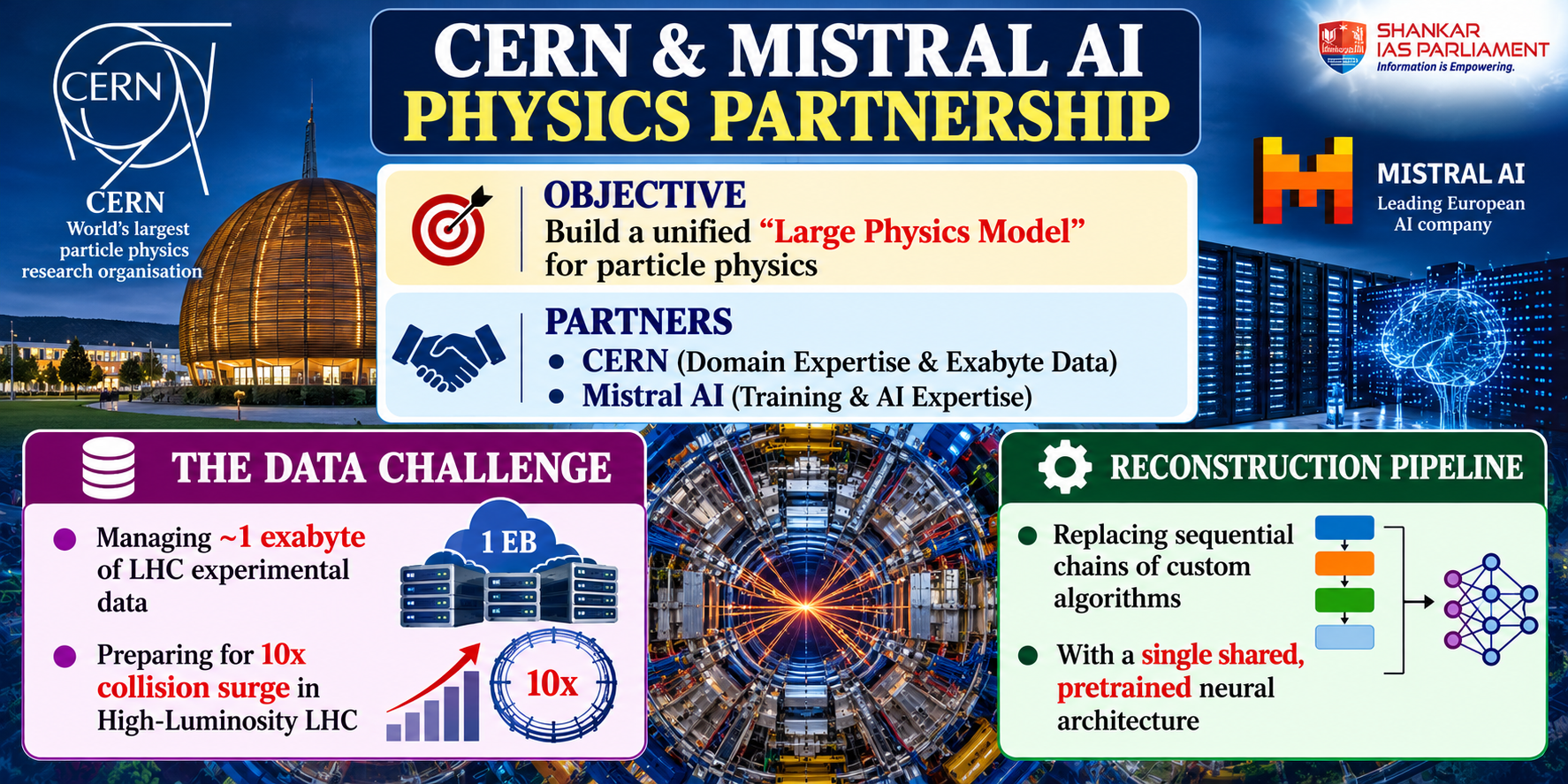
- The partnership focuses on building a unified Large Physics Model trained on billions of simulated proton-proton collisions generated at the Large Hadron Collider (LHC).
- Instead of relying on isolated, sequential chains of specialized algorithms to interpret detector traces, the model aims to learn across the entire collision reconstruction and particle identification chain simultaneously.
- Managing Exascale Data Loads
- CERN currently houses approximately one exabyte (one million terabytes) of experimental collision data.
- With the upcoming transition to the High-Luminosity LHC (HL-LHC) scheduled around 2030, particle collision rates are projected to increase tenfold, creating massive computational bottlenecks that demand next-generation AI processing efficiencies.
Strategic Significance
- Combines CERN's unmatched expertise in fundamental physics and large-scale computing infrastructure with Mistral's proficiency in frontier model training.
- The initiative aims to enhance precision measurements of known physical laws and scale up searches for unknown phenomena under extreme data workloads.
Reference
The Hindu | AI foundation models for physics



