Mains: GSII – International Issues
Why in News?
Recently, the U.S. President Donald Trump has signed into law the Lindsey O. Graham Sanctioning Russia and Iran Act, 2026, which could see tariffs of up to 100% being levied on imports from India if it continues to import oil from Russia.
What is the Background and Objectives of the Act?
- Objectives –
- To cut Russia’s war financing – Target Russia’s financial resources through sanctions on its leadership and major energy customers.
- To include Iran – The Act has been expanded to cover Iran, with sanctions extended until 2031.
- Increase economic pressure – To target countries maintaining significant energy ties with Russia.
- Conditions for Imposing 100% Tariffs – The Act allows the U.S. to impose a 100% tariff, after 30 days, on countries that:
- Were among the 5 largest importers of Russian crude oil or natural gas in the preceding 12 months and continue such imports; or
- Were among the five largest facilitators of Russian oil sanctions evasion.
- India: It is particularly exposed under the first criterion due to its large-scale imports of Russian crude oil.
- Tariffs in Addition to Existing Duties
- The 100% tariff would be additional to existing U.S. duties, including:
- Section 301, Trade Act, 1974: Addresses unfair trade practices.
- Section 232, Trade Expansion Act, 1962: Allows import restrictions on national-security grounds.
- Cumulative tariff burden – It could reduce the competitiveness of Indian expo rts in the U.S. market and adversely affect India’s export growth.
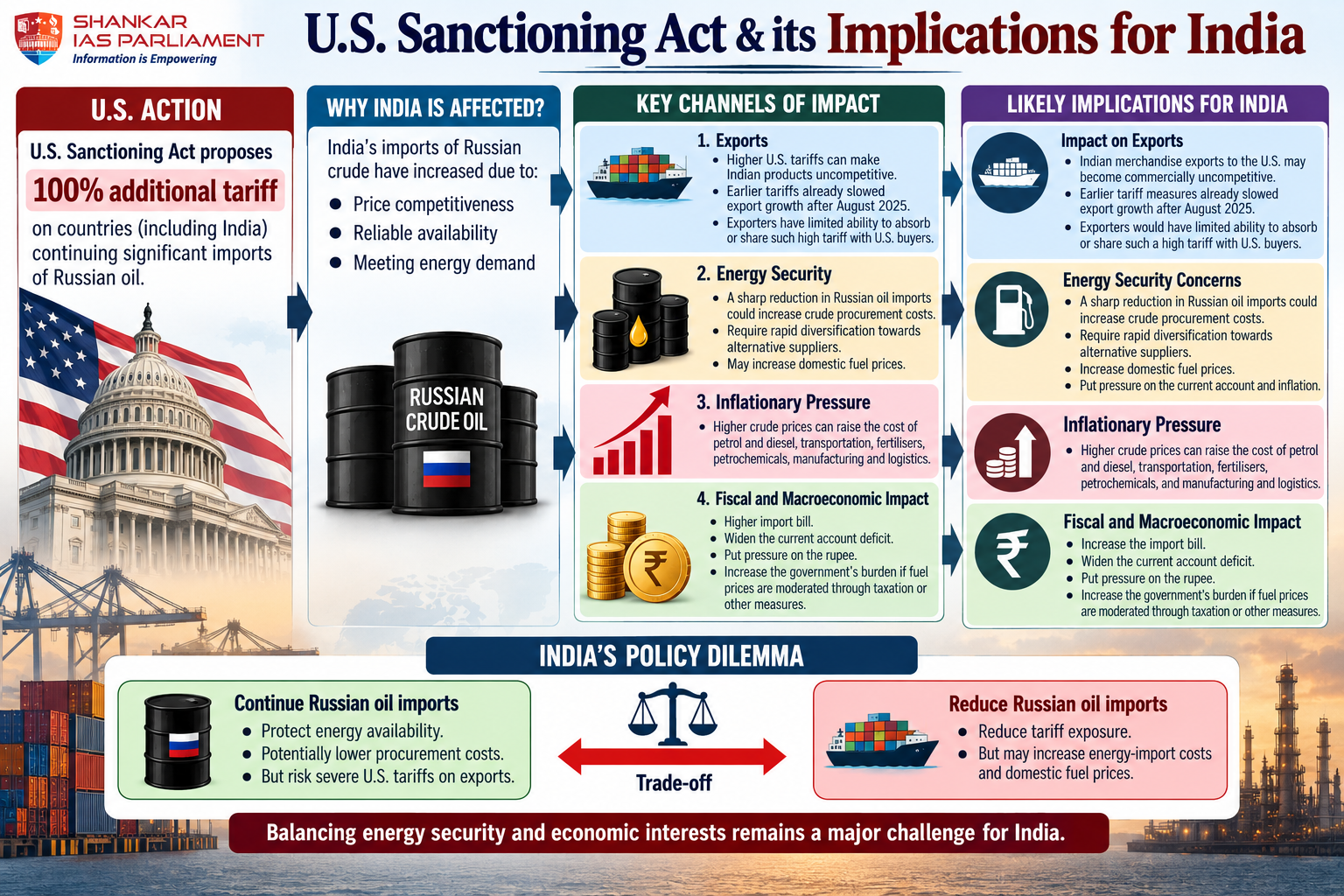
What are its implications on India?
- Impact on Exports – The U.S. is a major destination for Indian merchandise exports. A 100% additional tariff could make several Indian products commercially uncompetitive.
- Earlier tariff measures already slowed export growth after August 2025.
- Exporters would have limited ability to absorb or share such a high tariff with U.S. buyers.
- Energy Security Concerns – India's dependence on Russian crude has increased because of its price competitiveness and availability.
- A sharp reduction in Russian oil imports could:
- Increase India's crude procurement costs.
- Require rapid diversification towards alternative suppliers.
- Increase domestic fuel prices.
- Put pressure on the current account and inflation.
- Inflationary Pressure – Higher crude prices can raise the cost of:
- Petrol and diesel
- Transportation
- Fertilisers and petrochemicals
- Manufacturing and logistics
- Fiscal and Macroeconomic Impact – Higher energy costs could:
- Increase the import bill.
- Widen the current account deficit.
- Put pressure on the rupee.
- Increase the government's burden if fuel prices are moderated through taxation or other measures.
- India's Policy Dilemma – India faces a difficult trade-off:
- Continue Russian oil imports - protect energy availability and potentially lower procurement costs, but risk severe U.S. tariffs on exports.
-
- Reduce Russian oil imports - reduce tariff exposure, but potentially increase India's energy-import costs and domestic fuel prices.
What could be done?
- Diversify crude suppliers across the Middle East, Africa and other regions.
- Negotiate with the U.S. for tariff exemptions or a waiver.
- Strengthen diplomatic engagement with Russia and other energy partners.
- Expand strategic petroleum reserves to manage external supply shocks.
- Accelerate renewable energy, electric mobility and energy-efficiency measures.
- Support exporters through market diversification and trade agreements.
- Maintain compliance with applicable international sanctions while protecting India's legitimate energy interests.
|
Provision for Tariff Waiver
|
- The Act provides a possible waiver mechanism. The U.S. President can waive the tariffs after submitting to Congress:
- A written certification that the waiver is in the national interest of the U.S., and A report explaining the basis for the decision.
- Another possible route is a peace agreement accepted by the Ukrainian government, accompanied by an end to Russian military hostilities.
|
What lies ahead?
- The Act places India at the intersection of geopolitics, energy security and international trade.
- While continued Russian oil purchases may expose Indian exports to severe tariff pressure, a sudden reduction in Russian supplies could increase India's energy costs.
- India therefore needs strategy combining energy-source diversification, diplomatic negotiations, export-market diversification towards cleaner domestic energy.
Reference
The Hindu| U.S. Sanctioning Act & its Implications for India



