0.1357
7667766266
x

National Animal Disease Control Programme (NADCP)

iasparliament Logo
August 24, 2026

Mains: GS II – Health

Why in News?

The NADCP has been successful in eradicating the diseases and improving the health of the livestock.
What is the background?

  • Importance of livestock – Livestock is a crucial pillar of India’s rural economy, providing income, nutrition, employment and livelihood security to millions of farmers.
  • Livestock population ion India – According to the 20th Livestock Census (2019), India had 535.78 million livestock, including 302.79 million bovines.
  • Concerns – Diseases such as Foot and Mouth Disease (FMD) and Brucellosis have historically imposed substantial economic losses through reduced milk yield, impaired reproduction, lower animal productivity and restrictions on trade.

What is the NADCP?

  • NADCP – The Government launched the National Animal Disease Control Programme (NADCP) in September 2019.
  • ObjectiveTo control and eventually eradicate FMD and Brucellosis through mass vaccination, surveillance, digital monitoring and strengthened veterinary infrastructure.
  • It has evolved into one of India’s largest livestock-health interventions and an important component of the broader One Health and pandemic-preparedness framework.
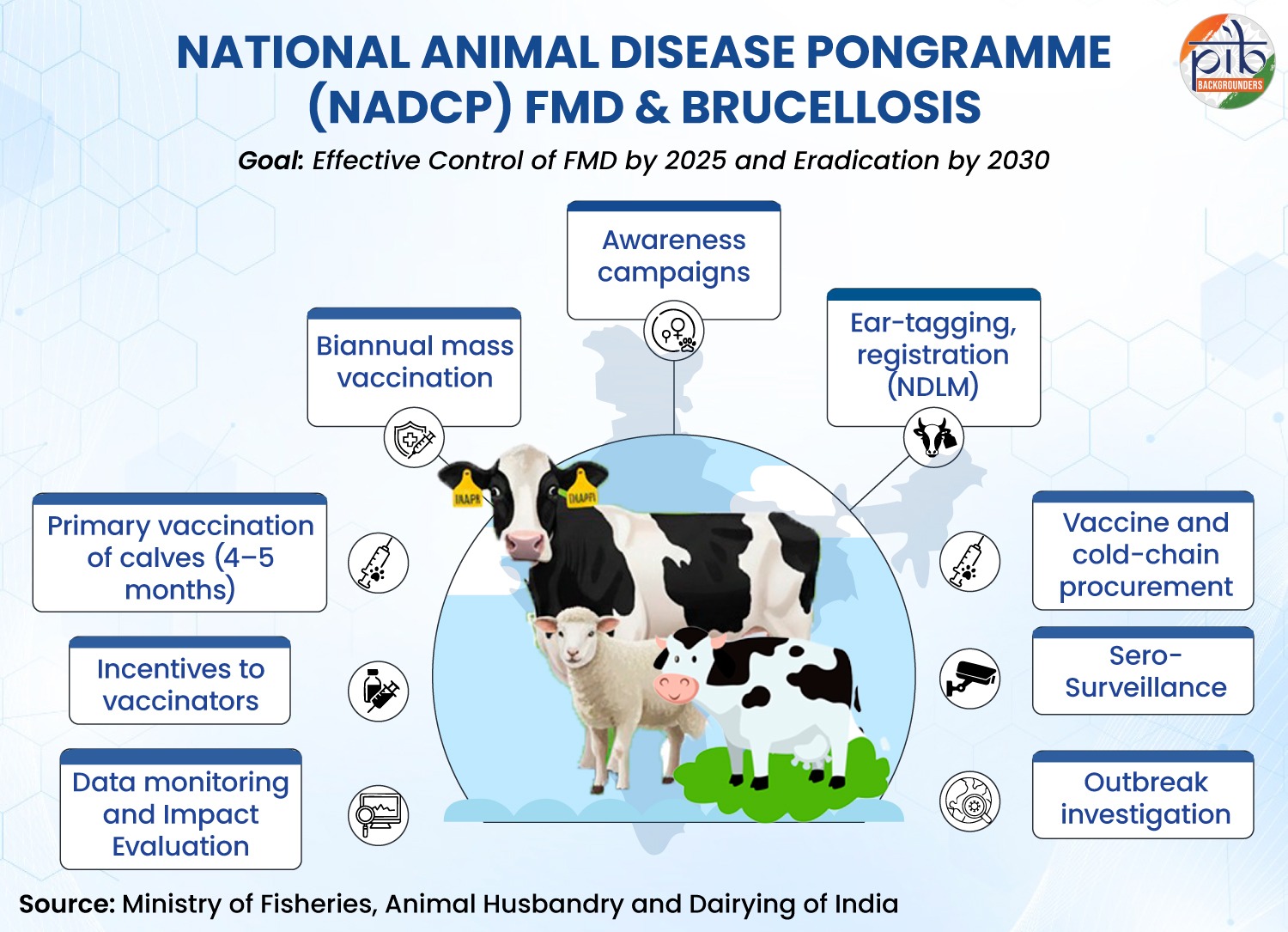
  • Design of NADCPThe programme follows a nationwide vaccination and surveillance strategy:
    • FMD – 100% vaccination of eligible susceptible livestock twice a year, with vaccination at six-month intervals.
    • Brucellosis – One-time vaccination of female bovine calves aged 4–8 months during their lifetime.
  • Disease surveillance through sero-surveillance and sero-monitoring.
  • Procurement of vaccines and strengthening of cold-chain infrastructure.
  • Outbreak investigation, virus isolation and typing.
  • Regulation of animal movement through quarantine and check-posts.
  • Ear-tagging and registration of animals on the Bharat Pashudhan Portal.
  • Public awareness and training of field officials.
  • Remuneration to vaccinators, with a minimum of ₹3 per vaccination dose.
  • Since 2024, FMD vaccination has also been extended to pastoral sheep and goats in Haryana, Himachal Pradesh, Uttarakhand, Jammu & Kashmir and Ladakh to reduce transmission along migratory routes.

NADCP

What are the major achievements?

  • FMD Control – The scale of the campaign is reflected in 147.16 crore cumulative FMD vaccine doses, benefiting 8.04 crore farmers.
  • The programme has substantially improved herd immunity.
  • Post-vaccination sero-monitoring shows average protective immunity of:
    • 78.1% for FMD serotype O
    • 71.7% for serotype A
    • 77.6% for serotype Asia1
  • Correspondingly, reported FMD outbreaks declined from 132 in 2019 to 40 in 2025.
  • Importantly, there has been no reported FMD outbreak caused by serotype Asia1 for the last three years.
  • The NSP antibody prevalence, an indicator of virus circulation and exposure, declined from 20.8% in 2019 to 8.1% in 2025.
  • This provides evidence of reduced viral circulation alongside strengthened population immunity.
  • Progress in Brucellosis ControlBrucellosis is a bacterial reproductive disease caused in bovines primarily by Brucella abortus.
  • It can cause infertility, reproductive failure and reduced milk and meat production.
  • Since there is no curative treatment for bovines, vaccination is central to sustainable control.
  • Under NADCP, female bovine calves aged 4–8 months receive a one-time lifetime vaccination.
  • In 2025, post-vaccination monitoring recorded seroconversion rates of:
    • 75.63% in cattle calves
    • 67.17% in buffalo calves
  • Reported Brucellosis outbreaks declined from 22 in 2019 to 15 in 2025, indicating progress in disease control.
  • Digitalisation and Last-Mile Veterinary ServicesA major strength of NADCP is the integration of animal-health interventions with digital technology.
  • The Bharat Pashudhan Portal provides each registered animal with a unique 12-digit Tag ID and integrates livestock registration with FMD and Brucellosis vaccination data.
  • By July 2026, more than 39.00 crore livestock had been registered on the portal.
  • This enables real-time monitoring, vaccination traceability, improved animal identification and evidence-based planning.
  • Last-mile healthcare has also been strengthened through 4,019 Mobile Veterinary Units (MVUs) operating across 29 States and Union Territories.
  • Through the toll-free 1962 service, these units have provided doorstep veterinary services to 136 lakh farmers and treated 276 lakh animals.
  • In addition, 39,810 Multi-Purpose Artificial Insemination Technicians in Rural India (MAITRIs) have been trained with financial support, strengthening rural veterinary and breeding services.
  • Livestock Productivity and Milk ProductionDisease control is closely linked with improved livestock productivity.
  • Indigenous and non-descript cattle productivity increased from 927 kg per animal per year in 2014–15 to 1,343.2 kg in 2024–25, a rise of 44.89%.
  • Buffalo productivity increased from 1,880 kg to 2,365.2 kg per animal per year, representing a 25.80% increase.
  • Overall average bovine productivity rose from 1,640 kg to 2,250 kg per animal per year between 2014–15 and 2024–25, an increase of 36.63%.
  • India’s milk production also increased from 146.31 million tonnes in 2014–15 to 247.87 million tonnes in 2024–25, registering a 69.4% increase over the decade.
  • The government aims to raise average milk productivity further to 3,000 kg per animal per year by 2030.
  • Institutional and Financial Support – NADCP is supported by ICAR institutions through research on vaccines, quality testing, surveillance, sero-surveillance, disease modelling and state-wise sampling.
  • States and Union Territories receive assistance for vaccines, vaccination accessories and cold-chain infrastructure.
  • Under the revised Livestock Health and Disease Control Programme (LHDCP), NADCP, the Livestock Health and Disease Control (LH&DC) component and Pashu Aushadhi have been brought under a single umbrella framework.
  • The Animal Husbandry Infrastructure Development Fund also facilitates private-sector participation in veterinary vaccine and drug manufacturing.
  • One Health and Pandemic Preparedness – The One Health approach recognises the interconnectedness of human, animal and environmental health.
  • Better animal disease surveillance can reduce zoonotic risks, promote antimicrobial stewardship and strengthen preparedness for emerging infectious diseases.
  • The National One Health Mission, approved by the Prime Minister’s Science, Technology and Innovation Advisory Council (PM-STIAC) in its 21st meeting on 7 July 2022, seeks to coordinate and integrate One Health activities across ministries.

The 2024 Pandemic Fund Project on “Animal Health Security Strengthening in India for Pandemic Preparedness and Response”, supported by the G20 Pandemic Fund with US$25 million, is being implemented in partnership with the Asian Development Bank (ADB), FAO and World Bank.

  • It strengthens genomic and environmental surveillance, laboratory capacity and cross-border cooperation.
  • The Standard Veterinary Treatment Guidelines (SVTG) promote scientific treatment, rational medicine use and antimicrobial stewardship, while the Crisis Management Plan (CMP) for Animal Diseases provides a framework for rapid outbreak response and recovery.

What could be done further?

  • India’s progress under NADCP demonstrates that mass vaccination, surveillance and digital traceability can substantially reduce livestock disease burden.
  • However, sustained efforts are required to achieve progressive alignment with international standards for FMD freedom.
  • Future priorities should include:
    • Expansion of laboratory accreditation and genomic surveillance.
    • Greater use of AI-enabled disease intelligence and real-time dashboards.
    • Climate-resilient surveillance systems.
    • Stronger biosecurity and regulation of animal movement.
    • Wider farmer awareness and community participation.
    • Deeper coordination under the One Health framework.
    • Continued investment in vaccine research, cold chains and last-mile veterinary services.

What lies ahead?

  • Healthier livestock means higher productivity, stronger rural livelihoods, improved food and nutritional security, greater trade potential and reduced zoonotic risk.
  • By integrating vaccination, digital traceability, veterinary infrastructure, scientific surveillance and One Health principles, NADCP is laying the foundation for a healthier, more productive and globally competitive livestock sector, contributing to the broader vision of Viksit Bharat 2047.

Reference

PIB| NADCP


Login or Register to Post Comments
There are no reviews yet. Be the first one to review.

ARCHIVES

sidetext

