Why in News?
Oct 2, 2024 marks the 10th year anniversary of the launch of Swachh Bharat Mission.
What is Swachh Bharat Mission (SBM)?
- SBM – It is largest behavioural change movement in the world, aiming to end open defecation through awareness campaigns, education, and infrastructure development.
- Launched in – October 2, 2014.
- SBM Phase I Period – 2014 to 2019.
- Aim - To create a Clean India by 2019.
- Address the issue of WASH (Water, Sanitation, and Health)
- Eliminating open defecation
- Improving unsanitary toilets
- Eradicating manual scavenging
- Enhancing solid waste management
- Promoting behavioural change regarding sanitation
- Components - The mission will cover all rural and urban areas.
- SBM Gramin (SBM G) - Implemented by Ministry of Drinking Water and Sanitation.
- SBM Urban (SBM U) - Implemented by Ministry of Housing and Urban Affairs
- Implementation Responsibility - Entire project is governed and monitored by state agencies.
- Unique Approach – SBM combines toilet construction with substantial investments in IEC (Information, Education, and Communication) and community engagement.
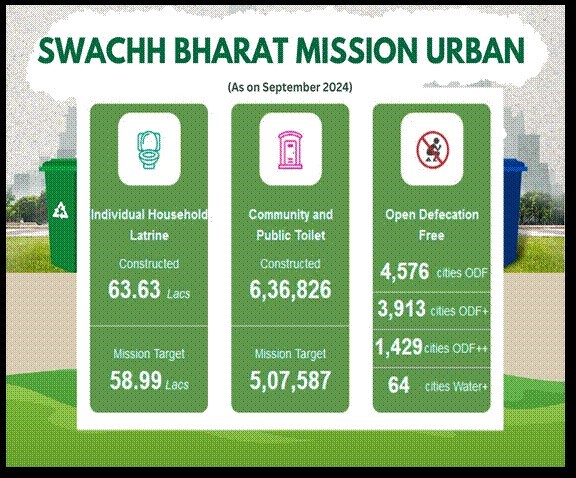
- Individual Household Latrine (IHHL) Scheme- It provides financial assistance to eligible households to build toilets.
- Community-Led Total Sanitation (CLTS)- It emphasizing community participation and behavioural change by mobilizing communities to collectively take action to end open defecation.
- IEC Campaign - The mission places a strong emphasis on IEC activities to create awareness about the importance of sanitation, hygiene practices, and the usage of toilets.
- Swachh Bharat Mission Phase II (2019-2025)
- SBM Urban 2.0 launched on October 1, 2021 to achieve Garbage Free Status for all cities.
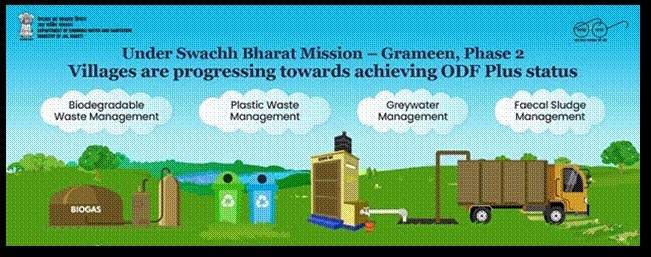
- SBM Gramin 2.0 was launched to transform all the villages from ODF to ODF Plus Model.
What are the achievements of SBM?
- ODF Free - Government declared India “Open Defecation Free” in 2019.
- Increased Toilet Construction - More than 12 crore toilets have been built since the launch of the Swachh Bharat Mission (SBM) 10 years ago.
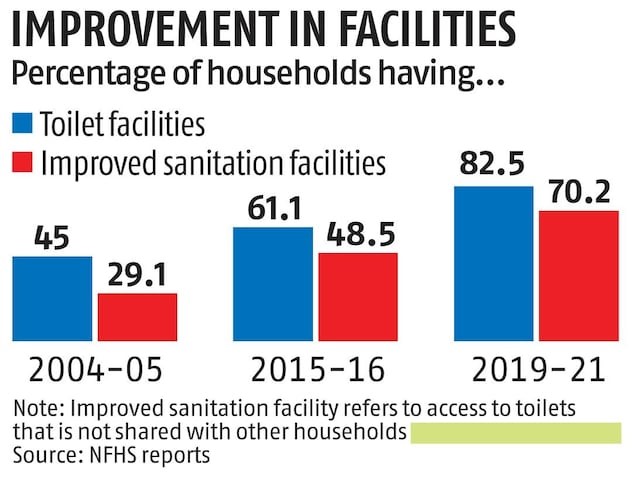
- Increased Toilet Access - Over 82% households had toilet access in 2019-21 up from 45 % in 2004-05.
- ODF Plus Villages - Currently, 93 % of villages have achieved the ODF Plus status.
- Waste Management - 78 % of the waste have been processed.
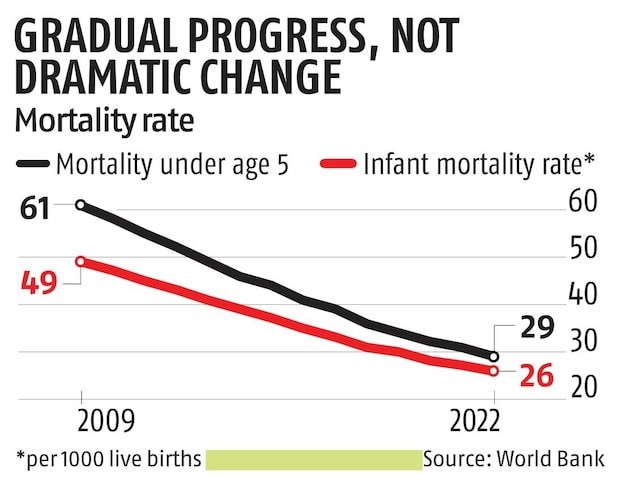
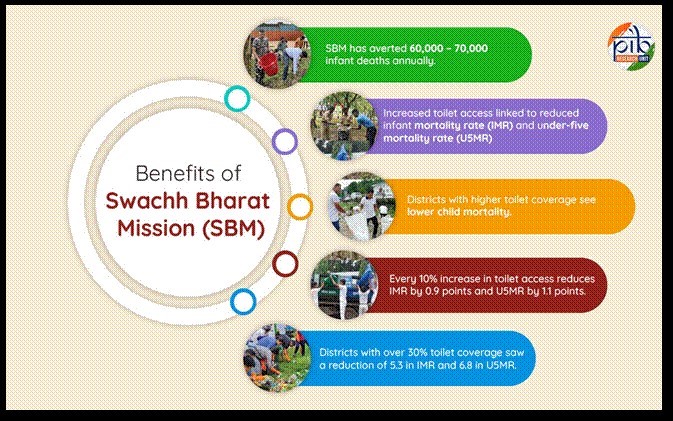
- Reduced Mortality - Improvements in sanitation facilities have led significant reductions in infant and child mortality rates.
- Districts with over 30 % toilet coverage under SBM experienced reductions of 5.3 in the Infant Mortality Rate (IMR) and 6.8 in the Under-5 Mortality Rate (U5MR) per thousand live births.
- Public Movement – The efforts of Sanitation workers, religious leaders, athletes, celebrities, and Non-Governmental Organisations and the general public have transformed the SBM into a huge public movement.
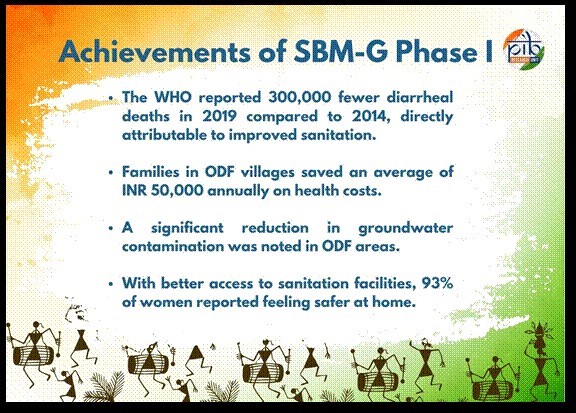
- Environmental Improvement – Significant reduction in ground water contamination and improvement in landscape are observed in open defecation areas.
- Women Safety - With better access to sanitation facilities, 93% of women reported feeling safer at home.
What are the issues?
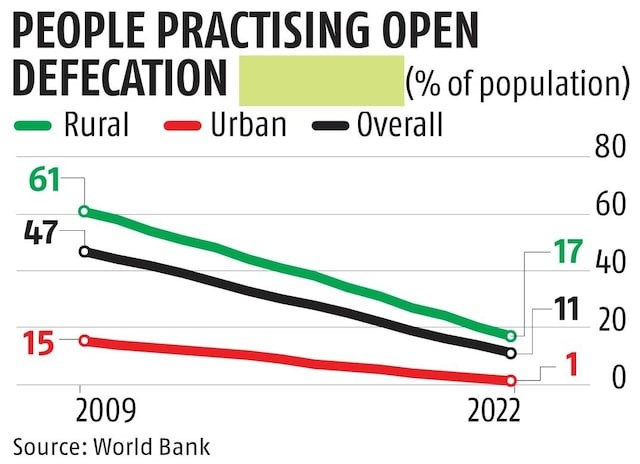
- Continuing Open Defecation - Although there has been a decrease in open defecation, 11 % of the population still practised it in 2022, mostly in rural areas.
- Rural Urban Divide - Urban centres have 95.6 % access to toilets compared to 76 % in rural India.
- Caste in Waste Management - Sanitation and waste management in India are associated with the wide prevalence of caste and the same old caste practices is still prevailing despite the efforts.
- Manual Scavenging - Only 66% districts in country free of manual scavenging.
- Poor Quality and Maintenance – The quality of toilets and lack of adequate water infrastructure discourage the continued used of the facilities.
- Inequality – The reach of SBM facilities in communities in slums and other marginalized is far less than developed areas of the cities.
- Waste Handling - In rural India, toilet construction has not been linked to waste treatment and in peri-urban areas, the faecal sludge generated is discharged into the environment without treatment.
- Insufficient Funds – Village panchayats do not have enough financial resources to get road sweeping machines, more vehicles to transport the waste.
- Decline in Budget Allocation - SBM urban had a massive downward revision in Revised Estimates of 2023-24 from the Budget Estimates by around 49 %.
What lies ahead?
- Implement cleanliness initiatives at the district, block, village, and local levels.
- Promote bio toilets to address manual scavenging and increase fund allocation for their rehabilitation.
- Improve the administrative and technical capacity of local governments for the effective implementation of diverse objectives of the mission.
- Increase the technological solutions in handling the solid waste from generation to disposal.
- Encourage the use of waste-to-energy plants and biological methanation at the local and regional level.
References
- Business Standard | 10 years of Swachh Bharat
- The Hindu | SBM
- The Hindu | The reality of the Swachh Bharat Mission
- PIB | SBM



