Prelims: Current events of national and international importance| Geography
Why in news?
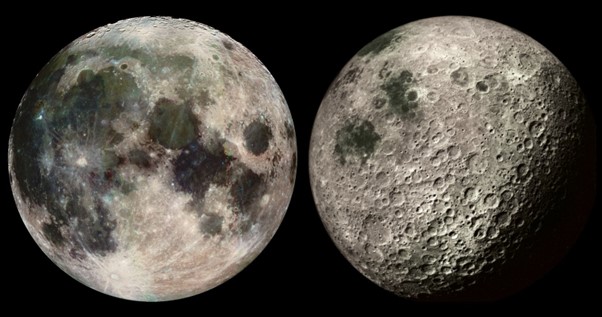
Recently NASA's Gravity Recovery and Interior Laboratory (GRAIL) mission revealed that moon’s two hemispheres look different due to difference in internal composition of Moon.
The two sides of the Moon—the nearside (facing Earth) characterized by large, dark basaltic plains called Maria and the farside (facing away) is marked by rugged, heavily cratered terrain.
- GRAIL mission – It is a NASA mission aimed at mapping the Moon's gravitational field to enhance our understanding of its internal structure.
- It is launched in 2011 with two identical orbiters, GRAIL-A and GRAIL-B, later named Ebb and Flow through a student contest.
- Objective – To create detailed gravitational map of lunar surface and understand the Moon's asymmetric thermal evolution.
- Method – By measuring distance variations between spacecrafts caused by gravitational anomalies.
- These measurements, accurate to within a micron, allowed scientists to infer the Moon's internal mass distribution.
Reasons for differences in two hemispheres
- Tidal deformation and gravitational asymmetry – The nearside (facing Earth) flexes more during its orbit due to Earth's stronger gravitational pull — a process called tidal deformation.
- This suggests that the nearside is warmer and more geologically active deep inside compared to the farside, which is more rigid.
- The difference in internal flexibility results in creating the Moon’s uneven surface features.
- Crustal thickness and surface composition – GRAIL data showed that the nearside crust is much thinner than the farside crust.
- The thinner crust made it easier for magma to rise and erupt, forming flat lava plains.
- In contrast, the farside’s thicker crust blocked magma, leaving behind a rugged, cratered highland terrain.
- This difference in crust thickness also affected how heat-producing elements were distributed, deepening the contrast between the two sides.
- Volcanic activity and heat distribution – The nearside experienced intense volcanic eruptions billions of years ago, which created dark basalt plains called maria.
- These eruptions also build up heat-producing elements like thorium and titanium in the nearside’s mantle.
- As a result, the nearside is 100–200°C hotter than the farside, leading to a long-lasting thermal imbalance.
- The farside, with fewer radioactive elements and less heat, remained mostly inactive and unchanged.
Significance of these findings
- Future lunar missions – It aids in developing lunar positioning, navigation, and timing systems.
- It is essential for success of upcoming crewed moon missions.
- Broader space exploration – The gravitational mapping techniques applicable to other moons for advanced search for extra-terrestrial life.
Reference
Times of India| Why the Moon Look So Different on Each Side


