National Strategy for Financial Education (NSFE)
- RBI has released the National Strategy for Financial Education (NSFE): 2020-2025 document for creating a financially aware and empowered India.
- It is the second NSFE, the first one being released in 2013.
- It aims to strengthen the ecosystem for various modes of digital financial services in all Tier-II to Tier VI centers to create the necessary infrastructure to move towards a less-cash society by March 2022.
- NSFE has been prepared by the National Centre for Financial Education (NCFE), under the aegis of the Technical Group on Financial Inclusion and Financial Literacy (TGFIFL).
- NCFE is a Section 8 (Not for Profit) Company under the Companies Act, 2013 promoted by RBI, SEBI, IRDAI and PFRDA.
- It has recommended a ‘5 C’ approach for dissemination of financial education in the country:
- Content - Financial Literacy content for various sections of population.
- Capacity - Develop the capacity and ‘Code of Conduct’ for financial education providers.
- Community - Evolve community led approaches for disseminating financial literacy in a sustainable manner.
- Communication - Use technology, media and innovative ways of communication for dissemination of financial education messages.
- Collaboration - Streamline efforts of other stakeholders for financial literacy.
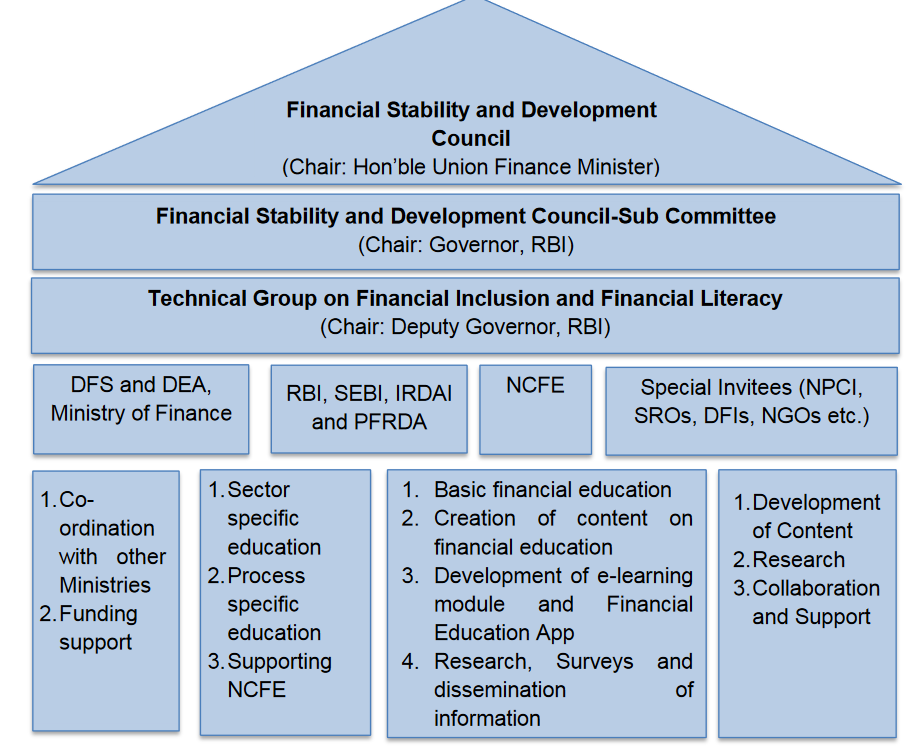
TGFIFL
- Technical Group on Financial Inclusion and Financial Literacy (TGFIFL) was set up in November 2011 by the FSDC.
- It is responsible for periodic monitoring and implementation of NSFE under the oversight of Financial Stability and Development Council (FSDC).
Nuakhai Juhar
- Nuakhai Juhar is an agricultural festival, also called Nuakhai Parab or Nuakahi Bhetghat.
- It is adopted from the tribal communities of western Odisha, which is celebrated to welcome the new crop of the season.
- Nuakhai festival traces its origin to the Vedic period in Panchyajna.
- One among them was Pralambana yajna which means the cutting of new crops and offering them to the mother goddess.
- Oral tradition of this festival dates back to the 12th century A.D. when this festival was celebrated by Chauvan Raja Ramai Deo, Bolangir district of Odisha.
- The festival is widely celebrated in Western Odisha, southern Chhattisgarh and adjoining areas of Simdega (Jharkhand).
- Its coastal counterpart is Nabanna, observed in Coastal Odisha.
- Festive activities include farmers offer the first produce from their lands to Goddess Samaleswari, the famous ‘Mother Goddess’ of Sambalpur district of Odisha.
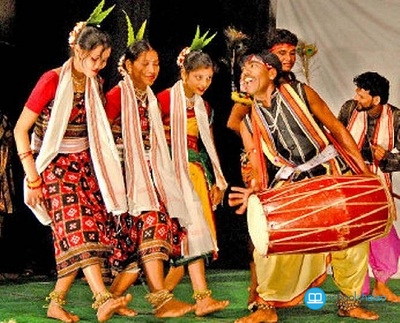
- Sambalpuri dance forms like Rasarkeli and Dalkhai can be witnessed during the festival.
Dalkhai Folk Dance
- Dalkhai is the most popular folk dance of Odisha.
- Mainly the theme of this dance is Radha and Krishna, Ramayana, Mahabharata, etc.
- It is known as Dalkhai because in the beginning and end of every stanza men shout the word ‘Dalkhai Bo!, it is used as an address to a girlfriend.
- It is performed in various festivals such as Bhaijiuntia, Phagun Puni, Nuakhai, etc.
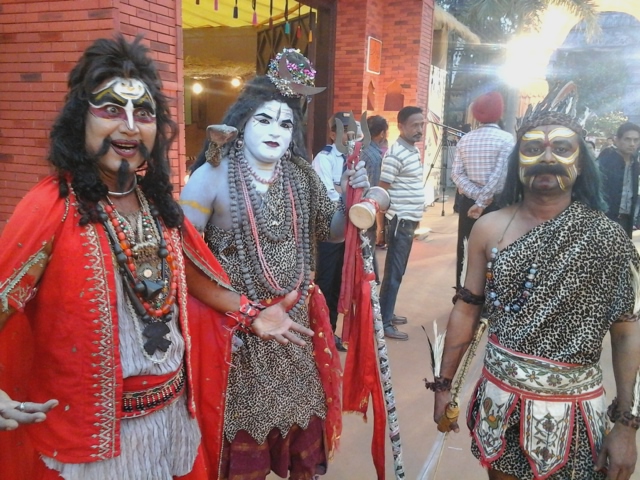
Behrupiyas
- Behrupiya festival is a traditional Indian style of street theatre and takes place every year in different locations-
- Delhi,
- Ahmedabad,
- Udaipur,
- Jaipur,
- Kumbh,
- Muzaffarnagar and others.
- Behrupiyas are impersonators, mostly known to perform in villages and markets all over India.
- They put on various costumes to play figures from mythology, folklore and traditional stories.
- They assisted in circulating, transmitting and publicising the various knowledge forms in the popular domain of Samaj, the people.
- The vibrant tradition of Ramlila can also be seen as an extension of this practice which continues even today.
- Arthashastra makes a mention of religious processions in the Mauryan times where artistes dressed as gods and were taken out in tableaux all around the kingdom.
- Behrupiyas are also said to have helped freedom fighters during the struggle for Independence.
Chora Museum
- Chora Museum in Turkey was built initially as a church in 534 AD, during the early Byzantine period.
- It is also known as Kariye in Turkish and the mediaeval Church of the Holy Saviour in Chora.
- In the 11th century, its internal walls, pillars and domes were covered with mosaics and frescoes showing scenes from biblical stories.
- After the conquest of Constantinople (capital city of the Roman Empire) by the Ottomans (1453), the church was seized and turned into a mosque in 1511.
- In 1945, it was converted into a museum.
- Recently, the Turkish President reconverted the Chora museum into a mosque.
- This is the second museum after Hagia Sophia to be converted into a mosque.
Open API Service
- ‘Application Programming Interface’ (API) is an interface that can be used to program software that interacts with an existing application.
- In practice, an API is “a set of functions and procedures” that allow one to access and build upon the data and functionality of an existing application.
- An open source API, also called public API, is an application programming interface made publicly available to software developers.
- Open APIs are published on the internet and shared freely, allowing the owner of a network-accessible service to give universal access to consumers.
- Recently Union government has announced a new feature 'Open API Service' for its contact tracing app Aarogya Setu.
- The Open API Service of Aarogya Setu addresses the fear/risk of Covid-19 infections and will help the people, businesses and the economy to return to normalcy.
- It can be availed by organizations and business entities, with following conditions,
- Entities who are registered in India.
- Entities with more than 50 employees.
- It will be used to get the health status of employees or any other Aarogya Setu User.
- It enables organizations to check the status of Aarogya Setu and integrate it into its various Work from Home features.
- It shall only provide the Aarogya Setu status and name of the Aarogya Setu User (strictly, with User's consent only), no other personal data shall be provided through the API.
Source: PIB, the Hindu,


