AR2770 Sunspots
- A Sunspot is an area on the Sun that appears dark on the surface and is relatively cooler than surrounding parts.
- The sun spots are as large as 50,000 km in diameter, are the visible markers of the Sun’s magnetic field.
- It forms a blanket that protects the solar system from harmful cosmic radiation.
- Sunspots are the areas where the star’s magnetic field is the strongest, around 2,500 times more than the Earth’s magnetic field.
- Most Sunspots appear in groups that have their own magnetic field, whose polarity reverses during every solar cycle, which takes around 11 years.
- In every such cycle, the number of Sunspots increases and decreases.
- A massive Sunspot group, AR2770, was observed using images of the Sun’s surface from NASA’s Solar Dynamics Observatory (SDO).
- This massive sunspot on the Sun will be turning towards earth which could result in major strong flares.
- Sunspots may release a huge amount of energy which in turn will lead to solar flares.
Solar flare
- Solar flares are the result of changes in magnetic fields on the sunspots that cause a huge explosion.
- These eruptions may lead to solar flares and storms.
- This phenomenon is called Coronal Mass Ejections (CME).
- These solar flares are often released into space and its radiation can disrupt with earth’s radio communication, GPS, Power grids and satellite.
- Solar flares caused by these CMEs can also trigger intense light in the sky, called auroras.
- Recently, scientists developed a new model that can successfully predict seven of the Sun’s biggest flares from the last solar cycle, out of a set of nine with the help of NASA’s Solar Dynamics Observatory.
Milne ice shelf
- Ice shelfs are large floating pieces of ice that form when a glacier or ice sheet flows into the sea surface.
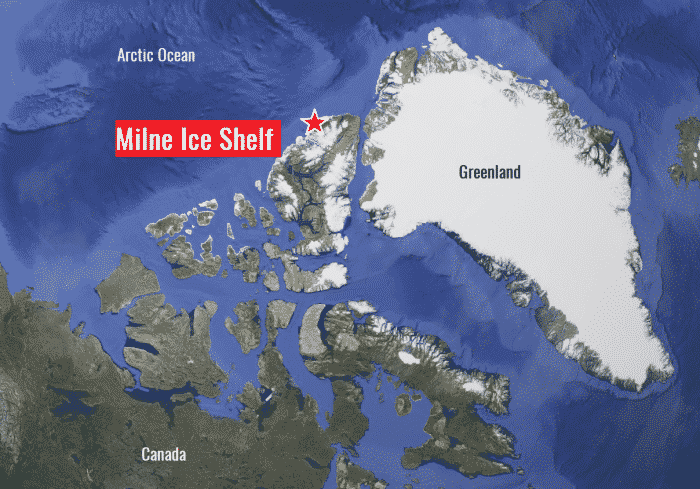
- Milne ice shelf is in Ellesmere Island, Canada and recently it was broken.
- The Milne ice shelf lost more than 40 % of its ice over 2 days end of July 2020.
- This has increased concerns over the rapid melting of ice and the breaking of old ice shelfs due to global warming.
- This also meant the last known Epishelf Lake, a water body dammed by the ice shelf and floating on the ocean surface on the Milne ice shelf, no longer exists.
Dwarf Planet Ceres
- Ceres is a dwarf planet and it is the largest celestial object in the asteroid belt between Mars and Jupiter.
- It has a diameter of about 950 km, which is more than one-fourth of Earth’s moon.
- It has 92 km wide crater named Occator located in Ceres’ northern hemisphere.
- Scientist have recently found that it is said to have salty water underground, by observing the cracks created to form a crater.
- This crater is said to have formed by an impact approximately 22 million years ago.
- The scientists have given Ceres the status of an “ocean world” as it has a big reservoir of salty water underneath its frigid surface.
- This has led to an increased interest of scientists that the dwarf planet maybe habitable or has the potential to be.
Mount Sinabung
- Indonesia’s active volcano Mount Sinabung erupted recently.
- A volcano can erupt when magma (a thick flowing substance), formed when the earth’s mantle melts, rises to the surface.
- Because magma is lighter than solid rock, it is able to rise through vents and fissures on the surface of the earth.
- After it has erupted, it is called lava.
- Not all volcanic eruptions are explosive, since exclusivity depends on the composition of the magma.
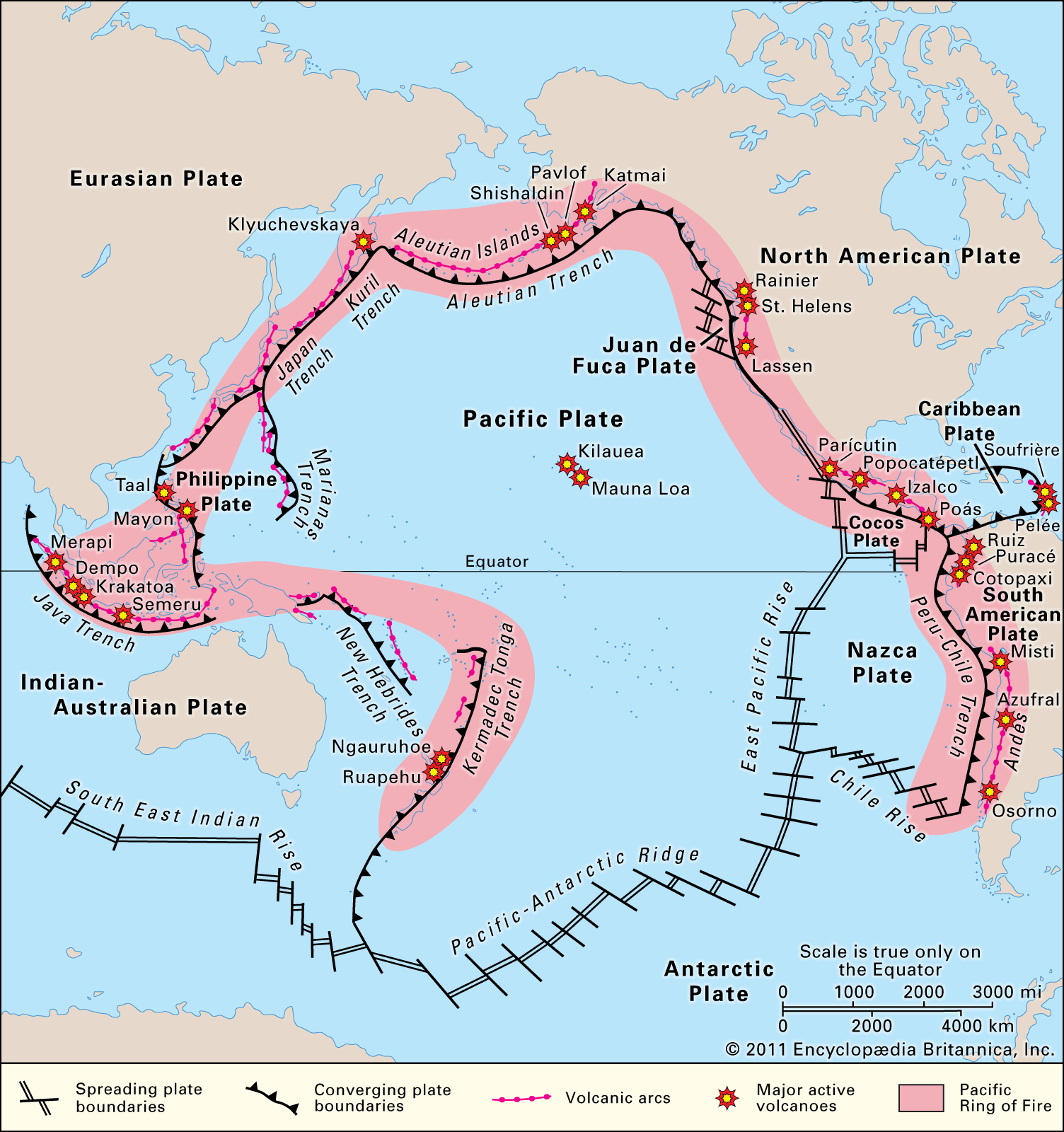
- Indonesia is home to many active volcanoes, due to its position on the “Ring of Fire”, or the Circum-Pacific Belt, which is an area along the Pacific Ocean characterized by active volcanoes and frequent earthquakes.
Krishi Megh
- Union Ministry of Agriculture & Farmers’ Welfare has launched the Krishi Megh.
- It is a step forward towards digital agriculture of New India.
- It aims to meet the services and infrastructure needs of Digital Agriculture of National Agricultural Research and Education System (NARES).
- The existing Data Centre (ICAR-DC) built during 2012 shall be strengthened with cloud computing infrastructure.
- It would deploy mission critical applications such as e-Office, ICAR-ERP, Education Portal, KVK Portal and mobile apps, etc.
National Agricultural Research & Education System
- NARES is a Government of India-World Bank funded project, designed for strengthening the national agricultural education system in the country.
- The overall objective of the project is to provide more relevant and high-quality education to the agricultural university students that is in tune with the New Education Policy - 2020.
Rashtriya Krishi Vikas Yojana
- RKVY scheme was initiated in 2007 as an umbrella scheme for ensuring holistic development of agriculture and allied sectors.
- The scheme incentivizes States to increase public investment in Agriculture & allied sectors.
- In 2017, the component of Remunerative Approaches for Agriculture and Allied Sector Rejuvenation (RKVY-RAFTAAR) was added.
- It is a Centrally Sponsored Scheme in the ratio of 60: 40 except in the case of northeastern and hilly states where the sharing pattern is 90:10.
- For UTs the grant is 100% as Central share.
- The main objective is to develop farming as a main source of economic activity.
- It provide all the states with autonomy and flexibility in making plans as per their local needs.
- It aims to reduce the risk of farmers by focusing on increasing the income generation through mushroom cultivation, integrated farming, floriculture, etc.
- Union Ministry of Agriculture is funding start-ups under the innovation and agripreneurship component of Rashtriya Krishi Vikas Yojana in 2020-21.
- These start-ups are in various categories such as agro-processing, artificial intelligence, digital agriculture, farm mechanization, waste to wealth, dairy, fisheries etc.
Source: PIB, Indian Express


