Prelims – Current events of national and international importance| General issues on Environmental ecology & Bio-diversity.
Mains (GS III) – Conservation.
Why in News?
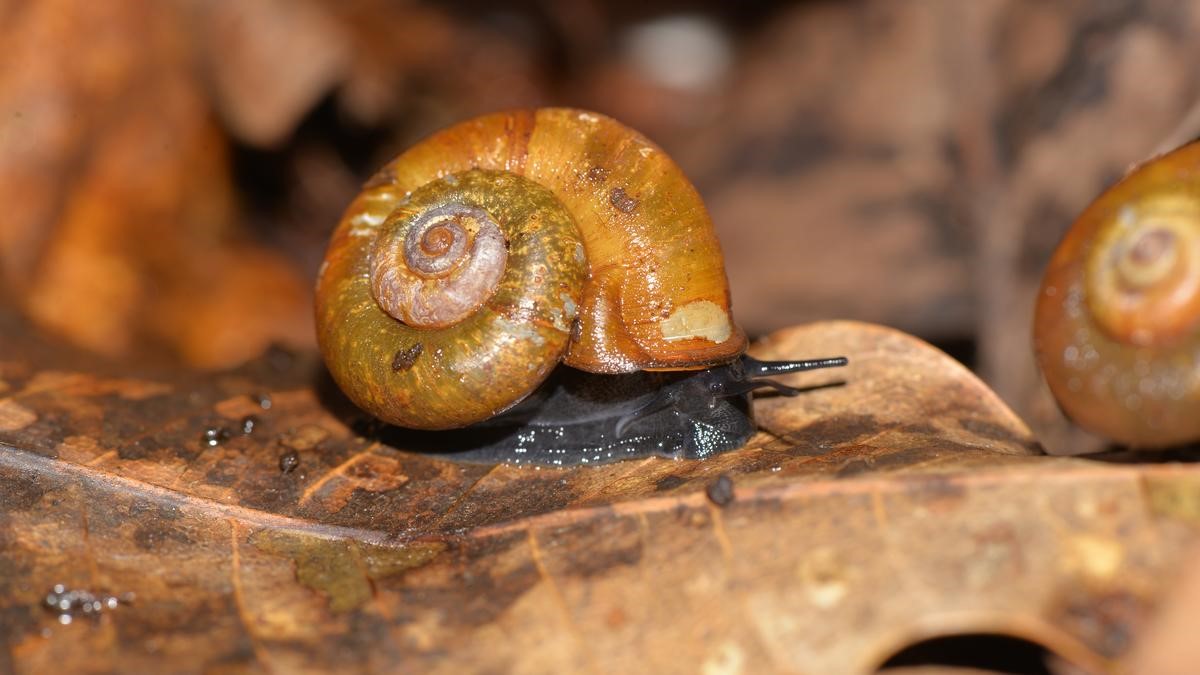
A team of researchers from India and U.K. have discovered a species of land snail from the Konkan region of Maharashtra and named it, ‘Theobaldius konkanensis’.
- It is a new species of cyclophorid (any snail in the family Cyclophoridae) land snail.
- Endemic to -Northern Western Ghats.
- Habitat - Found on the forest floor among leaf litter and on moist, decaying branches in tropical evergreen and semi-evergreen forests.
- Behaviour - It is active during the day and night.
- Distinction - It differs from all other Indian Theobaldius species.
- This species also tends to have a more elevated spire than other Theobaldius species.
- Appearance - Snail’s shell is thick, conoidally depressed, widely umbilicated with regularly increasing whorls, corneous yellow qin colour with brown striations, collabrally striated periostracum that wears off in patches.
- Distribution - Theobaldius currently numbers 20 species and were distributed in India (9 species), Sri Lanka (11 species) and Sumatra (1 species) island in Indonesia.
- Species in India - T. nivicola and T. orites - North-east India.
- T. anguis, T. deplanatus, T. maculosus, T. ravidus, T. stenostoma, and T. tristis - endemic to the Western Ghats;
- T. annulatus - occurs in both Sri Lanka and the Western Ghats.
- Mating - Most of the operculate land snails have separate sexes and majority of land snails are hermaphrodite (having both sex).
- Land snail and slug breed only in rainy season. They reproduce by cross-fertilisation as well as self-fertilisation.
- Lifespan - 2 to 7 years.
- Significance - Land snails are excellent bioindicators and are susceptible to climatic fluctuations.
Reference
The Hindu | Theobaldius konkanensis


