What is the issue?
- In April 2019, cross-LoC (Line of Control) trade was suspended by India. Click here to know more.
- With the increasingly strained relations with Pakistan now, it is wise that India makes a revised strategy on restarting cross-LoC trade.
When was connectivity established?
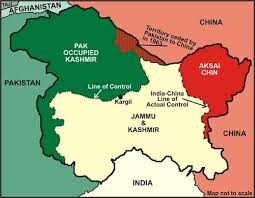
- It was in 1972 that the LoC between India and Pakistan was thought of, as a part of the Shimla Agreement.
- Though the LoC was mostly an issue of contention, it was 33 years later that the two governments decided to take a significant step.
- On April 7, 2005, then Indian PM Manmohan Singh flagged the first cross-LoC bus, called ‘Karwaan-e-Aman’.
- It was operated from the Sher-i-Kashmir stadium in Srinagar towards Muzaffarabad.
- This Confidence Building Measure (CBM) came as a humanitarian reform reuniting divided families and friends.
How did trade come up?
- In 2008, the two governments decided to take forward the existing transport potential to trade.
- The Foreign Ministers of India and Pakistan decided to finalise the modalities of intra-Kashmir trade and truck service.
- Cross-LoC trade, following barter system, thus began in October 2008.
- It took place across Uri-Muzaffarabad and Poonch-Rawalakot for a list of 21 mutually agreed tradable items.
How significant was this?
- The trade measure was aimed at converting social interconnectedness into commercial interdependence of the two similar yet separate sides of the LoC.
- It was rightfully presumed that trade would flourish on the basis of the emotional capital of the people living on either side.
- In all, the LoC gave rise to hope in the virtuous cycle between trade, trust and people-to-people connect, building bridges and reconnecting communities
- The Cross-LoC trade was much more than a mere commodity exchange as the sentiments of the people attached to it kept it successful.
- Importantly, cross-LoC trade did manage to connect the two divided sides of Jammu and Kashmir.
- It, thereby, created a constituency of peace in an otherwise tense region.
- Between 2008-2018, trade worth Rs.7,500 crore was transacted across the LoC.
- This has generated more than 1.7 lakh job days and an approximate freight revenue of Rs.66.4 crore for transporters in J&K and Rs. 90.2 crore was paid to labourers.
- A sizeable community of traders, businesses, transporters and labourers have benefited from this trade.
What are the trade facilitation measures to be taken?
- Given the present situation in J&K, it is imperative that India plans an outreach connecting all stakeholders including the ecosystem of cross-LoC trade.
- Besides, there is a need for a revised strategy towards the re-initiation of cross-LoC trade.
- Concerns around transparency have negatively impacted this trade over the last decade.
- So, the lack of transparency needs to be addressed in the complete ecosystem.
- The measures could include standard operating procedure, invoicing, GST norms, and trader registration.
- Other steps to address the long-standing concerns around cross-LoC trade include -
- clarifications on harmonised system codes to avoid misrepresentation of commodities
- rules of origin to avoid third country goods
- GST rates and inter-State taxation rules to avoid tax evasions
- a trader registration policy to ensure that credible traders are involved in the trade
- Digitisation of systems and procedures at the trade facilitation centres at Uri and Poonch is another important step to help take LoC trade to the next level.
- Globally too, digitisation of procedures and lower human intervention are the two major pillars that drive trade across borders.
- Digital platforms to monitor invoicing, traders’ records, balancing and truck details will ensure real-time checks by the authorities, leaving lesser room for misuse.
What is the way forward?
- Until the trade suspension, both bus links and trade had survived for more than a decade despite intermittent suspensions and ceasefire violations.
- The current suspension of LoC trade could be seen as a window of opportunity to address the concerns hitherto unaddressed.
- The cross-LOC trade should be revived in a stronger and more organised manner.
- In its new avatar, Cross-LoC trade could continue to prove the value of a peace-through-trade policy, and one that has stood the test of time globally.
Source: The Hindu


