What is the issue?
- For the past several months, Sudan has been witnessing countrywide protests, leading to a military intervention recently.
- Here is an overview on the evolution of conflicts, the causes, and recent developments.
What was going on in Sudan?
- Sudan has been engulfed by violence for more than a century, even while it was under the British-Egyptian colonial rule.
- Since independence in 1956, this North African nation has seen sectarian violence, famines and political instability.
- The latest coup ousting Bashir is the fifth such forcible takeover.
How was Bashir's rule?
- Omar al-Bashir became the country’s ruler in 1989 after he toppled a democratically-elected government.
- He was supported by the National Islamic Front, an affiliate of the Muslim Brotherhood in the country.
- The National Islamic Front sought to enforce Saudi-sponsored orthodox Islam in Sudan.
- After Bashir came to power, the country went on to adopt this radical version of Islam.
- It departed from the moderate Sufi tradition that it earlier followed.
- This caused great detriment to women’s rights and to the status of minorities.
- Sudan thus became the nesting ground for the world’s jihadists and even sheltered Osama bin Laden in the 1990s.
- The first few years of Bashir’s rule were especially blood-soaked.
What were the earlier conflicts?
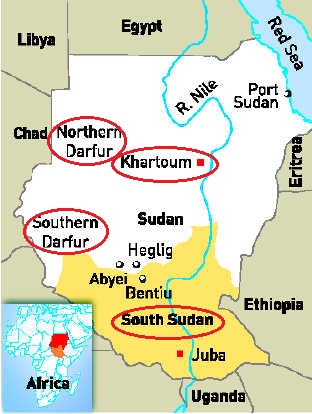
- Minorities' resentment (in southern parts of the country) since 1983 led to a bitter civil war that lasted for 22 years and claimed over 20 lakh lives.
- The region finally seceded in 2011 to form the new country of South Sudan, taking away more than two-thirds of Sudan’s oil reserves.
- Bashir also pitilessly cracked down on the insurgency in the gold-rich Darfur region.
- Its Muslim but non-Arab people accused Bashir of only favouring Arab Muslims.
- A savage militia backed by Bashir used sexual violence, torture, and starvation as methods to suppress dissent.
- During his three-decade rule, Bashir had outlawed several organisations opposed to his rule such as trade unions.
- He also jailed or murdered political opponents and journalists.
- The US designated the repression as ‘genocide’ in 2004.
- The International Court of Justice in 2009 issued a warrant against Bashir.
What is the immediate cause for the current protetsts?
- People were already wary of Bashir’s autocratic rule.
- In December 2018, Sudan took measures to enact austerity measures recommended by the International Monetary Fund (IMF).
- It devalued its currency, the Sudanese Pound, and cut back on subsidies.
- This led to a steep rise in inflation and food prices.
- The price rise in essential commodities sparked anger among the Sudanese people.
- The current protests have been organised by recently emerged groups such as the Sudanese Professionals Association.
- Protests erupted in the eastern part of the country and soon reached the capital Khartoum.
How did it evolve thereafter?
- The Bashir regime initially tried to deprive the movement of popular support by claiming that the rallies were backed by the rebel movement from the Darfur region.
- This tactic backfired as the crowds grew in size, and the slogan “We are all Darfur” was raised.
- So what began as a protest against price rise transformed into a mass movement, calling for Bashir’s resignation.
- Sudan’s male-dominated Sharia-inspired setup also came under attack.
- Following this, a tremendous women turnout was registered in the protest and women went on to constitute 70% of the protesters.
- Religious leaders who supported Bashir were also denounced.
What happened finally?
- The persistence of the protests finally compelled the military to step in.
- Military intervention ejected Bashir from power, thereby ending his brutal 30-year rule, and he was sent to prison.
- In turn, a Transitional Military Council (TMC) took power.
- The TMC has since announced a three-month emergency and transition period of 2 years.
- It has promised transfer of power to a civilian government in its aftermath while reserving few ministries for itself, such as Defence.
- Since taking power, the Council has appointed fresh faces to key positions such as the army, police and the intelligence wing.
- It has also lifted restraints on the media.
Why is protest still continuing?
- Protesters were dismayed by the coup and believe that the TMC is run by those close to Bashir.
- Notably, the leader of the Bashir-supported militia, General Mohamed Hamdan, was appointed as the Vice President of the Transitional Military Council.
- So protests are continuing against the newly-imposed military rule.
- The African Union Commission has also criticised the military takeover.
Source: Indian Express


