Why in news?
A new study reveals the connection between Northeast monsoon and El Nino, with the help of rock formations in Meghalaya.
What is the study on?
- The rock formations in a cave near Cherrapunji in Meghalaya were studied by researchers from a US university.
- New evidence was found suggesting the possible influence of the state of the ocean waters in the faraway Pacific on India's winter rainfall.
- It records the connection between winter rainfall amounts in northeast India and climatic conditions in the Pacific Ocean.
How is summer monsoon and El Nino connected?
- India’s summer monsoon (June to September) brings in about 70% of annual rainfall in the country.
- It is known to be heavily influenced by the variability in sea-surface temperatures of Pacific Ocean.
- This is a condition referred to as El Nino Southern Oscillation (ENSO).
- A warmer than usual Pacific Ocean, off the coast of South America, is known to suppress the summer monsoon rainfall in India.
What is the case with winter monsoons?
- ENSO is known to have an impact on the winter monsoon (October to December) i.e. the northeastern monsoon as well.
- E.g. the warming of sea-surface waters is seen to help winter rainfall rather than suppressing it
- But the relationship is not so strongly established in this case as the impact varies in time and space.
- The influence is weaker in October and stronger in November and December.
- Similarly, the rainfall over southeastern peninsular India and Sri Lanka is strengthened with warming ocean.
- But again this is diminished over Thailand, Vietnam and the Philippines.
What is the recent revelation?
- The findings are based on more than 3 years of research on stalagmites of the Mawmluh Cave, near Cherrapunji, in the East Khasi Hills district.
- Stalagmites are the mineral deposits, mainly limestone, in caves.
- These solid stalagmite structures, or mineral deposits, are the result of slow but steady water dripping in the caves.
- They contain several thin layers of different kinds of minerals that get picked up while the water is flowing.
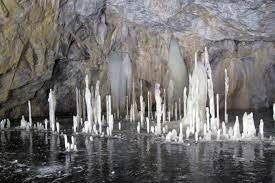
- On studying the composition of these stalagmites, scientists deduced the amount of rainfall that could have happened over the caves in the past.
- They also studied if the water was a result of local rainfall, or had flown in from a different place.
- With this, the local variations in rainfall in the past were estimated and this was correlated with old ocean records of the Pacific Ocean.
- The stalagmites indicate the recurrence of intense, multi-year droughts in India over the last several thousand years.
- They reflect the changes in the amount of monsoon rainfall and changes in monsoonal circulation in the atmosphere.
- This distant link between land and ocean records could aid in predicting dry season rainfall amounts in northeast India.
What is the significance?
- North-eastern monsoon is vital for several regions in the Northeast and India’s eastern coast.
- It gives more than 50% of the annual rains in coastal Andhra Pradesh, Rayalaseema, TN, south interior Karnataka, and Kerala.
- Winter rainfall following weak monsoon years in India can alleviate water stress for farmers.
- The study gains significance, in this context, as it could help in predicting the winter rainfall and prepare for rainfall variations.
- Stalagmite records from monsoon regions, including India, are also vital to understanding past variability in the global climate system.
Source: The Indian Express, Science Daily


