Why in news?
Commemoration services were recently held at the Srebrenica-Potocari Memorial and Cemetery in remembrance of the victims of the Srebrenica massacre.
What is the Srebrenica Massacre?
- Srebrenica is a town in Bosnia and Herzegovina in south-eastern Europe.
- In July 1995, approximately 8,000 Muslims, mostly men and boys were killed in Srebrenica.
- It was carried out by the Bosnian Serb forces led by Commander Ratko Mladić.
- These killings were later classified as 'genocide' by international tribunals investigating the massacre.
What led to this?
- The disintegration of Yugoslavia in 1991 threw the south-eastern and central Europe in chaos.
- It led to violent inter-ethnic wars in the region over the next few years.
- The Bosnian War took place between 1992-1995.
- It witnessed a period of displacement and ethnic cleansing of Bosniaks or Bosnian Muslims and Bosnian Croats.
- The Bosnian Serb army and paramilitary forces were behind this.
- In many ways, the Srebrenica massacre was a result of this regional conflict.
- According to some researchers, this massacre was the worst atrocity against civilians in Europe since the Holocaust.
What happened during the Srebrenica massacre?
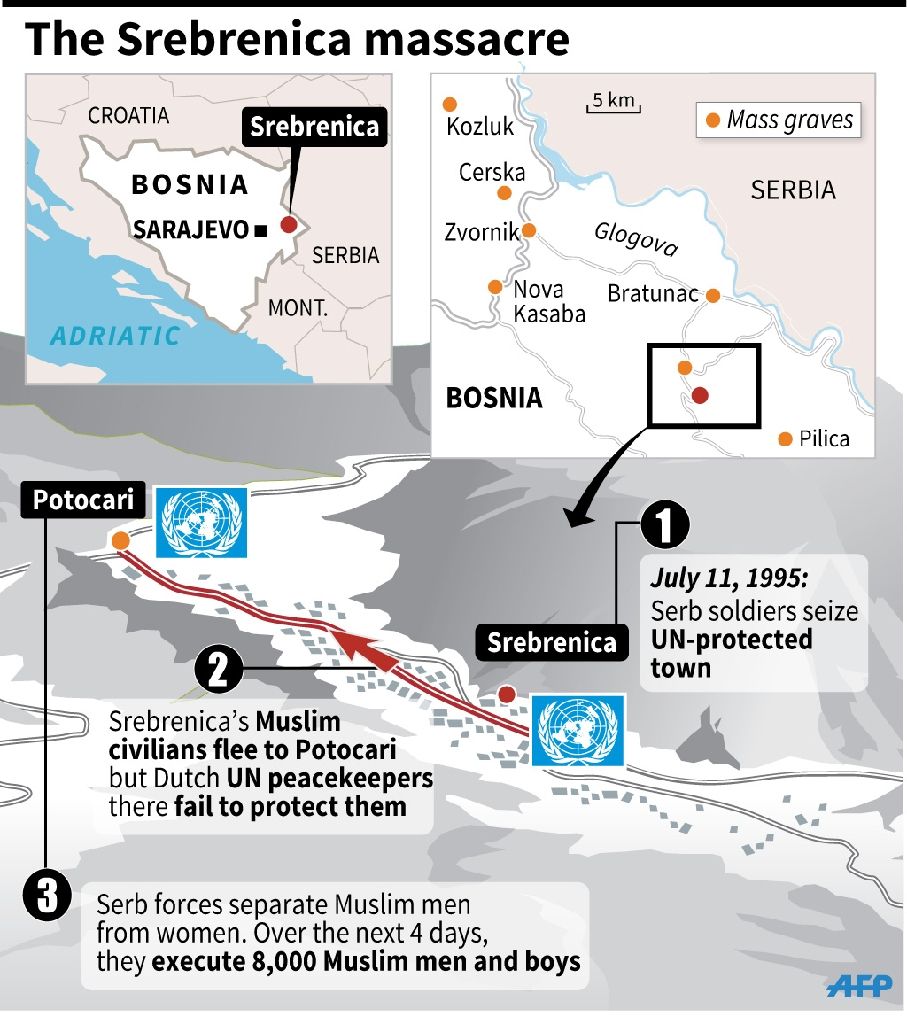
- During the war, the Srebrenica massacre started on July 11, 1995.
- It was when Commander Ratko Mladić occupied the town of Srebrenica.
- Thousands of Bosnian Muslim families sought refuge with the Dutchbat.
- It was a Dutch battalion under the UN forces that had been deployed, following the upheaval during the Bosnia War.
- Many Bosnian Muslims had sought refuge believing it to be a safe zone.
- But this UN peacekeeping mission led by the Netherlands failed to stop these murders.
- Some researchers say the mission did not protect Bosnian Muslims.
- But more worse, in some cases, it actively handed over young boys and men to Bosnian Serb forces knowing that they would be killed.
- The safe zone later fell under the control of the Bosnian Serb forces after the Dutch forces surrendered.
- It is said that the 8,000 Muslims who were killed during the massacre were murdered within 2 weeks of the start of the occupation of Srebrenica.
What was the extent of the violence?
- Babies, young boys and men were subjected to atrocities and killings.
- Besides, the massacre also saw widespread crimes against women, where girls and women were subjected to violence and rape.
- Witnesses, girls and women, later said that they had not been given any protection by UN forces.
- This was despite the forces having witnessed the violence that was being perpetrated in front of them.
- Survivors recounted how Bosnian Serb forces had forced Bosnian Muslims to dig their own graves and later shot them to death.
- 25 years after the massacre, bodies of victims continue to be found in mass graves.
What did the later investigations reveal?
- The International Criminal Tribunal for the former Yugoslavia investigated war crimes of 1990s that occurred during the conflict in the Balkans.
- It found that efforts had been made by the Bosnian Serb army to remove bodies from the mass graves to other sites.
- This was done in an attempt to conceal the extent of the crimes and killings.
- This removal of bodies made it difficult to identify victims.
- Also, investigations by the tribunal showed that in many cases, body parts of one victim were found in different graves due to displacement.
- The tribunal said that this indicated that the killings of the Bosnian Muslims were premeditated and had been extensively planned.
- In 1995, the Tribunal indicted Ratko Mladić and Radovan Karadžić, the President of the Republika Srpska, for war crimes against Bosnian Muslims in Srebrenica.
- [Republika Srpska is one of the two entities of Bosnia and Herzegovina, the other being the Federation of Bosnia and Herzegovina.]
- Then UN Secretary General Kofi Annan submitted his own report on the Srebrenica Massacre in 1999.
- He acknowledged the failures of the UN in preventing the massacre.
- He said that the tragedy of Srebrenica would forever haunt the history of the UN.
What were the internal investigations by the governments?
- For the Netherlands, the failures of the Dutchbat and reports of the troops participation in various forms in the violence led to an inquiry by the government in 1996.
- A report was published 7 years later.
- It acknowledged the failures of the peacekeeping mission.
- Also, the Dutch government admitted some responsibility for their inability to protect victims during the massacre.
- In March 2003, Bosnia and Herzegovina began their own investigations on the Srebrenica massacre.
- They relied heavily on the findings of the International Criminal Tribunal for the former Yugoslavia.
- The investigations were concluded the next year.
- The government admitted that crimes had been committed against Bosnian Muslims.
- An official apology for the massacre was later issued by the government.
- Some nationalists in the country have however disagreed with the findings of these investigations.
What were the further developments?
- 10 years after the massacre, in 2005, the US House of Representatives officially passed a resolution.
- It recognised the massacre as the Srebrenica Genocide.
- In March 2016, Radovan Karadžić was found guilty of genocide, war crimes and crimes against humanity by the earlier mentioned Tribunal.
- He was sentenced to 40 years’ imprisonment.
- A year later, in November 2017, Ratko Mladić was found guilty of genocide, war crimes and crimes against humanity, and sentenced to life imprisonment.
What is the recent event?
- On 11 July 2020, 25 years on, commemoration services were held at the Srebrenica-Potocari Memorial and Cemetery.
- During this ceremony, bodies of 9 victims that were recently identified were buried in the cemetery.
- World leaders also issued statements in remembrance of the massacre.
- It is to be noted that according to some researchers, many Serbian politicians and citizens refuse to call it genocide.
- Also, public buildings continue to hold names of people convicted of war crimes against Bosnian Muslims and others who were in positions of power during the massacre.
Source: The Indian Express


